”Think about it for a moment. An artistic young boy grows up hearing the names of hundreds of male artists who have made their way before him. He hears Michelangelo, Rembrandt, Rubens, Renoir, Van Gogh. . . . He knows that his dream is a possible one.
”For a young girl to know the name of even one woman artist she must in all likelihood come from an enormously sophisticated home. Whom might she have heard of? Georgia O`Keeffe–and let us not forget that O`Keeffe herself was fortunate enough to have Stieglitz backing her up! How differently she might feel about herself and her dream–and how differently others might feel about it as well–if they could take a field trip through an entire museum of superb works done by women artists before her. I would hope that we would be able to offer young women role models. That`s a large part of what is missing for them.”
As dreams go, Wilhelmina Holladay`s sounds gentle enough. Yet the establishment and nurturing of the new National Museum of Women in the Arts in Washington, Holladay`s dream turning reality, has been predictably tough.
Now that she and her husband finally have found a building to house their growing collection–a magnificent 1907 structure two blocks from the White House that recently endured the ignominy of hosting an adult movie theater
–Holladay is traveling the country drumming up funds and support. The museum`s first exhibition, ”American Women Artists 1830-1930,” is scheduled to open in April, 1987.
In Chicago to address a chapter of the American Association of University Women, she was proceeding next to high tea in Dallas.
”We have a goal of $30 million, and we have already raised about $10
(million). Some women have been very generous.” She mentions four anonymous gifts of over a million dollars each. The gifts require matching grants, and she has been successful so far in finding them. Holladay is hoping for 500,000 visitors a year to the museum, whose core of 400 paintings by more than 150 women artists representing 16 countries is from the Holladays`
private collection.
From earliest childhood, Wilhelmina Holladay was taught not only to admire and appreciate visual beauty but also to analyze her response to it.
”I had a grandmother who was fantastically aware of esthetic values. She really raised me. As a little girl, I would say, `Look, Grandma, isn`t that flower beautiful?` and she would reply, `Yes, dear, but why? Is it the color you find beautiful? The shape? The smell? Does it remind you of something else beautiful?` ”
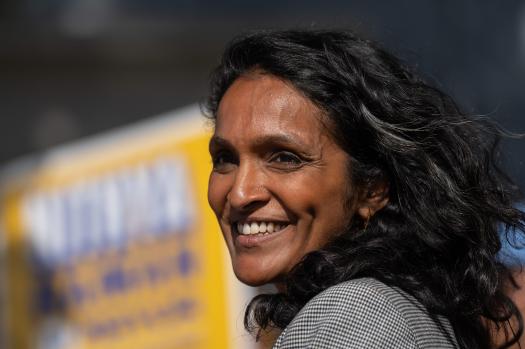
Talking about her grandmother, Holladay`s patrician features soften. She smiles as she remembers her grandmother.
”She really created in me a heightened awareness of beauty. I learned to sort out my responses. Perhaps it was the patina of her certain glaze or the associations with a certain flower that gave me pleasure. If you develop the habit of analyzing your responses you develop an esthetic.”
Graduating from her grandmother`s tutelage, young Wilhemina studied art at Elmira College and traveled to Paris to do postgraduate work in the history of art. When she married architect-entrepreneur Wallace Holladay, she chose a man whose own esthetic was highly developed. ”He would certainly call himself an amateur, but Wallace is quite a gifted watercolorist. I believe that all those renderings at architecture school teach them a good bit.”
The young couple shared a love of travel as well as art. It was on a museum tour of Europe 20 years ago that the focus for their personal art collection came to them.
They had gone to Vienna expecting to feast on the fabled Vermeers, Memlings, Breughels and Durers. Exploring the State Museum, they found themselves gorging instead on what should have been a mere hors d`oeuvre. The treat was a still life, modestly placed and hung, of a pair of goblets, a scattering of gold coins and a spray of tulips. The painter was one ”Clara Peeters.”
”1594. An old Dutch mistress,” Wallace Holladay joked.
”And why not?” countered wife Wilhelmina.
Neither of the Holladays had ever heard of Peeters but they encountered her again, only one week later, at the Prado in Madrid. No question, her work was astonishing. The four panels that they found at the Prado were masterworks. Wilhemina Holladay remembers her astonishment on computing that Peeters was only 17 when she painted them. Who was this prodigy? Why didn`t they know more about her?
Back home in Washington, Holladay set about researching this mysterious gap in her education. Turning to H.W. Janson`s ”History of Art,” the premier text on art history, she was stunned to find no mention of Clara Peeters. Looking further, she realized that the oversight was ”somewhat larger.”
Holladay looked for mention of Vigee-Lebrun, court painter to Marie Antoinette, one of Europe`s most reknowned portraitists–none. She hunted in vain for a mention of Mary Cassatt, the American Impressionist the French have co-opted as their own creation. Not one. Rembrandt`s contemporary Rachel Ruysch, whose flower paintings commanded higher prices than his, was nowhere to be found. Vatican painter Lavinia Fontana, who supported her eleven children by her work, was similarly absent.
Not one single woman artist was mentioned in any of the 16 Janson editions. Wilhemina Holladay was ”piqued” by the omissions.
How many other women artists might have similarly been deleted or expunged from art history by art historians whose focus was on their masculine confreres? Was it really a question of excellence or something more sinister? (As of last December, the National Gallery owned 2,530 paintings; 51 were by women).
”I believe you have found your focus,” her husband Wallace stated.
”And so we began,” Holladay remembers. ”Painting by painting, artist by artist, we set out to track down great women artists who had been forgotten or ignored. We found that some eras had been good to women artists and that others had been far more repressive.”
”During the Renaissance, women artists flourished. They were court painters, papal painters, the heads of universities. Then, in later ages, they were not even allowed to study.”
Wilhemina Holladay recounts these facts with delicate rue. Her manner is gentle and all the more persuasive because of it.
”Women could bear children, but they were deemed too delicate to bear the sight of the naked human body in life-drawing classes. A woman artist, Angelica Kauffmann, could found England`s Royal Academy but, because she was a woman, her art could not be hung in it. A portrait of her by one of her male contemporaries graces the gallery instead.” Holladay`s irony wears a velvet glove nearly as soft as her voice.
The Holladays collected more and more glorious objets d`art and more and more atrocity stories. They found cases where the work of women artists was attributed to the man they studied with. Works by well-known women artists mysteriously became ”anonymous” when credit was due. Even art that was anonymous to begin with was seldom attributed to women in the popular imagination: ”90 percent of American Indian art is women`s art.”
Didn`t the discovery of this injustice fill her with rage?
”I hope my response has been more productive than that,” Holladay says. ”It is a part of our Western heritage to devalue women and their works.
”I have never been a publically avowed feminist,” she explains, preferring to couch her work on women`s behalf under the broader umbrella
”humanism.” An indefatigable charity worker, to Holladay women are a disenfranchised group to which she happens to belong by reason of birth.
”My hope is that by showing a considerable body of works of excellence, people will find themselves revising their views.”
”Seeing is believing,” is her simple motto. ”If people don`t believe that women can be great artists, we will simply show them. A picture is worth a thousand words and the museum should house hundreds of them.
Mildly stated, Holladay`s approach does not sound as revolutionary as it is. That is intentional. Holladay sees her work as cultural and prefers to sidestep any attempts to politicize her esthetics. She speaks of
”excellence,” not ”politics.” And yet, the museum she proposes would contain 98 percent more works by women than the National Gallery does, and that fact is in itself revolutionary.
”I think when people see the magnificence of the work, a great many questions will be laid aside,” Holladay says.
Questions such as: If a woman painter were really so great wouldn`t we know about her no matter what?
In a word: ”No,” and that is a situation that Holladay hopes the museum and its accompanying collection of writing on women`s art will remedy.
She has also found herself facing the occasional abrasive question.
”There are those who ask me whether I think it will really do women a service to separate their work out from that of men. This is a serious question, but those who ask it do not realize that women are as under-represented as they are in existing collections. The task of restoring them to prominence is too monumental for any of the existing museums to undertake. They cannot do it and we can. Once I explain that, people seem to think differently. It really is that simple.”