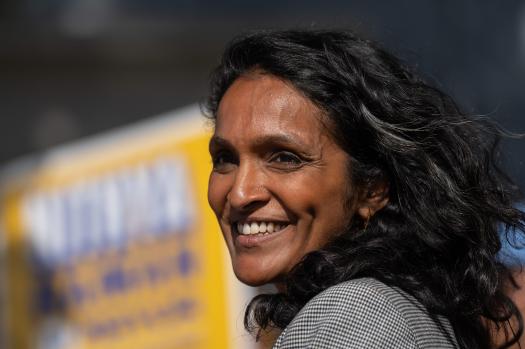
Some divas just like to have fun. Here was soprano Kiri Te Kanawa, Dame Commander of the British Empire, the glamorous darling of legions of opera and concert lovers, crossover queen of the recording industry, giggling and sighing like a schoolgirl over . . . a poster of Walter Payton?
It was an incredibly beautiful summer day and Te Kanawa, her tanned skin glowing beneath her navy-blue-and-white tennis togs, was sipping lemonade on the terrace of the Lake Shore Country Club in Highland Park.
A friend interrupted our conversation to present her with the familiar Chicago Symphony Orchestra marathon poster in which the Bears running back is posed alongside conductor Georg Solti. The gimmick is that Payton is dressed in Solti`s tails and holds a baton, while the maestro sports Payton`s jersey and clutches a football.
Te Kanawa was ecstatic. Her local concert and opera engagements-which include her return to Lyric Opera as Fiordiligi in Mozart`s ”Cosi Fan Tutte,” which opens Saturday night at the Civic Opera House-seemed far from her mind. The only thing that mattered to her at that moment was having a picture of ”Sweetness” to put up on her wall.
”I`m going to try and get him to sign this, if he comes to the concert,” she burbled. ”I got to know him when we took part in a fundraiser put on by the Royal Family. We were all dressed in medieval costumes and he was a knight on a horse with square wheels. We flew back together last week on the Concorde.”
The singer waved to her husband, Australian businessman Desmond Park, who was playing tennis with their two children on an adjacent court. ”My husband once asked me, `Why do you like athletes so much?` I said that it`s because I admire achievers. It`s this totalness they show and the power of what they do.”
She took a sip of lemonade and smiled. ”They are rather like me, I suppose, because I can do something that many others cannot. That`s why I like to be with achievers.”
When I told her she`s very much an achiever herself, she blushed slightly. ”Well, it`s nice, but then you try to achieve more. Sometimes it gets a little bit out of hand!”
Meet Kiri Te Kanawa, woman and artist of contradictions.
There is just-plain Kiri, lively and outgoing, whose lack of pretense reflects her lower-middle-class New Zealand origins. (She is part Maori, part European, and she takes her surname from her adoptive parents.) Athletic by nature, she plays a mean game of tennis and she saw to it that the family homes in England, Portugal, New Zealand and the United States all are near golf courses.
Then there is Dame Kiri, the celebrated opera star, who, at 43 and at the peak of her vocal form, knows exactly who she is and what she wants, who has achieved a degree of success and recognition unmatched by all but a golden handful of classical performers in today`s musical world.
Chicagoans had glimpses of both Kiris earlier this year. Ravinia got a foretaste of her wondrous Fiordiligi just two nights after the diva showed up at the opening night gala swaddled in $250,000 worth of gold and diamond jewelry from C.D. Peacock. A few months later, she sang Desdemona to Placido Domingo`s Otello at Georg Solti`s 75th birthday gala with the Chicago Symphony, excerpts of which will be telecast at 9 p.m. Dec. 28 on WTTW-Ch. 11, with a simulcast on WFMT (98.7 FM). At concert`s end, a playful Te Kanawa tossed balloons in the maestro`s direction.
”If anyone wants to know what I`m like,” the singer said, laughing,
”they have only to look at my star sign, which is Pisces. We Pisceans are totally unpredictable.”
The contradictions are resolved in Te Kanawa`s art. From the outset, she has been able to communicate her sheer enjoyment of singing to everyone, wherever and whenever she has sung. Her musical instincts, her beautiful voice, her way with an audience all serve to draw the listener close to her, close to the inner truth of the music.
Onstage Dame Kiri is a tall, proud beauty, darkly sensual, qualities she exploits to the fullest in the countesses and other betrayed ladies she usually portrays. But physical allure is only part of the tale. There`s her perfectly poised, creamy tone, delicate in phrasing, spanning the full soprano range with exceptional ease, glowing with a warm, womanly serenity.
She describes her voice as ”lyric, silvery and fumey, not necessarily smoky.” If so, it must be the fumey sound that Mozart and Strauss had in mind for their music.
It did not hurt the soprano`s popularity one bit, of course, that 600 million television viewers heard her sing at the royal wedding of Prince Charles and Lady Diana in 1981, a year before she received the distaff equivalent of British knighthood. The broadcast made her a household name among the general, non-operatic public.
Since then, she has been the subject of an ”authorized” biography
(”Kiri,” Atheneum, $13.95), appeared in several British TV specials and films (Joseph Losey`s ”Don Giovanni”), cut a pop record with the late Nelson Riddle (”Blue Skies” on London) and made two Broadway show albums (”West Side Story” and ”South Pacific”) for DG and CBS, respectively.
Meanwhile, she has not been neglecting her operatic public. Late last month, London released her recording of Strauss`s ”Arabella,” one of her signature roles and a part that brought her to Lyric Opera for the first time in 1984. The diva remains a much-loved presence at London`s Covent Garden and the Metropolitan Opera, where she will return later in the season for performances and broadcasts of ”Otello” and ”Cosi Fan Tutte.”
It is a reliable measure of Dame Kiri`s drawing power that opera producers are willing to move heaven and earth-not to mention their carefully wrought schedules-just to keep her on their rosters.
Originally, the Lyric had planned to build its new production of ”Die Fledermaus” around the soprano and to present both this season. But when Dame Kiri announced that she was dropping the role of Rosalinde from her repertoire (the music, she says, lies too low for her), Lyric general director Ardis Krainik elected to substitute ”Cosi,” an opera that would allow the Lyric to retain most of the principal singers, including Te Kanawa, already contracted for ”Fledermaus.” (The new ”Fledermaus” has been shelved until 1989-90.)
For the last few months, two of her recent albums, ”Kiri Sings Gershwin” (EMI Angel) and ”My Fair Lady” (London), have held the No. 1 and No. 2 slots, respectively, on Billboard`s best-selling crossover records chart. People are snapping up Kiri records who have never heard her Fiordiligi, Desdemona, Arabella or any of the dozen or so roles with which she favors the opera houses of the world. And that is just fine with her.
”I`m not a snob,” she declared. ”If you add up the audiences who could hear me sing one opera in a given city, you would have perhaps 8,000 people. You find you are singing to basically the same group of people over and over, which to me is not achieving anything. But if you bring new people into the world of opera by crossing over to Gershwin, ”Blue Skies,” ”South Pacific,” then you have achieved an incredible amount.”
Dame Kiri neglected to explain why someone who hears her croon ”I`m Gonna Wash That Man Right Out of My Hair” on his home stereo is necessarily going to rush out to buy tickets (rather more expensive than the cost of a record or cassette) to hear her sing Mozart in the opera house. But it is never wise to challenge a diva when she`s on a verbal roll.
”The problem is that a lot of Americans think I shouldn`t sing Gershwin. Well, who`s got a monopoly on his music? He didn`t tell anyone that a Polynesian couldn`t sing his music.” (Te Kanawa actually is one-quarter Polynesian.) ”I mean, a voice is a voice is a voice.
”Besides, I would have killed for the chance to work with Leonard Bernstein on his recording of `West Side Story.` And then when `South Pacific` came up, I thought: Fabulous! I had heard that show all through my childhood and saw the movie 100 times. I was totally in love with it. And that`s why I did feel that I was allowed to make the recording.”
Given the fact that Te Kanawa is managed by the same firm, Herbert Breslin Inc., that has pushed tenor Luciano Pavarotti into megastardom, one might assume that the (blue) sky`s the limit as far as the PR advancement of the diva`s own career is concerned. But she insists she is not hungry for that kind of fame, that she is proceeding down the crossover path with the utmost caution.