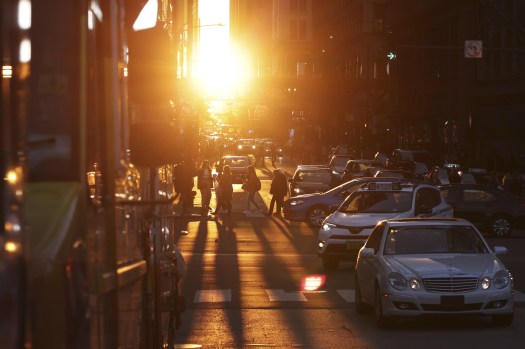
If Chicago Mayor Richard Daley thought those who fly were upset when he bulldozed Meigs Field, wait until those who drive start getting tickets via the mail for running red lights.
A week ago the mayor introduced legislation that would impose $90 fines when cameras to be installed at selected city intersections capture red-light runners on film.
In a 30-day evaluation at just two intersections, cameras caught more than 4,500 red-light runners, though none were ticketed.
While it is believed 4,499 of the offenders were cab drivers, it’s a serious problem nonetheless.
Cameras will photograph the offending car, and the speed, time of day and location will be recorded. Offenders will be mailed a ticket to commemorate the event and be given a choice of slipping $90 into the return envelope or appearing in court and waiting in line with 4,499 cab drivers to fight the charge, though the photo would make it difficult to insist your car slipped out of the garage on its own and ran a red light trying to get to Gino’s East before it closed.
Red-light cameras aren’t new, just new to Chicago. We wrote about them in 2001, when they began appearing in 50 cities in four states.
At the time an estimated 800 people were being killed and another 200,000 injured each year in accidents involving red-light runners. The cameras were seen as a means of reducing the carnage.
You’d think that anything that could help reduce the body count would be welcome by all motorists because they are potential victims. And the red-light camera is so easy. No muss, no fuss. If you choose to sin, you pay your penance–via check, no stamps, please.
Un-uh.
While our society is quick to place blame, it is very slow to accept it.
So while tests of red-light cameras proved to reduce accidents, deaths and injuries, lawyers as well as motorist associations that pay homage to the radar detector and laws that they feel infringe on their rights, got their shorts in a knot.
Opponents of red-light cameras argued that maybe red-light runners kill people, but red-light cameras photograph people and that’s a worse offense because it’s an invasion of privacy.
The problem was that while the cameras in most cities simply photographed the license plate, which allowed the driver to claim in court that the car did act on its own in making a late-night pizza run, in California and Arizona the camera also captured the mugs of front-seat occupants to eliminate any such arguments in court.
Opponents of the cameras were furious because if Dad was behind the wheel, but the woman alongside wasn’t Mom, well, as we said, it was an invasion of privacy.
But that wasn’t the only gripe. Opponents also charged that the only reason a city would install the lights was not to save lives but to increase revenue. Of course, if the city didn’t have to mop up after every accident, it would save lives and money, but you know how difficult it is to reason with lawyers on a rant.
And, opponents said, before installing cameras the city first goes street by street to shorten the length of time the yellow light appears, ensuring a quick red light will pad the coffers.
Of course, that argument can’t be made in Chicago, where yellow lights aren’t on long enough to be shortened without doing away with them.
Stay tuned.
Cut the chitchat: The National Transportation Safety Board says it hopes the 48 states that don’t prohibit inexperienced drivers from chitchatting on a cellphone (only New Jersey and Maine do) while behind the wheel will adopt legislation to do so.
Inexperienced drivers are defined as those with a learner’s permit.
The NTSB says motorists distracted on cellphones take up to 1.5 seconds longer to react to a road hazard, a greater problem for the novice driver, and that cellphone distractions were responsible for 2,600 fatalities and 330,000 injuries last year.