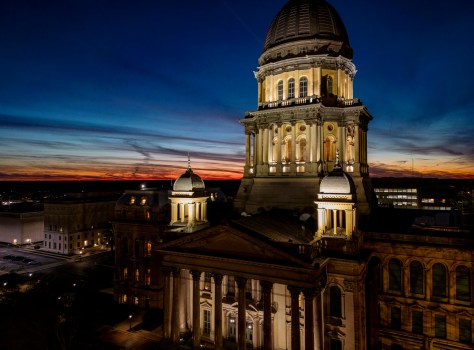
If you check your calendar, it says 2017 — unless you’re in Springfield, where the calendar is always flipped to the next election. It’s 2018 under the Capitol dome.
Gov. Bruce Rauner, wearing his signature plaid flannel, recently released a campaign ad in which he blames Democrats for ignoring the severity of Illinois’ problems. The state Republican Party is in fierce campaign mode and recently released video of Democratic Comptroller Susana Mendoza climbing inside her taxpayer-funded SUV, a purchase for which she has been criticized. Wait for that bit to show up in campaign ads.
Democrats, meanwhile, issue daily harsh takedowns of Rauner, from Chicago Mayor Rahm Emanuel openly mocking him to Emanuel’s schools chief blaming the governor for a “racist” school funding formula. Mendoza routinely sends out news releases attacking Rauner, even coining the phrase “Rauneritis,” which she describes as a personality disorder. And the Democrats lining up to run against Rauner keep trying to link him to President Donald Trump, even though he stayed out of the presidential race and has since distanced himself from Trump.
Journalists covering state government should take training courses in adolescent conflict resolution. That’s the caliber of discourse between elected officials.
Do you know who doesn’t care about the daily political score? Bond rating agencies that monitor Illinois’ dysfunction with increasing alarm. “Illinois is at a critical juncture and its leaders must choose between further credit deterioration and drift without compromise, or the potential for stabilization,” Ted Hampton, a Moody’s Investors Service executive, now warns. “With a budget consensus, Illinois could quickly secure its financial position.”
But there’s no consensus. The state’s bill backlog hit $13 billion in March. Illinois still has the lowest credit rating of any state and is seven notches lower than the median state rating nationwide, Moody’s says. The state is approaching a point where it might not be able to pay bondholders and pension funds. What’s more, Moody’s notes, the state’s condition comes from a gridlock of wills, not some disaster beyond Springfield’s control.
If you thought the partisan divide in Washington, D.C., was an impassable gulch, try the terrain of Springfield. No one is legitimately, earnestly working on a solution. The bad financial news has not galvanized Springfield’s Democratic power brokers to strike a deal with Rauner. Lawmakers are halfway through their spring legislative session and moving dozens of bills — but not a budget.
Then this popped up: an “Illinois Comeback Agenda” from Democrats. They’ve spent two years blasting Rauner for attempting to tie a budget deal to his broader economic and reform agenda. How many times did we hear House Speaker Michael Madigan and others lambaste Rauner for linking budget negotiations with non-budget items? Now some of Madigan’s House members, and Democratic senators, are doing the same. We’ll wait for their mea culpas.
Their agenda includes higher taxes on the wealthy and corporations, tighter ethics rules, a minimum wage hike, more state-subsidized child care and — get this — redistricting reform. According to the Comeback website, Democrats want legislative maps to be drawn “fairly, to accurately represent constituents in a way that doesn’t play politics.” Is that so. Democratic leaders, who have controlled the General Assembly for the past 15 years, have forcefully blocked remap reform without a peep from their members.
So forgive us for viewing the Democrats’ new agenda with skepticism. We’ll know they’re serious if they work with Rauner to find common ground on a budget and on proposals he will sign into law, not to simply pass piles of bills they know he’ll veto.
Two months of the General Assembly’s spring session remain. If lawmakers can’t deliver solutions, they invite voters to ask: Why do we keep electing legislators who perpetuate disaster?
The politicians are in an all-fired hurry to get to 2018. Maybe they shouldn’t be.