


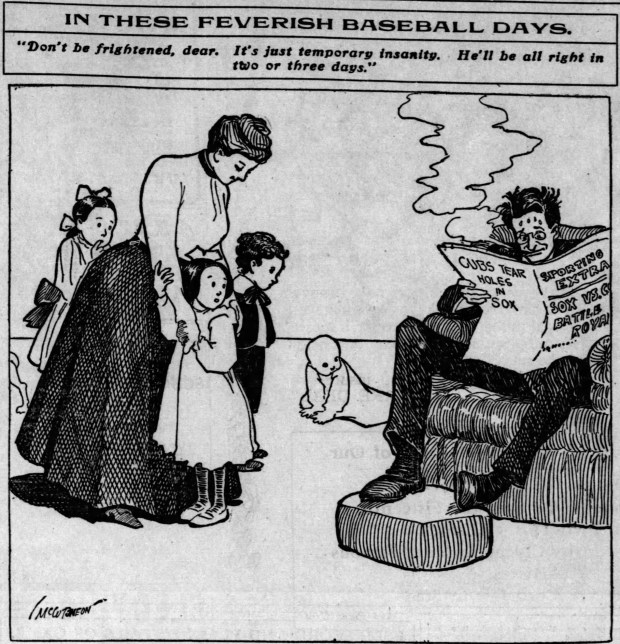


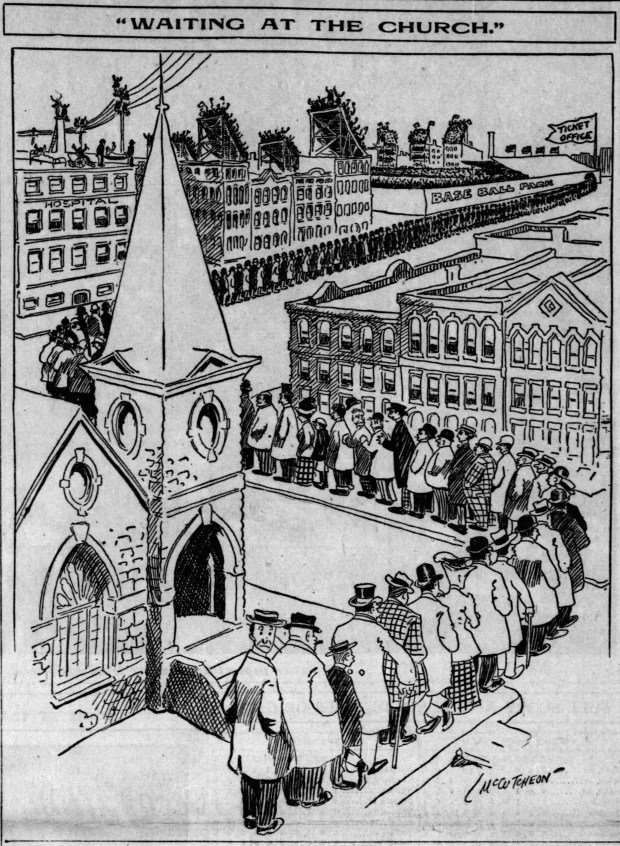
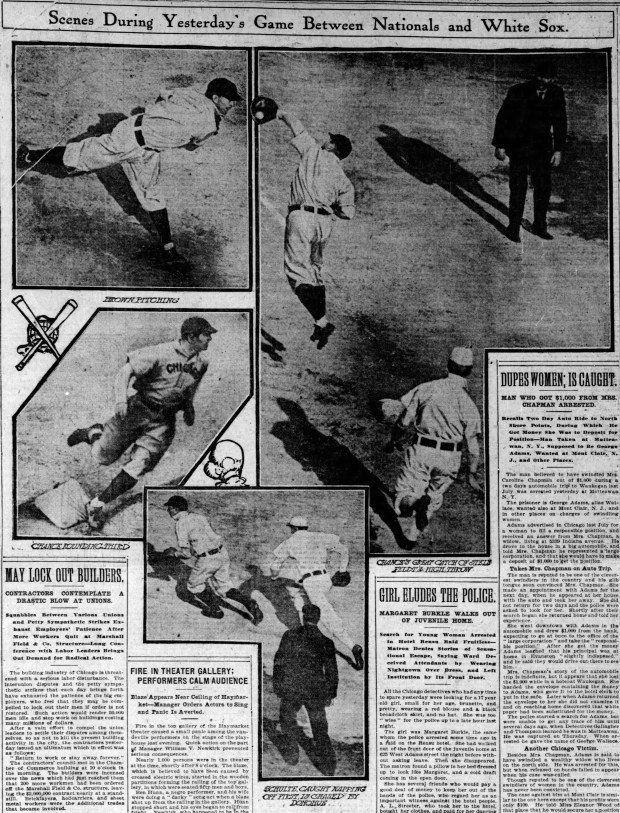


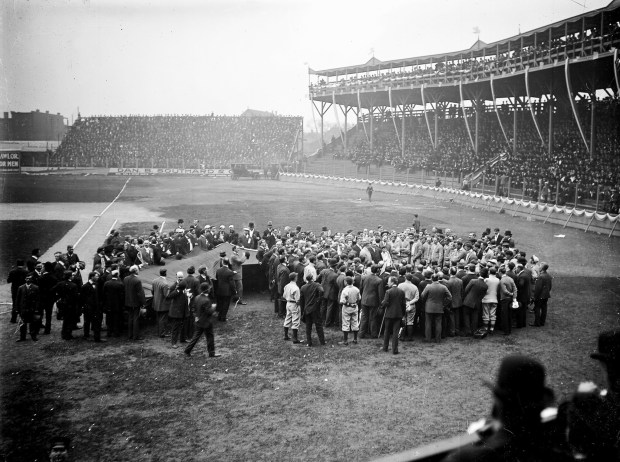


In the fall of 1906, the Cubs and the White Sox were in the World Series — both for the first time. It would be the last Series meeting between teams from the same city until the Yankees and Giants, then both playing in the Polo Grounds in New York, met in 1921 for the first of three consecutive Fall Classics.
As Chicago Tribune reporter Don Pierson noted in 1996: “Because pro football, basketball and hockey weren’t invented yet, the 1906 baseball season had little competition for sporting excitement in a town still rebuilding from the 1871 fire. World wars hadn’t even been invented, so a World Series was indeed a happening.”
Some, however, considered the Cubs-White Sox matchup a mismatch because of each team’s path to the championship series.

The Cubs
The 1906 Cubs went 116-36 during the regular season, setting a record for wins that still stands 114 years later. The 2001 Seattle Mariners tied the mark, but — spoiler alert — neither team won the World Series. The 1906 Cubs’ .736 winning percentage still is the best all time because they played 10 fewer games than the ’01 Mariners.
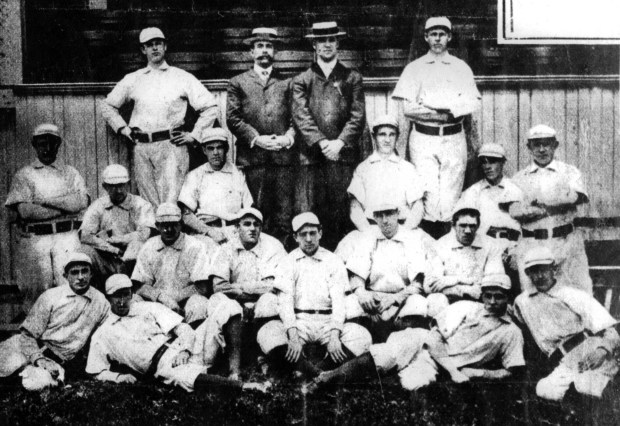
The 1906 Cubs were managed by first baseman Frank Chance, who completed the double-play trio of shortstop Joe Tinker and second baseman Johnny Evers. The trifecta better known as “Tinker to Evers to Chance” served as the inspiration for New York Evening Mail columnist Franklin P. Adams’ 1910 poem, “Baseball’s Sad Lexicon.” The poem appeared the same year in the Chicago Tribune under the name “Gotham’s Woe.” Tinker to Evers to Chance became synonymous with fielding artistry, though baseball historian Bill James maintains that they turned only 54 double plays in 770 games together. And they were hardly a smooth-functioning unit off the field; Tinker and Evers went years without speaking to each other.

Chance rightfully earned his later nickname — “Peerless Leader” — for being the most successful manager in Cubs history. As Jerome Holtzman, former Chicago Tribune national baseball reporter and later official historian for Major League Baseball, wrote in 1996, “Chance’s record as the Cubs’ manager has never been matched — four pennants and two World Series championships in his first five full years. He had the respect, if not the affection, of his players but was fired after the 1912 season because of a long-simmering dispute with owner-general manager Charles Murphy, a former Cincinnati sportswriter, who was involved in many shady deals and was eventually banned from baseball.”
The Cubs also had solid pitching, led by Mordecai “Three Finger” Brown, who as a child mangled his right hand in a corn chopper badly enough to lose a finger. Brown (26-6, 1.04 ERA) had one of his best seasons on the mound in 1906. He entered the Hall of Fame in 1949, joining Tinker, Evers and Chance, who went in as a unit in 1946.

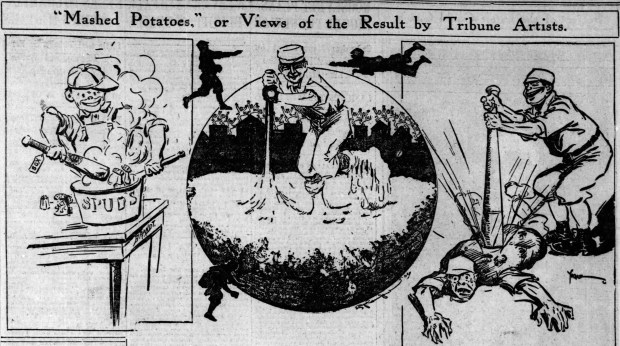
The Chicago Tribune in 1906 often referred to the Cubs as the Nationals — for their play in the National League — or the Spuds, in recognition of the Irish ancestry of team owner Charles Murphy. They weren’t even the North Siders yet, calling the West Side Grounds — also known as West Side Park — their home. The old park was located on the present site of the University of Illinois-Chicago Medical Center.

The White Sox
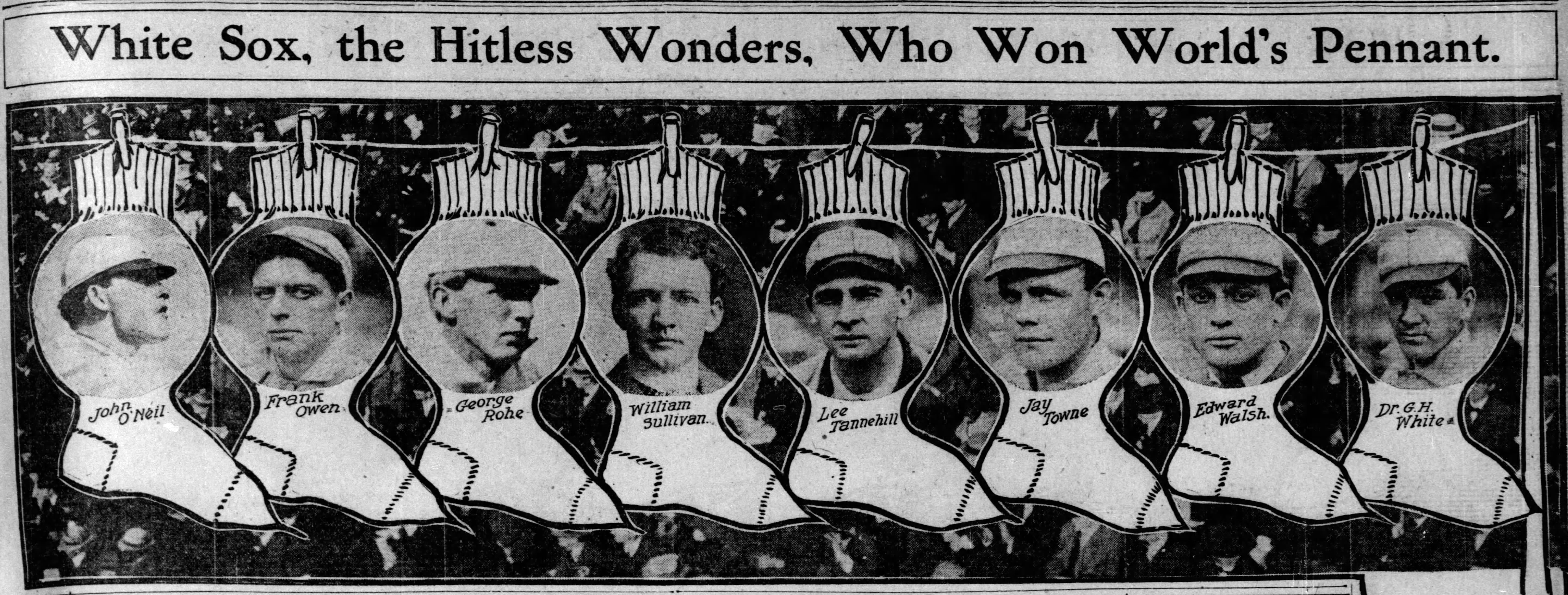
The White Sox, on the other hand, were World Series underdogs. Manager Fielder Jones‘ team hit .230 — worst in the American League — during the 1906 season with only seven home runs. The Sox earned the nickname “Hitless Wonders,” however, after a club-record 19-game winning streak during August, rising from sixth place to clinch the American League pennant on Oct. 3.
Great pitching — a 2.13 team ERA — supported the team’s unbelievable finish, led by Future Hall of Famer Ed Walsh, who threw the first no-hitter at Comiskey Park in 1911 and still holds the lowest of lifetime ERA of all time at 1.82.
The Cubs went into the Series as 3-1 favorites. Chicago Tribune baseball writer Hugh S. Fullerton, though, disagreed, picking the Sox. His editor thought Fullerton’s pick was so ridiculous he refused to print the article until after the World Series.
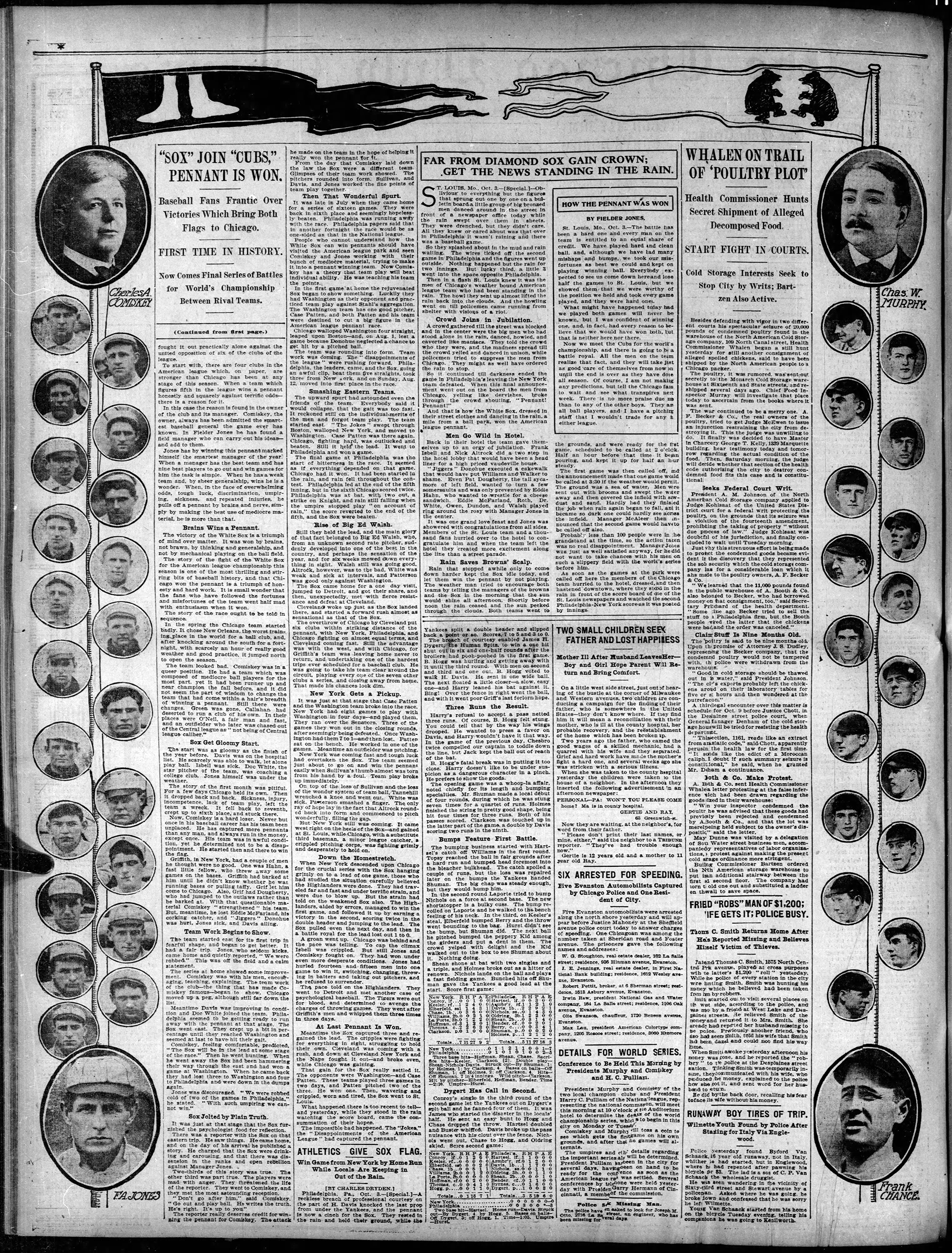

Here is how the Tribune covered the 1906 World Series:
Game 1: White Sox 2, Cubs 1
Oct. 9, 1906
West Side Grounds (also known as West Side Park; formerly at Congress Parkway and Loomis, Harrison and Throop streets).
Attendance: 12,693.

The Series began on the 35th anniversary of the Great Chicago Fire, amid snow flurries at the Cubs’ home park.
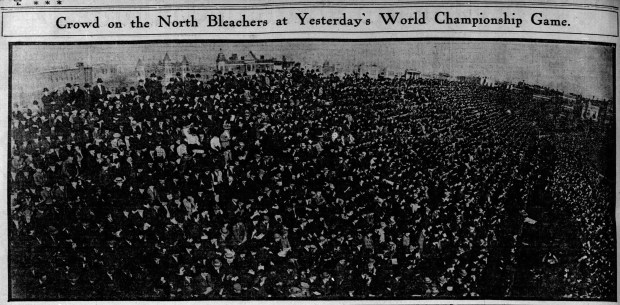
All 2,000 reserved box seats were sold out, but grandstand tickets were available for $1.50 (roughly $52 in today’s dollars) and 50 cents for bleacher seats. Many fans chose to stay home because of the frigid weather. Or, they gathered at the Auditorium Theatre or the First Regiment Infantry Armory to observe Chicago Tribune-provided reproductions of the game — “as nearly as possible play by play” — flashed across a 20-square-foot scoreboard with a baseball diamond on it.
Business stopped and City Hall shut down, but “speculators” reselling tickets outside the stadium were busy. Only eight scalpers, however, were arrested for their illegal activities — the name of each printed in the next day’s Chicago Tribune.
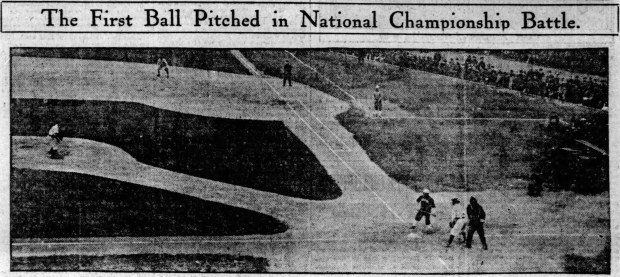
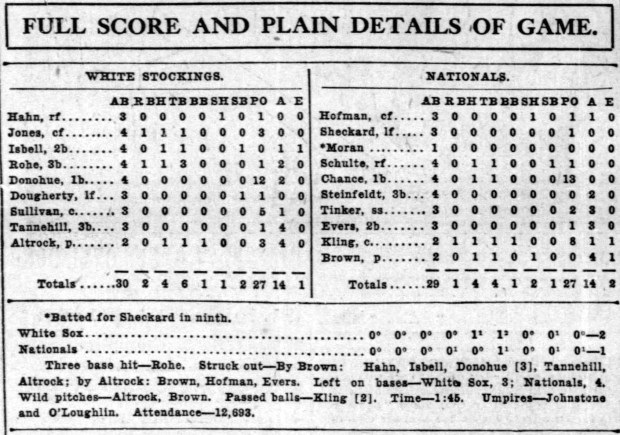
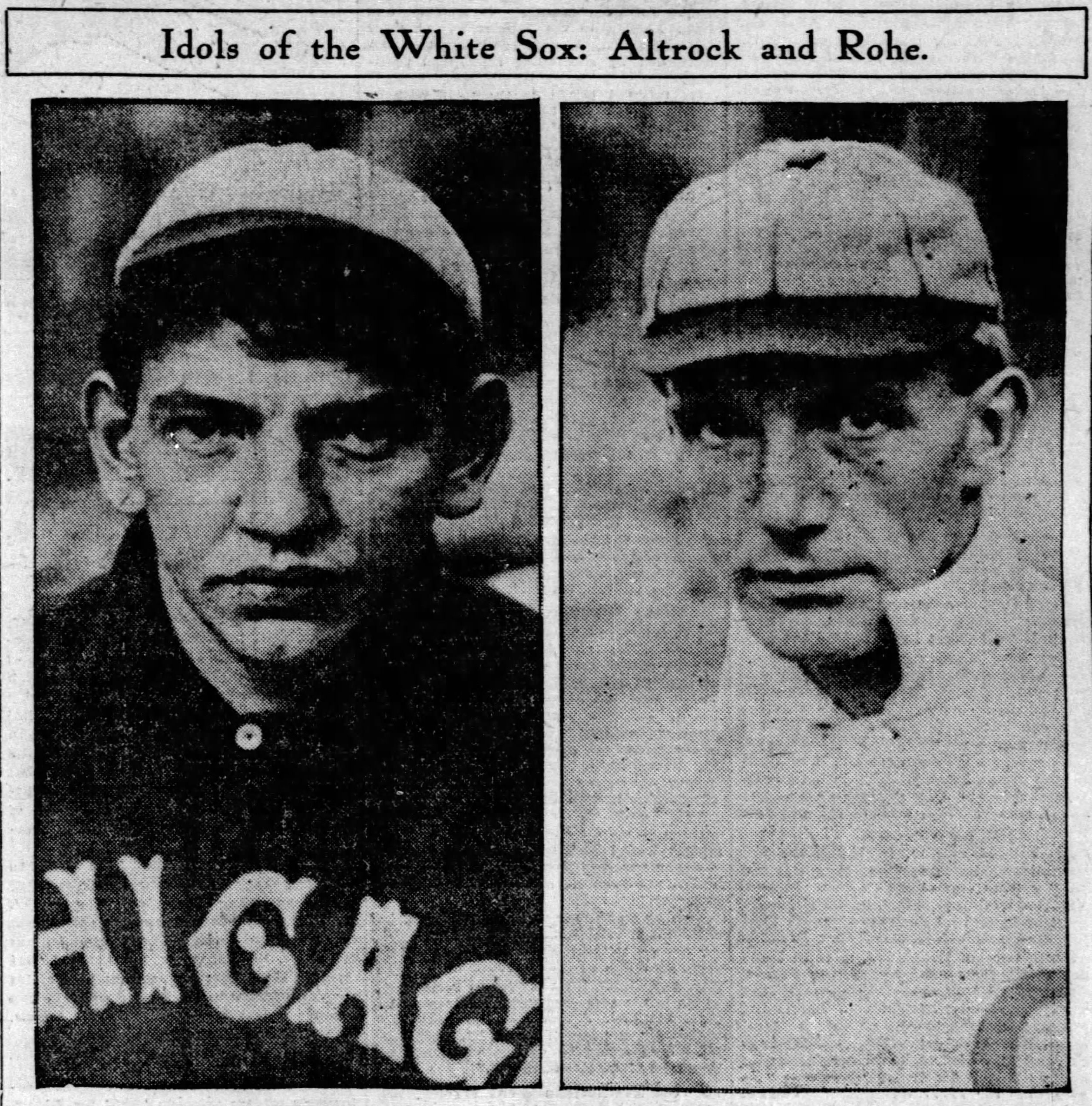
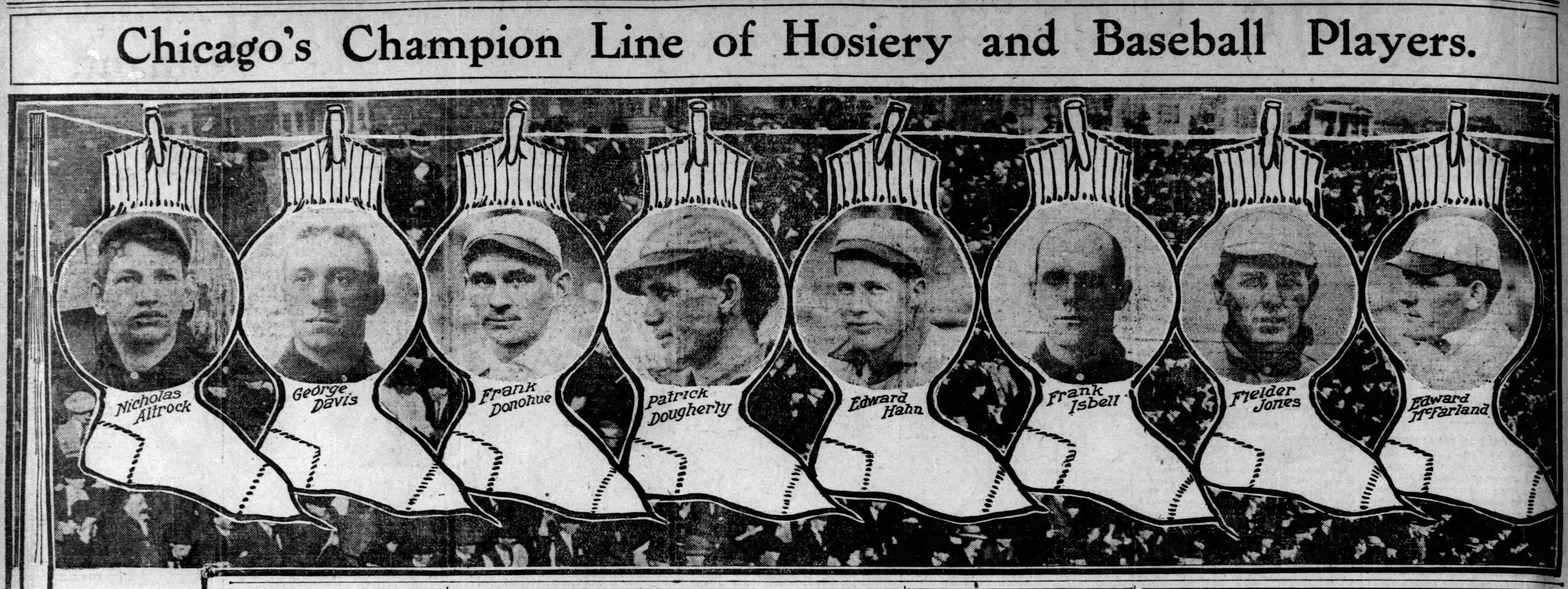
Against the heavily favored Cubs — “favorites of the well-heeled Michigan Avenue crowd,” former Chicago Tribune reporter Bob Vanderberg noted in 1997 — the White Sox (“heroes of the working man and the stockyards set,” according to Vanderberg) took the opener as Nick Altrock outdueled Mordecai “Three Finger” Brown, with each pitching complete-game four-hitters. The Sox scored the go-ahead run in the sixth on Frank Isbell’s RBI single.


Game 2: Cubs 7, White Sox 1
Oct. 10, 1906
South Side Park III (formerly at Pershing Road and Wentworth Avenue)
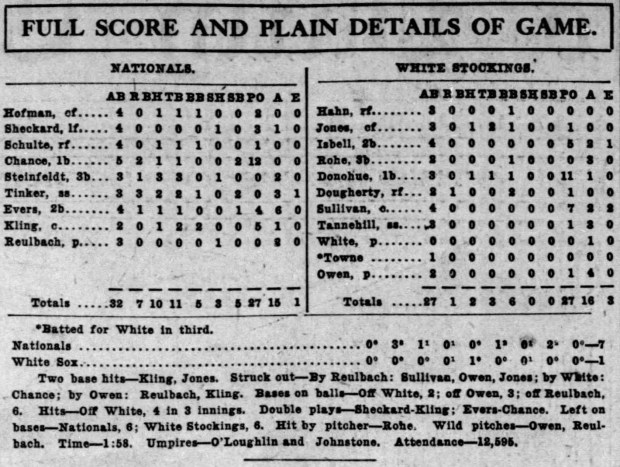
Attendance: 12,595
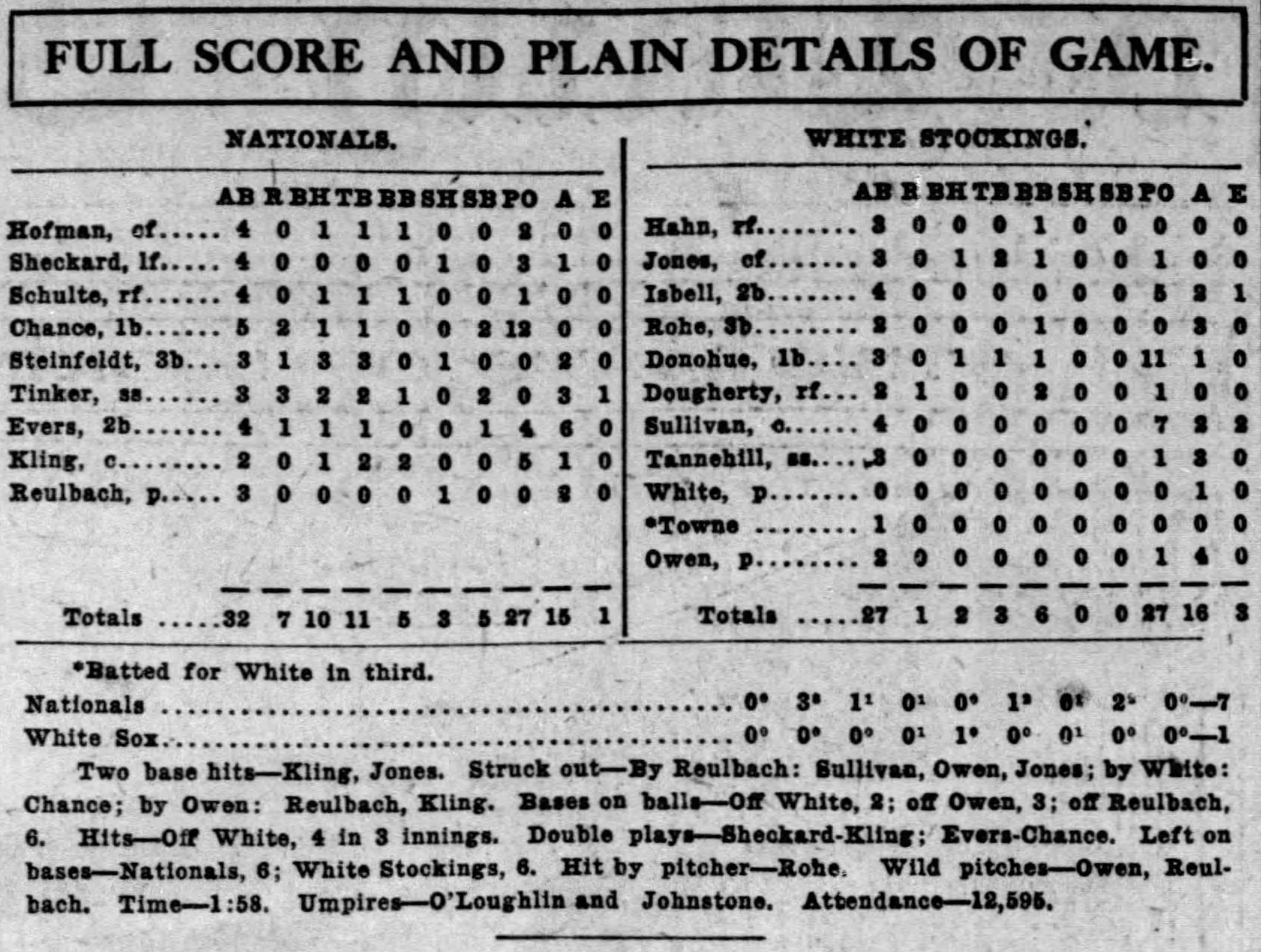
The setting shifted the next day to the Sox’s home field, but the weather didn’t change. The morning Chicago Tribune recommended anyone attending Game 2 wear “heavier overcoats.” With temperatures again in the 30s, the Cubs, behind Ed Reulbach’s one-hit pitching, beat the snow and the Sox 7-1. Harry Steinfeldt went 3-for-3 with an RBI and Joe Tinker went 2-for-3 with three runs scored.
That night, two boys, aged 16 and 17, were arrested for stealing $60 from a grocery at 657 N. Ashland Ave. The pair admitted they had used the money to attend Games 1 and 2 and to stuff themselves with concessions.

Game 3: White Sox 3, Cubs 0
Oct. 11, 1906
West Side Grounds
Attendance: 13,667

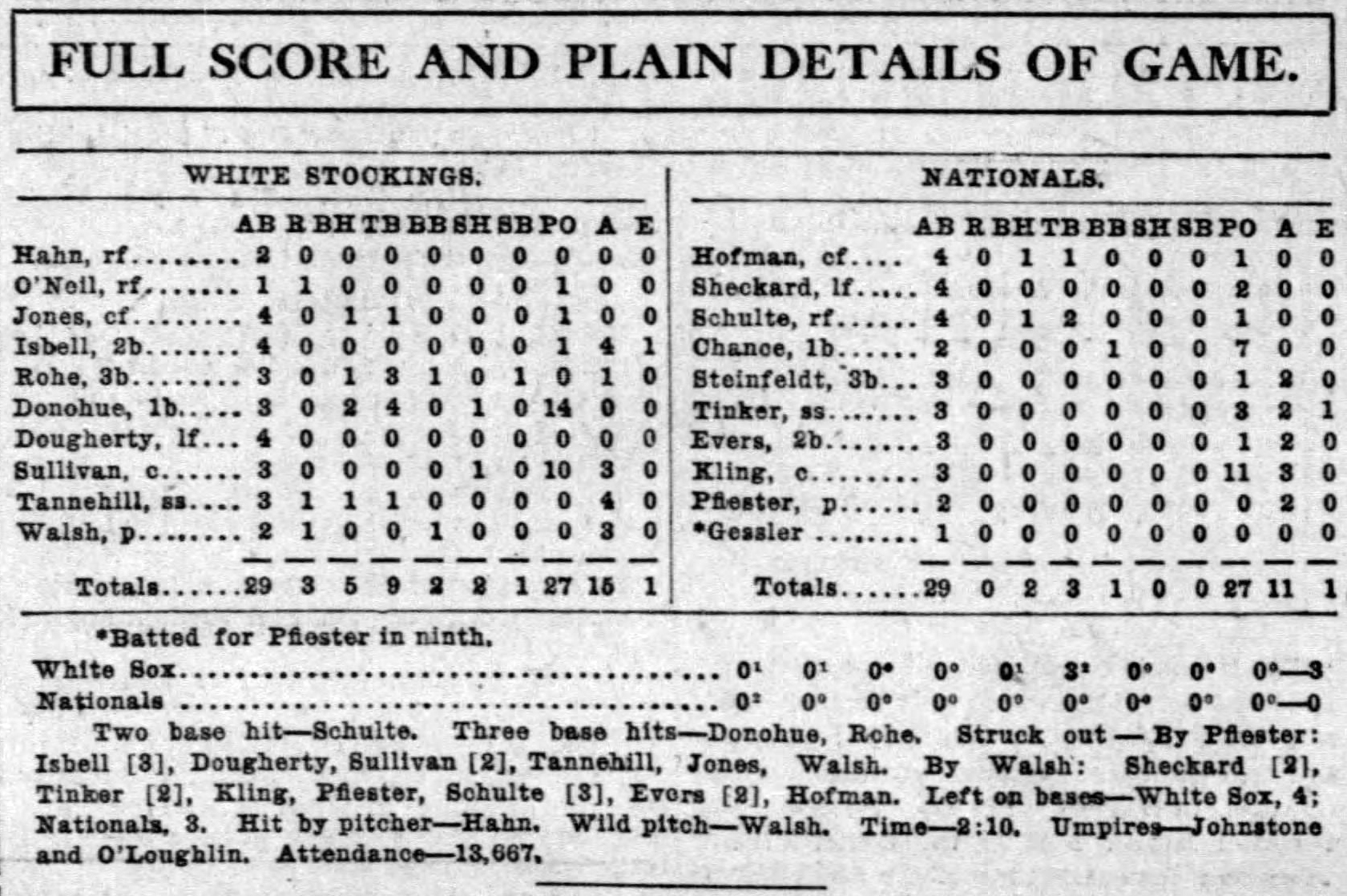
Finally, the weather warmed and 13,667 people jammed the West Side Grounds for Game 3 of the Series.
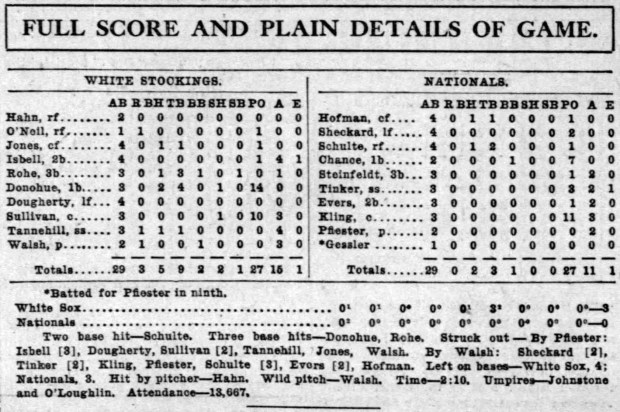
The Cubs, though, didn’t have a chance against right-hander “Big Ed” Walsh. He fanned 12 and allowed only two hits, none after the first inning.
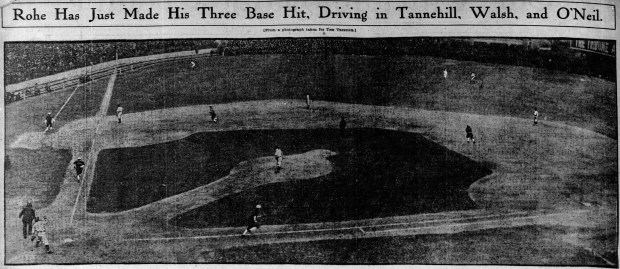
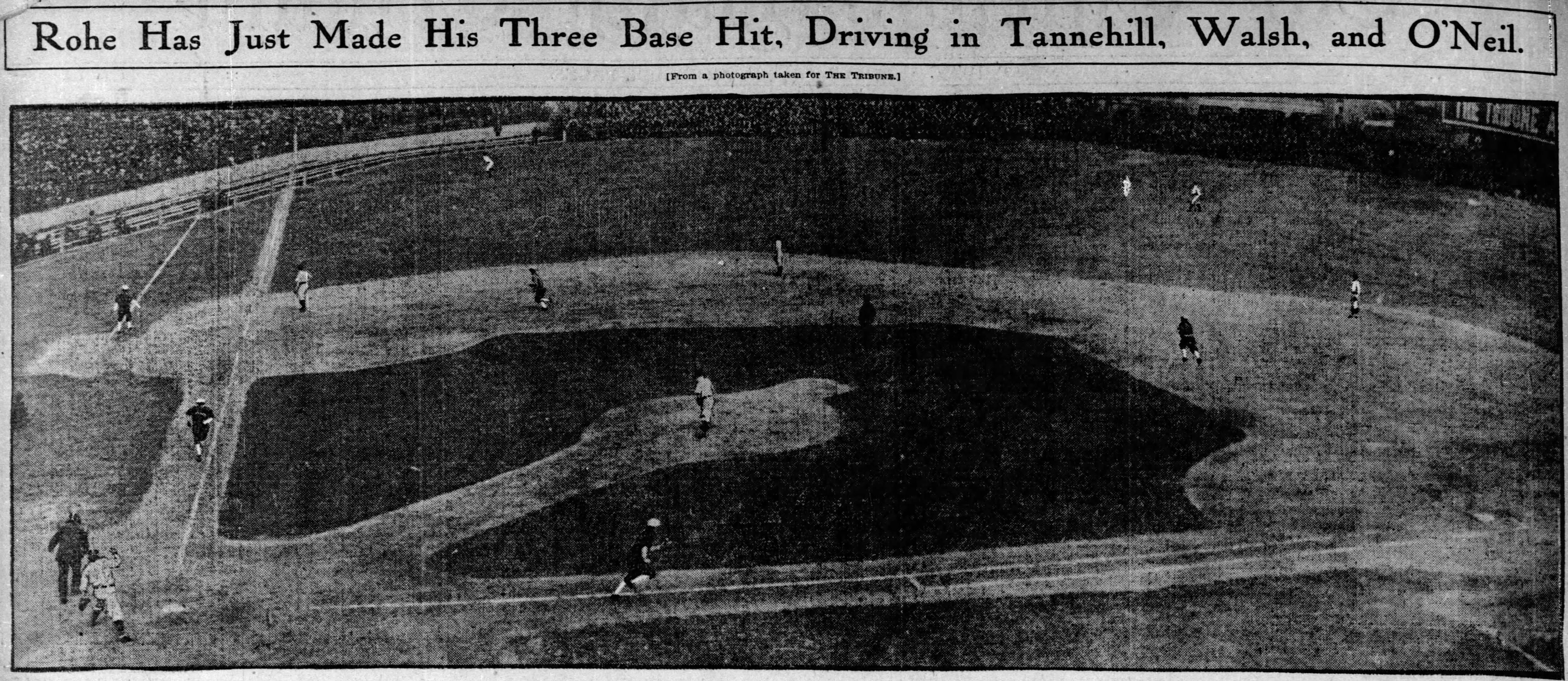
With the game scoreless in the sixth, the Cubs’ Jack Pfeister hit and broke Ed Hahn’s nose with a pitch to load the bases. Pfeister got the next two hitters, but George Rohe, a reserve infielder, hit a shot to left for a bases-clearing triple — the only runs scored by the White Sox. Walsh continued to dominate, much to the delight of the Sox faithful en route to a 3-0 victory.
With the warmer temperatures also came flaring tempers. In one instance, South Side Ald. Charles Martin (5th), a rather enthusiastic Sox fan, got himself arrested after a brawl with a Cubs fan in the Stratford Hotel bar. As police arrived to toss Martin into the paddy wagon, he yelled: “Don’t try to arrest me! I’m Ald. Martin!” The cops were not impressed.
Game 4: Cubs 1, White Sox 0
Oct. 12, 1906
South Side Park III
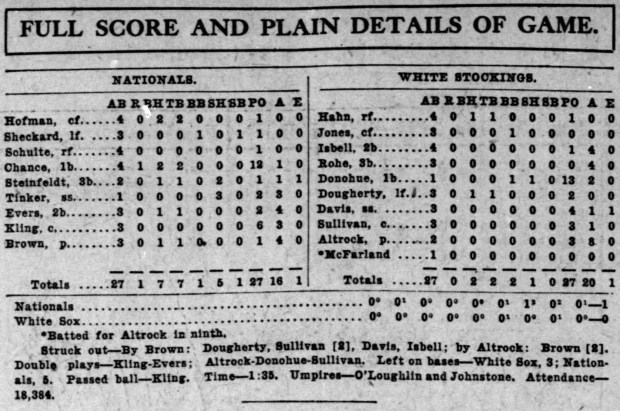
Attendance: 18,385
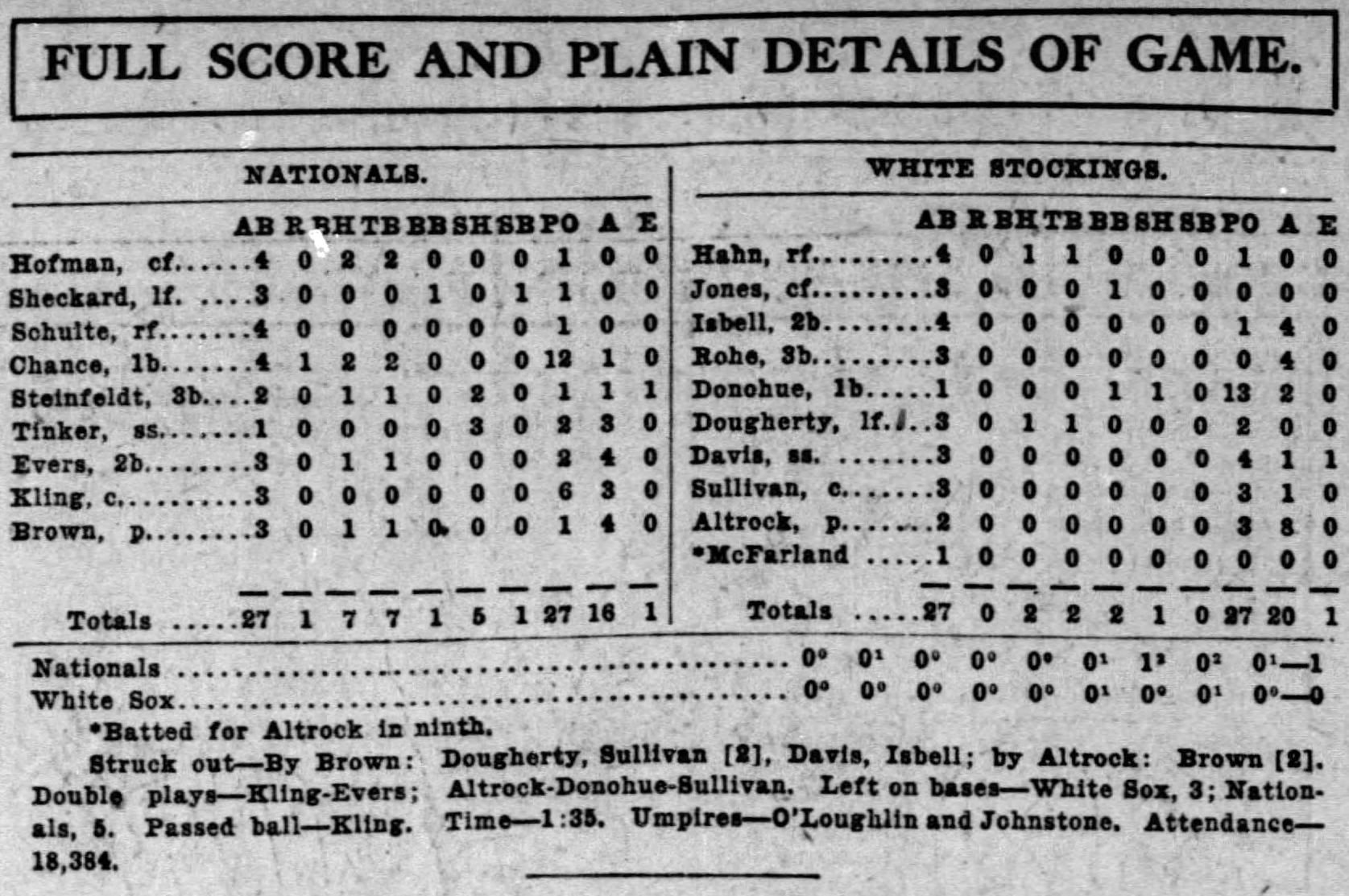
On the South Side the next afternoon came another shutout, this one a 1-0, two-hitter masterpiece thrown by Brown against Game 1 winner Altrock. The only run of the game came on a single off the bat of Johnny Evers that scored Cubs player-manager Frank Chance in the seventh.

Game 5: White Sox 8, Cubs 6
Oct. 13, 1906
West Side Grounds
Attendance: 23,257
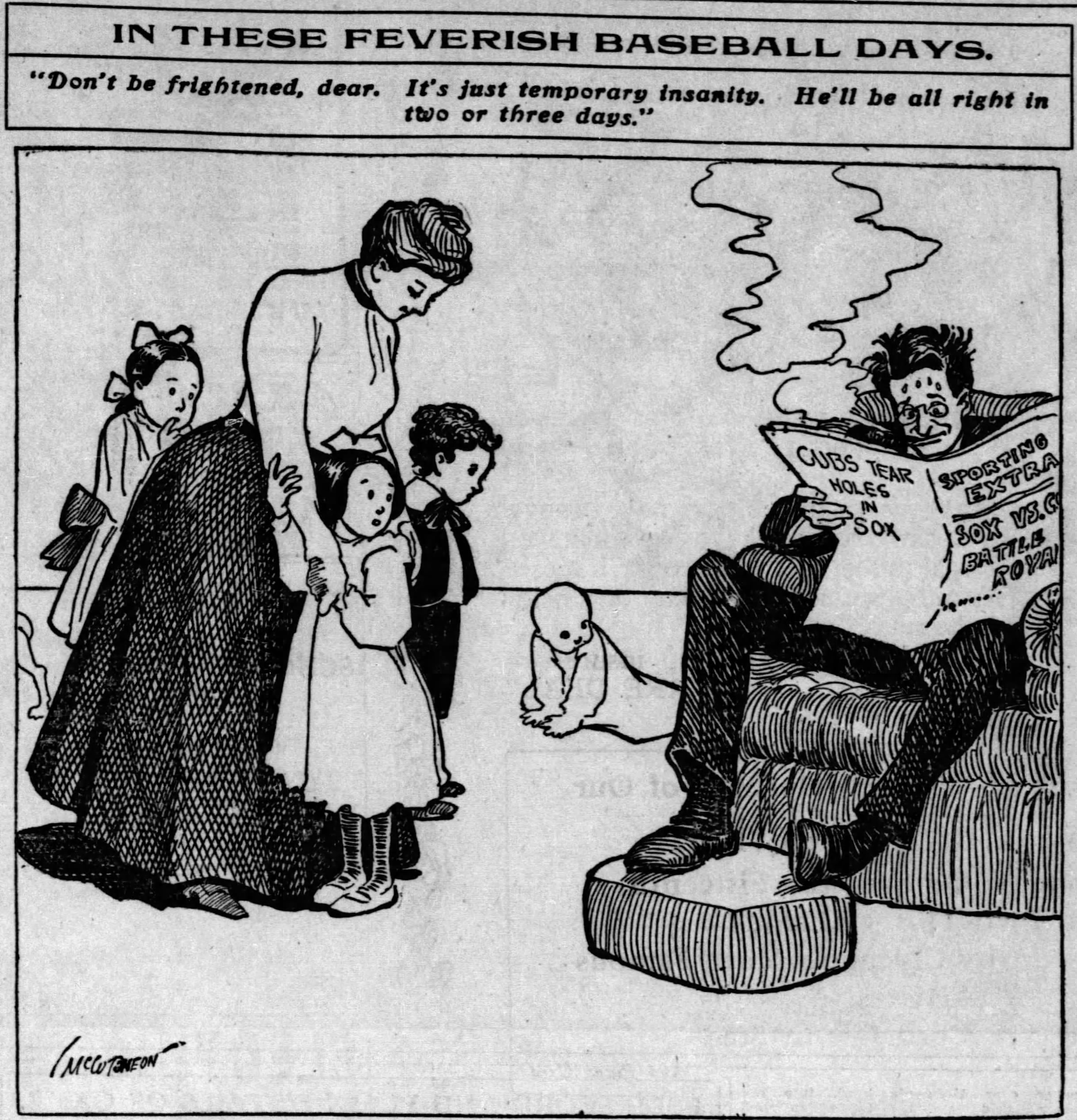
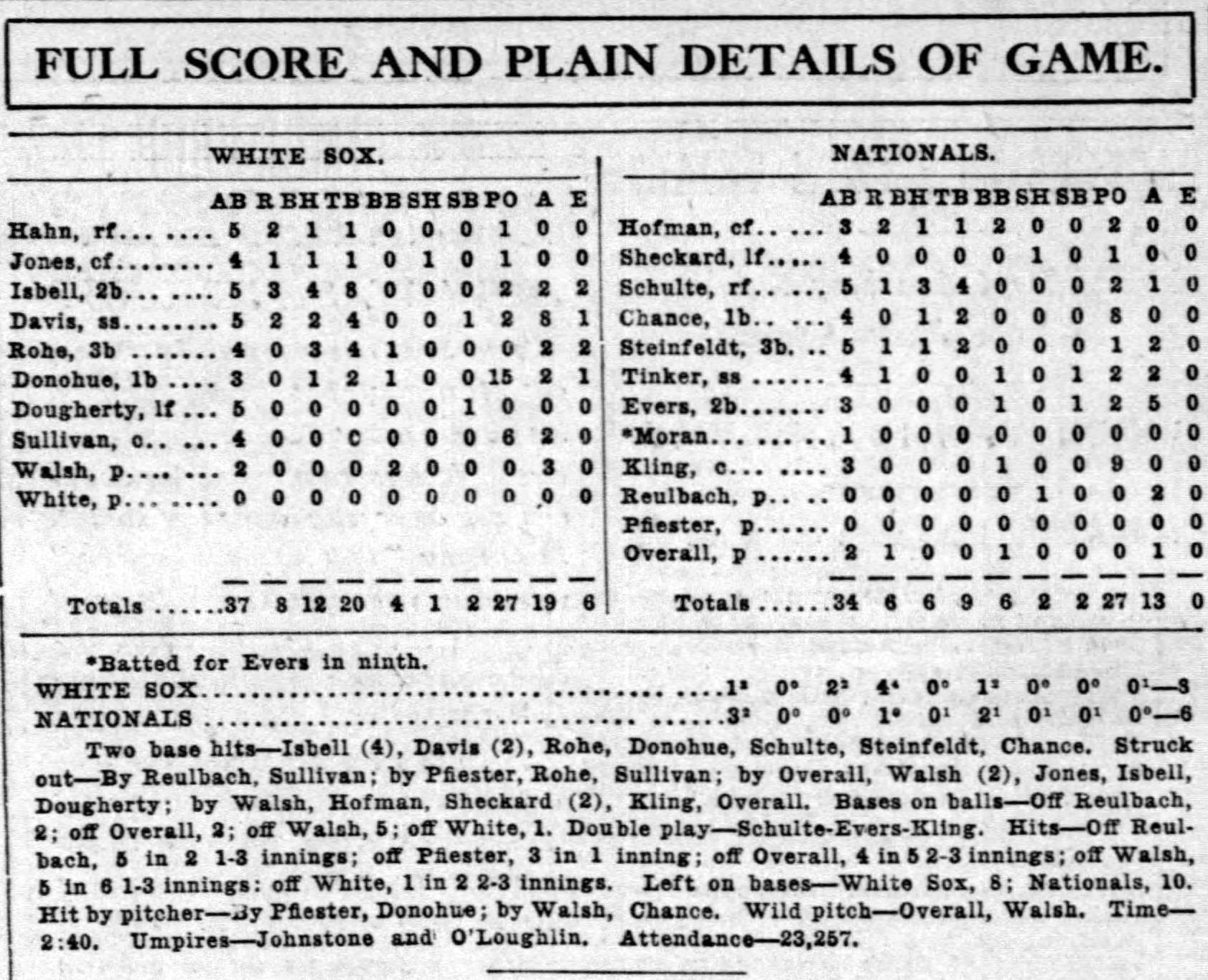
Game 5 presented the first time both World Series teams went to their bullpen in the same game. Jack Pfiester of the Cubs relieved Ed Reulbach in the third inning; Doc White of the Sox replaced Ed Walsh in the seventh. As the Chicago Tribune’s Jerome Holtzman wrote in 1985, “This game included still another first: Ineffective, Pfiester lasted less than two innings and became the first reliever removed for another, Orval Overall coming on for him in the fourth. Pfiester was the loser, the first reliever involved in a Series decision.”
The Sox outslugged the Cubs. Chided by manager Jones for failing to hit, Frank Isbell responded with four doubles and four RBIs. George Davis had two doubles and three RBIs and George Rohe had three hits.
Overflow crowds were permitted to stand behind ropes on the playing field. Sox hitters, especially infielder Isbell, perfected the art of lofting routine flies into the crowd for ground-rule doubles.
The visiting team won the first five games of the Series — the first time in postseason history that happened.
At least one Cubs fan lost it after the game. John J. Ryan, of 60 Carpenter St., carried his allegiance a bit too far when, at Clark and Randolph streets, he went after a group of Sox fans with his fists. Cops, perhaps Sox fans themselves, arrived and hauled him off to the lockup.
Game 6: White Sox 8, Cubs 3
Oct. 14, 1906
South Side Park III
Attendance: 19,249

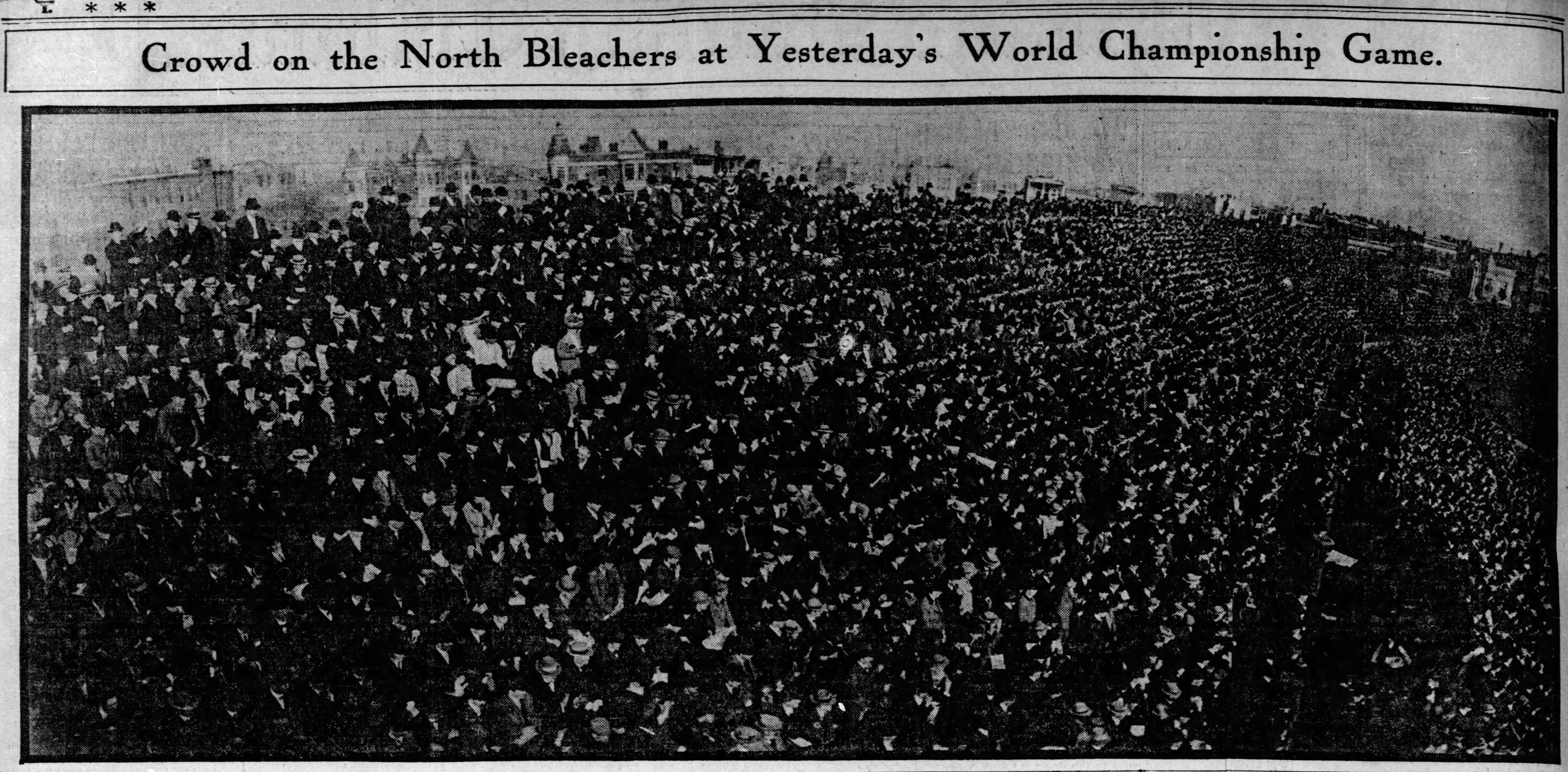
The teams split the first four games, then the White Sox took Game 5. They needed only one more game to win the Series and they could do it on Columbus Day at their park. Nearly 20,000 jammed South Side Park, and thousands waited in the streets. With Cubs ace Brown on the mound — after one day of rest — a seventh game seemed certain.
The Cubs scored a run in the first inning, but the Sox scored three, then exploded with four in the second. In the Cubs ninth, with the score 8-3 and two out, Frank Schulte hit a weak ground ball to the mound. Doc White tossed to first, then ran for his life as Sox fans swarmed the field and into the streets.
The Sox held their crosstown rivals to 18 runs in six games and won the World Series 4-2.
Career-long substitute George Rohe, playing because George Davis was hurt, was the Series hero as his triples won Games 1 and 3. He scored eight runs in each of the last two games and totaled 26 hits. Rohe and Jiggs Donahue were the Series hitting stars with .333 averages. Ed Walsh and Doc White won Games 5 and 6, in which the Sox totaled 16 runs.
Charles A. Comiskey’s Sox, not the Cubs, were champions of the baseball world. Comiskey, “with a roll of bills consisting of some $2,000,” the Tribune reported, “announced that there would be no sleep for him for the next 24 hours.” After the game, Comiskey handed Jones a check for $15,000. Combined with the more than $25,000 in gate receipts, each of the 21 players was set to receive $1,924 for their World Series win.
That night, bonfires were set for a party of thousands of White Sox fans that lasted into the morning. Some even went to the residences of some of their heroes such as Jones at 3521 S. Ellis Ave. and Rohe at the Hotel Hayden, 152 E. 36th St. In return, some players ended up joining the crowd in the celebration.
Cubs faithful stayed inside and mourned. An embittered Frank Chance said: “There is one thing I will never believe, and that is the Sox are better than the Cubs.” Chance never got his revenge but did get redemption when the Cubs won the 1907 and 1908 World Series. The Sox ruled the baseball world once more in 1917, but the ’06 Series might well remain a unique moment in the city’s sports history.



Afterword
White Sox’s win leads to the creation of Comiskey Park: As the “Hitless Wonders” in 1906, they had stunned the city and nation by winning the pennant and upsetting the Cubs in the World Series. In 1907, they led the majors in home attendance, drawing 666,307 fans to their old park at 39th Street and Wentworth Avenue. In 1908, spitball pitcher Ed Walsh, moistening the ball with slippery elm bark he carried in his mouth, won an amazing 40 games.
These successes were enough to spring team owner Charles Comiskey into action. For $100,000 he bought a tract of land near 35th Street that previously belonged to Mayor John Wentworth and included a truck farm and a junk yard. In October of 1909, Davis submitted his sketch of the steel and concrete kite-shaped park. Ground was broken on St. Patrick’s Day 1910. An unexpected steelworkers’ strike caused concern, but the park opened on time, July 1, 1910. Construction costs neared $500,000.

Enshrined in the Baseball Hall of Fame: You might miss this gem unless it’s pointed out to you because the 108-year old artifact looks as if it has seen more than its fair share of hard use. But it’s the lone relic on display at the Hall from the only all-Chicago World Series.

The Cubs got their revenge — but not against the White Sox: Former Chicago Tribune reporter Bob Verdi summed it up best in 1996 — “The Cubs were so upset, they won the next two World Series.”
The Cubs dipped to 107 wins in 1907 and 99 in 1908, but they won the World Series both those years. It would be more than a century before their next title, and the team that won it in 2016 was a worthy one, outscoring opponents by 252 runs during a 103-win season.

Finally, a rematch: It would be 91 years before the Cubs and White Sox would play each other again in a non-exhibition game. On June 16, 1997, the Cubs traveled to Comiskey Park and walloped the White Sox 8-3.
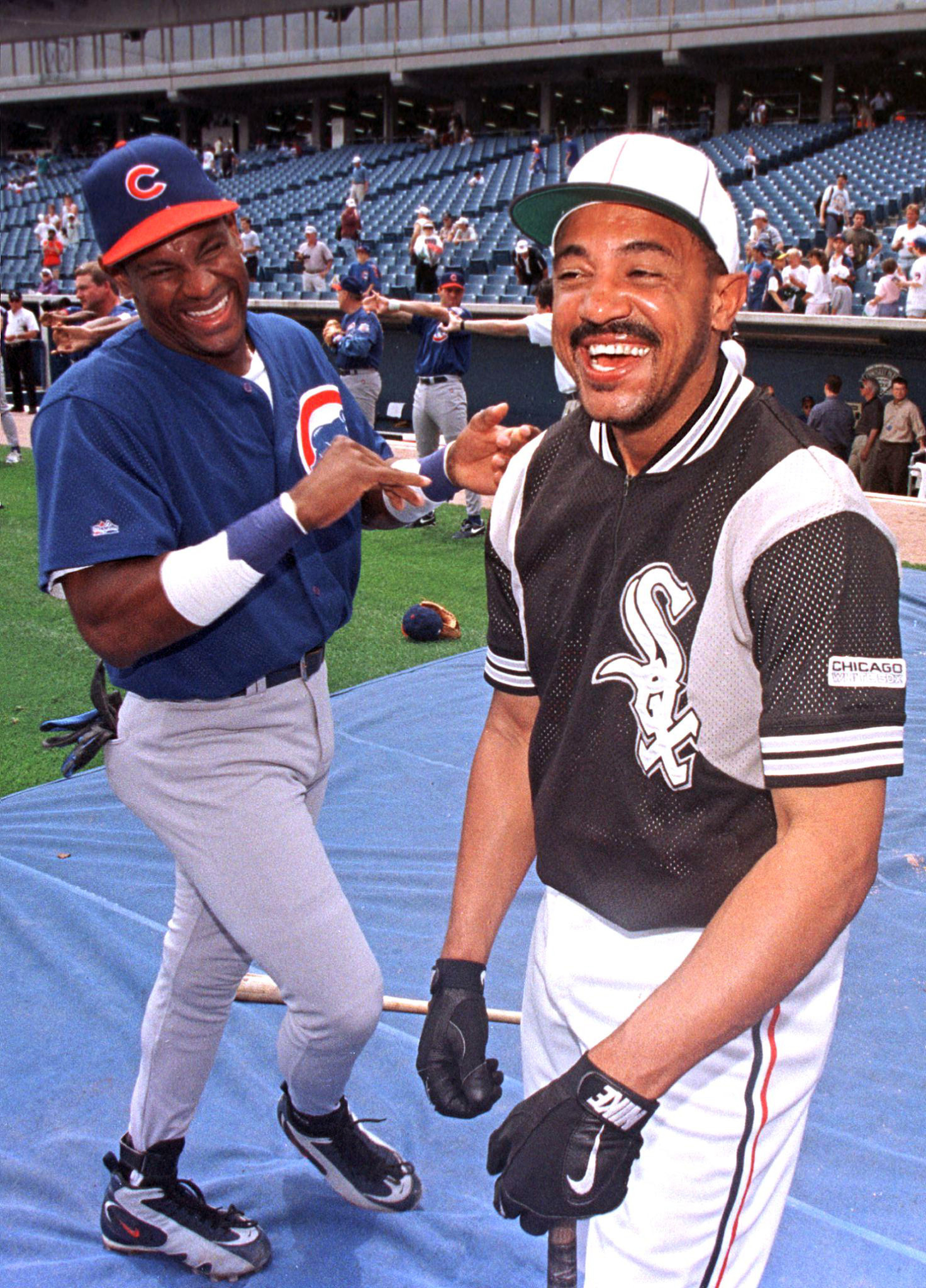
Both teams in the postseason: The only time aside from 1906 and 2020 both teams made the postseason was 2008, when both flamed out in the Division Series. Joe Maddon’s Tampa Bay Rays beat the Sox and the Los Angeles Dodgers swept the Cubs.

Sources: Chicago Tribune reporting and archives; baseball-reference.com; Major League Baseball; Associated Press; San Francisco Examiner; Society for American Baseball Research; “When Chicago Ruled Baseball: The Cubs-White Sox World Series of 1906” by Bernard A. Weisberger; “Chicago Days: 150 Defining Moments in the Life of a Great City” by Chicago Tribune