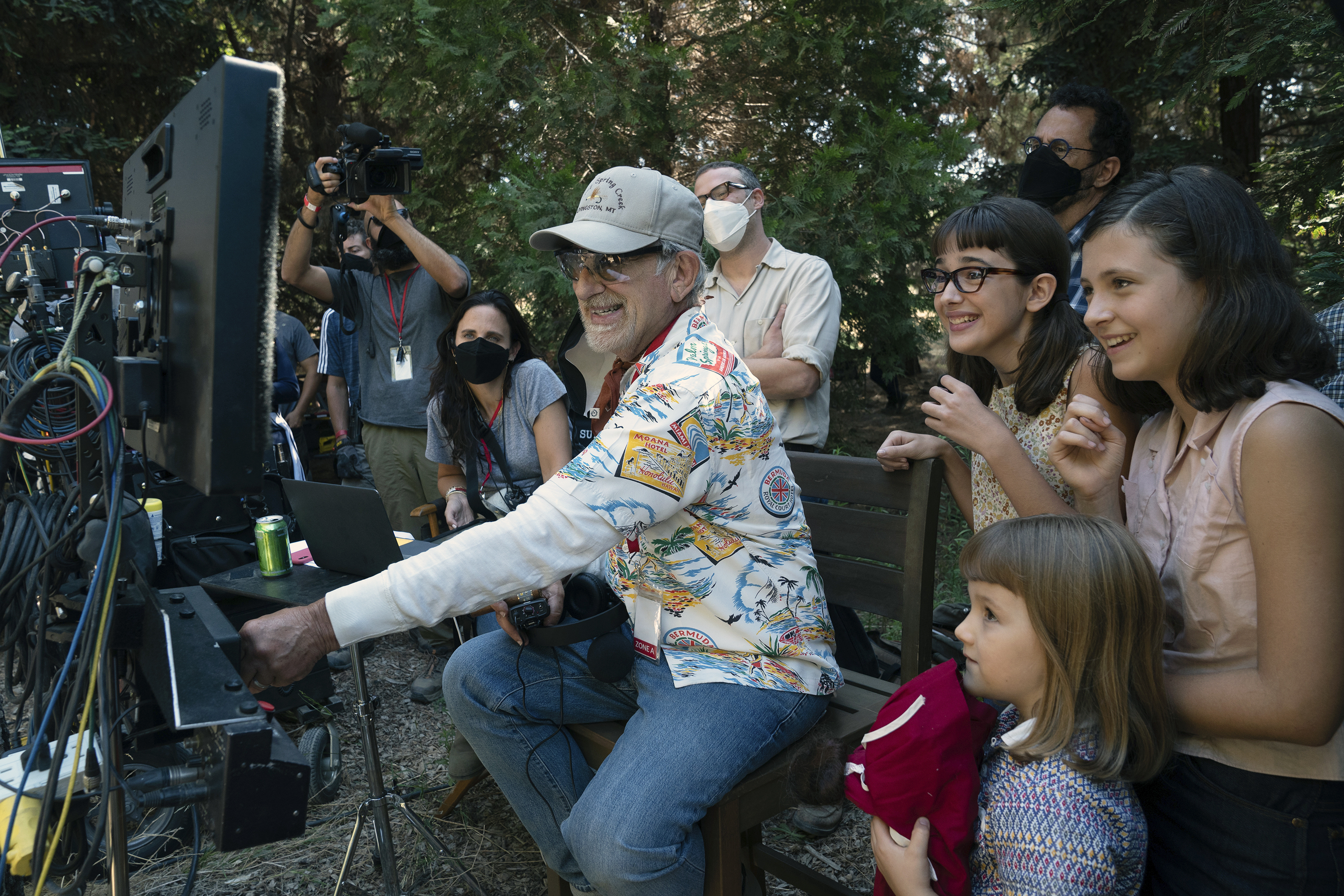


Like so many kids of the 1970s and ’80s, I’m grateful for the hero just out of the frame. And it’s not because Steven Spielberg launched “Indiana Jones” and “E.T.” and wrote about a Mikey (“The Goonies”) just like me who finds the treasure to save his family. It’s because nobody mines the heartbreak and alienation of the dual citizen that is the child of divorce any better than Spielberg, and I’m guessing nobody ever will.
Two photographs carry all I can remember of my parents parting ways when I was a year old. My father, shirtless and smiling broadly through his Bee Gees beard, lounging with me on the couch. I’m not on his lap but squirming away, repelled, as if I already knew it was over.
The other print shows me clutching my Winnie the Pooh and my 36-year-old mother’s hand in the spring sun, her auburn hair ablaze against the black robe she wears while bobbling her newly minted social work diploma. It was the end of the beginning, my mother as a new divorcee, set to launch a home practice so she could be there when school ended and then work late into the night.
Much like Spielberg’s fictional parents Mitzi and Burt in his latest Oscar-nominated movie, “The Fabelmans,” my mother was the poet-soul and my father the numbers guy. A refugee from Egypt by way of Paris, my father made his way through school to become a hospital administrator managing multimillion-dollar budgets, while my mother, a literature student who emigrated from Panama, reveled in jointly revising the stories that make up a life.

Like the movie’s main character Sam and the nearly 50% of American children who witness divorce, I kept replaying the scene of the crash of my parents’ divorce as if it, too, were “The Greatest Show on Earth,” the first film Sam sees — or more aptly, “The Only Show in Town.” Like Sam and Spielberg, I found ways of using art — music, writing and, even now, my day job as a psychologist — to reconcile and redeem the complications of a life lived constantly in transit between two irreconcilable countries.
And for many years, I’ve believed what lion tamer Uncle Boris — played magnificently in the film by Judd Hirsch as a wise old borscht belt man — says to warn and enchant the young Sam: There’s no way to honor your art without betraying your family, and yet there’s no way to live without art either.
This is what Spielberg has done so miraculously. From “Catch Me If You Can” to “Schindler’s List” and now “The Fabelmans,” he revisits the site of trauma and finds a way to both honor and lament it, and his art somehow carries it. It allows us as children of divorce to feel, for a few brief hours, that the world that broke apart can still find its way back together and that the alienation is an integral part of the sensitivity that keeps us repairing the world one story at a time.

And how Spielberg helps us reconcile those broken marriages we children of divorce have all endured. One pivotal scene shows us the glorious light inside Mitzi, dancing in a nightgown in front of car headlights. We, like her daughters, are embarrassed by the exposure of her nakedness. And yet, we are also just as taken by the command and intricacy of the Bach concerto she plays at the piano.
In Burt’s character, too, we find the reassurance of a man constantly attempting to make the world more knowable and controllable, and despite his tedious explanations on how to light a campfire, he is eminently decent and endearing.
Spielberg in “The Fabelmans,” and in so much of his oeuvre, shows us elemental truths about what it is to be human. There’s no way to reconcile the head and the heart, the familiar and the alien. We can only reach for symbols and hold them up before our very eyes. That is the magic and the art, and that just might be what saves us all.
Michael Alcee, Ph.D., is a clinical psychologist in private practice in Tarrytown, New York, and a mental health educator at the Manhattan School of Music. He is the author of “Therapeutic Improvisation: How to Stop Winging It and Own It as a Therapist.”
Submit a letter, of no more than 400 words, to the editor here or email letters@chicagotribune.com.