
Corned beef. Kishke. Chopped liver. Kosher dill pickles.
Those are a few of the things that come to mind when you think of Jewish delis. But there’s a lot more to learn about them than favorite foods as you will discover at the Illinois Holocaust Museum & Education Center’s exhibit “I’ll Have What She’s Having”: The Jewish Deli, which opens on Oct. 22 and runs through April 14, 2024.
The exhibit was organized by the Skirball Cultural Center in Los Angeles and localized by the Skokie museum.
“Culturally, we knew it would be exciting for our audience,” said Arielle Weininger, Chief Curator of Collections & Exhibitions. “But obviously, everything that we bring to the museum has to be a mission fit for us — has to talk about the history of the Holocaust or of social justice or civil rights violations.”
Then they discovered that a significant part of the exhibition dealt with Holocaust survivors who had opened Jewish delis in this country, worked at them, or congregated at them “to create a sense of community postwar,” Weininger said.
The exhibit has been at the New York Historical Society and the Holocaust Museum in Houston. In each location, Skirball has encouraged the presenting organizations to add local history to the exhibit.
“When you look at the Chicago and Skokie deli scene, it’s very much steeped in that Holocaust survivor history,” Weininger said.
She explained that after the Holocaust, you couldn’t find the foods in Europe that are standards at Jewish delis. At the delis that were established in this country by survivors “people could connect to the food that was of their families and of their communities in Europe,” Weininger said.
For over a year-and-a-half, Weininger contacted businesses in the area to create the local element of the exhibit.
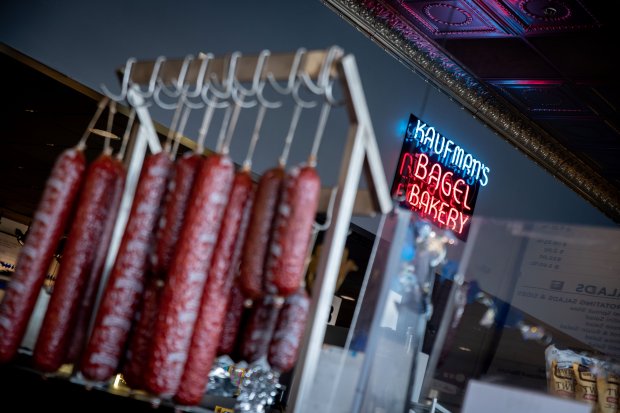
She discovered that Kaufman’s Bagel & Delicatessen in Skokie was opened in 1960 by Holocaust survivor Maury Kaufman and that many of the bakers who worked there were survivors. That included the father of Howard Reich of the Chicago Tribune.
Bette Dworkin’s family purchased Kaufman’s in 1984; she is now the sole owner.
“He kind of became a bit of a mentor for me,” Dworkin said about Maury Kaufman. Dworkin carries on the traditions that have kept Kaufman’s thriving all these years.

“In the standpoint of what we’re making, it’s very similar,” Dworkin said. “It’s more extensive. I try and find more specialty products.” She cited the huge selection of mustards in the store. Dworkin reported that the most popular items in Kaufman’s are corned beef, lox, and tuna salad, in that order. Gefilte fish and bagels are also customer favorites.
“We have so many homemade items,” Dworkin said. That includes soups and kugels. They smoke their own sturgeon, whitefish, sablefish, and turkeys.
The business has weathered some tough times, including having to close the store for a year following a fire in 2011, but their customers stayed loyal. Dworkin reported that people kept asking when they were going to reopen.
“After we reopened, I remember walking by the fish counter and hearing two guys go, ‘What did we do when they were closed?'”
Dworkin donated several items to the Holocaust exhibit — her late father’s jacket, a meat slicer, and an old Sinai 48 clock.
Dworkin concluded that Jewish delis are “a piece of culture that continues on.”
“Another wonderful thing about so many of these businesses is they’re family-owned and they go down through the generations,” Weininger reported. “Even if they switch hands, like Kaufman’s did to the Dworkin family.”
Other items in the exhibit include a drawing of Danny Wolf, the late owner of The Bagel, at the age of two in the Czech concentration camp Terezin where he was born. His family’s ID cards are also displayed.
Visitors will also see cookbooks, ads, and business cards from Hungarian Kosher Foods, which was opened by Margit and Sandor Kirsche, Hungarian survivors of Auschwitz who met in the United States.
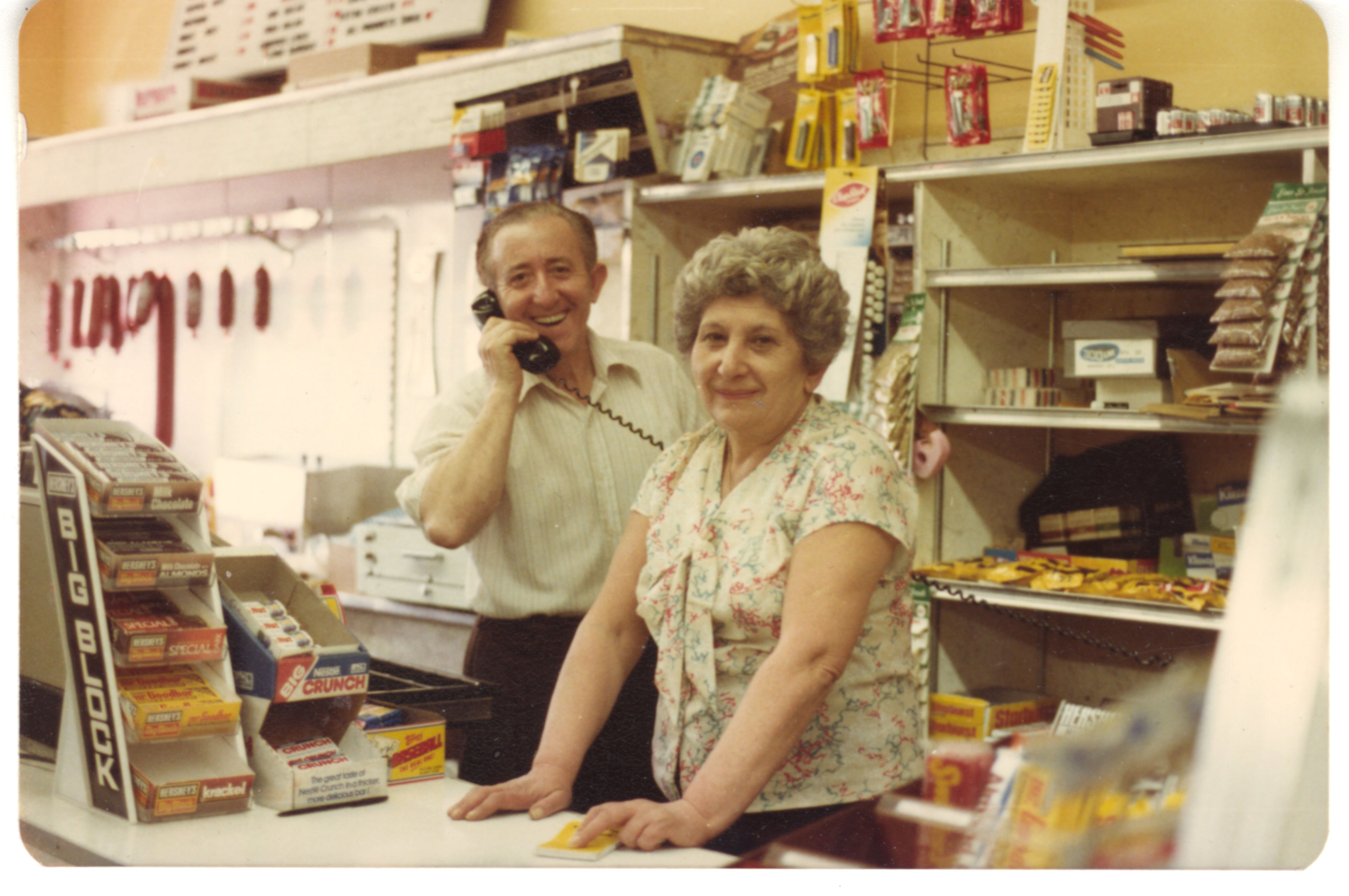
Holocaust survivors Fela and Leon Lesorgen opened Leon’s Deli on Howard and Crawford in Skokie in 1953. It was across from East Prairie School, which made it a favorite spot of youngsters from the school, as well as the teachers.
Even though they closed the store in 1981, sisters Regina Corush and Sheila Domash have fond memories of the deli — although only Corush and their brother Seymour Lesorgen enjoyed working there.
“I was in grammar school across the street,” Domash recalled. “I had all my friends come in and I hated them seeing me behind the counter.”
“I practically lived there,” Corush said. “I helped a lot. During lunch, I’d give candy.” She would also help out when one of her parents went on vacation — separately, because the store was open every day.
Both sisters agree that everybody knew and liked their dad. That legacy has remained with them. “When we went to our reunion for the closing of East Prairie School, when they gave us IDs, my name was Leon’s Daughter No. 1; her name was Leon’s Daughter No. 2,” Corush recalled.
Domash believes that the popularity of the place could be attributed to her dad’s personality. “He had such a friendliness to him,” she explained. “He was an all-around nice guy.” She discovered that he had done many favors for people in need.
It wasn’t only Leon’s personality that kept the customers coming. Domash reported that their mother made chopped liver and tuna twice a week for the entire time that the store was in operation.
Having their story be part of the exhibit, Domash said, would be honoring her late parents “in a way that would make them happy.”
That’s only a small sampling of the stories related and items displayed in the exhibit. There’s even a film that the museum created about the history of Manny’s Cafeteria & Delicatessen, Kaufman’s Bagel & Delicatessen, and The Bagel.
Weininger said, “I think this is going to be a fun exhibition for visitors to remember some of the places that they used to go and to see the new and exciting things that are opening. There really is a revival of delis now. I hope that they realize that there is a large and interesting history behind all of this.”
“I’ll Have What She’s Having”: The Jewish Deli exhibit
When: 10 a.m.-5 p.m. every day but Tuesdays Oct. 22-April 14, 2024
Where: The Illinois Holocaust Museum & Education Center, 9603 Woods Drive, Skokie
Tickets: $18 adults; $12 seniors; $8 students; $6 ages 5-11; free for children under 5
Information: 847-967-4800; ilholocaustmuseum.org
Myrna Petlicki is a freelance reporter for Pioneer Press.