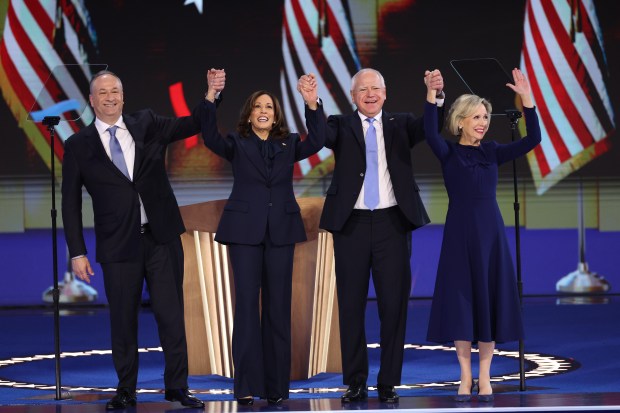


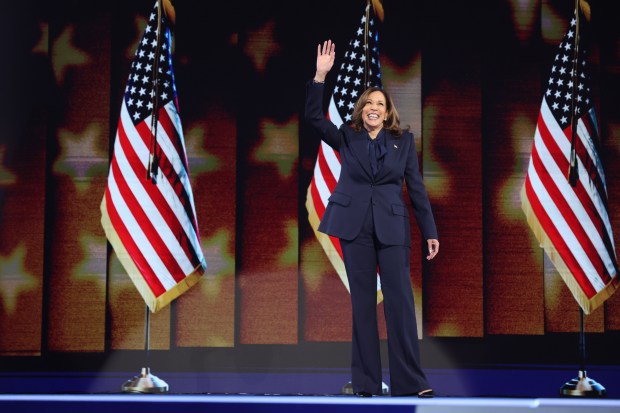








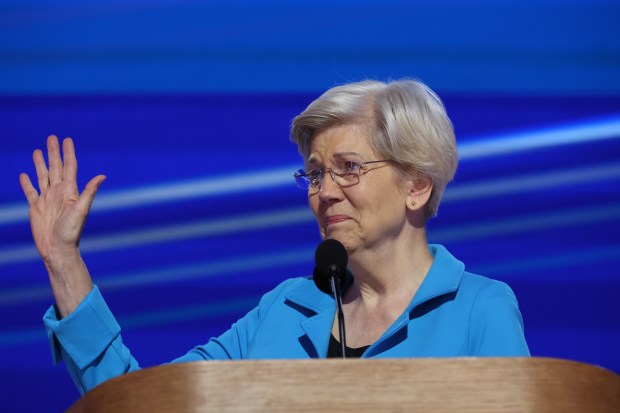






Vice President Kamala Harris formally accepted the Democratic nomination for president Thursday, pledging her election would present to the nation a “precious, fleeting opportunity to move past the bitterness, cynicism and divisive battles of the past” and create “a chance to chart a new way forward.”
“I promise to be a president for all Americans. You can always trust me to put country above party and self, to hold sacred America’s fundamental principles, from the rule of law to free and fair elections to the peaceful transfer of power,” Harris said.
“I will be a president who unites us around our highest aspirations, a president who leads and listens, who is realistic, practical and has common sense and always fights for the American people from the courthouse to the White House. That has been my life’s work,” she said.
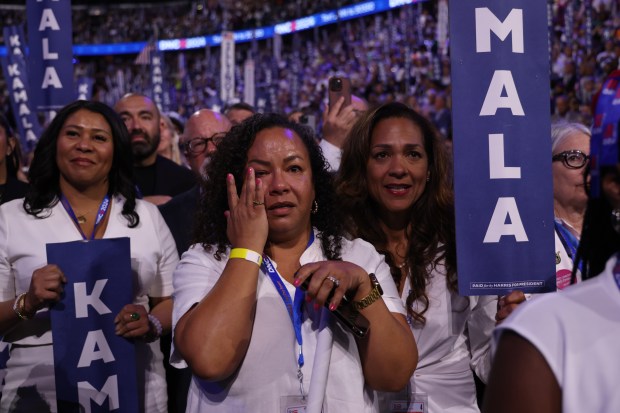
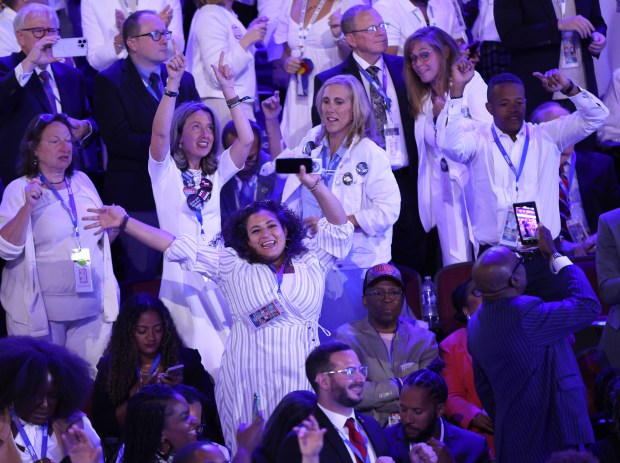
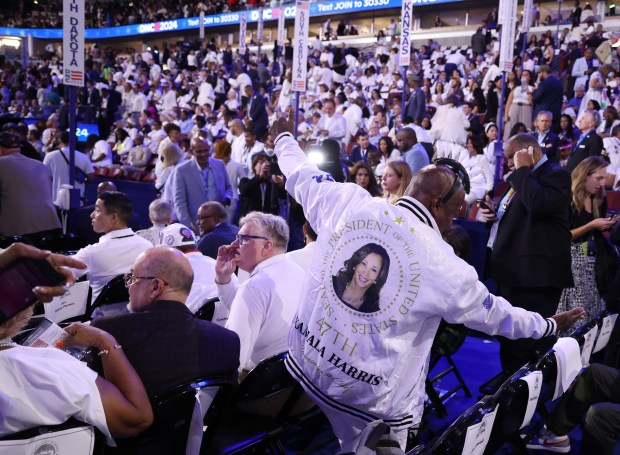
Harris was greeted with a three-minute standing ovation by thousands of delegates and political activists who crowded into the United Center, prompting officials to deny entrance to hundreds of others for safety reasons.
In a 36-minute address, Harris vowed she would aim to secure a middle-class tax cut, restore federal protections for abortion and that she would renew the effort for a bipartisan bill to deal with the nation’s porous border.
At the same time, she provided a contrast with Republican rival former President Donald Trump and warned that his return to the White House would also mean a return to a chaotic presidency but with “no guardrails.”
“In many ways, Donald Trump is an unserious man. But the consequences of putting Donald Trump back in the White House are extremely serious,” she said.
“Consider not only the chaos and calamity when he was in office, but also the gravity of what has happened since he lost the election,” she said.
She noted the deadly Jan. 6, 2021 riot at the U.S. Capitol and his promise to pardon those convicted in the insurrection, his vow to imprison those he views as political enemies, as well as his conviction on felony business fraud charges in New York and a finding by another New York jury that he was liable for sexual abuse.
Trump, she said, would use “the immense powers of the presidency of the United States, not to improve your life, not strengthen our national security, but to serve the only client he has ever had: himself.”
“America,” she said, “we are not going back.”

“I see a nation that is ready to move forward, ready for the next step,” Harris said. “In America, where we hold fast to the fearless belief that built our nation and inspired the world, that here in this country that anything is possible, that nothing is out of reach.”
Harris also said she and President Joe Biden were continuing to work to find an end to Israel’s war on Hamas that has led to the deaths of more than 40,000 Palestinians in Gaza. Such a ceasefire plan would ensure “Israel is secure, the hostages are released, the suffering in Gaza ends, and the Palestinian people can realize their right to dignity, security, freedom and self determination.”
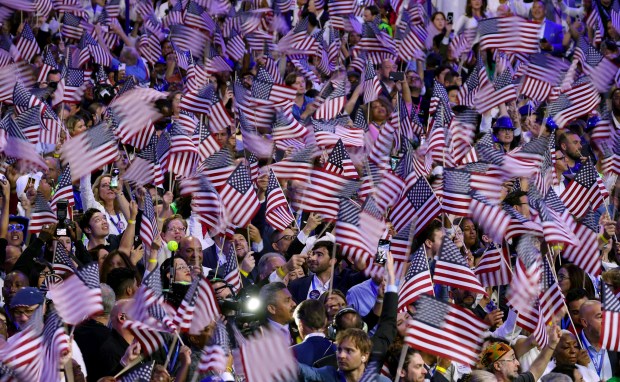
Pro-Palestinian supporters protesting against U.S. military support for Israel provided the only discordant note to a convention that focused on unity and found Democrats pushing a strong flag-waving patriotic picture.
“Our opponents are out there every day denigrating America, talking about how terrible everything is,” said Harris, 59.
“America, let us show each other and the world who we are and what we stand for: freedom, opportunity, compassion, dignity, fairness and endless possibility,” she said.
Harris’ speech occurred on her 10th wedding anniversary to first gentleman Doug Emhoff, who joined he in the United Center.

While Harris spoke at the United Center, several thousand people gathered three miles away at Soldier Field’s southern end for a free watch party on the stadium’s jumbotron.
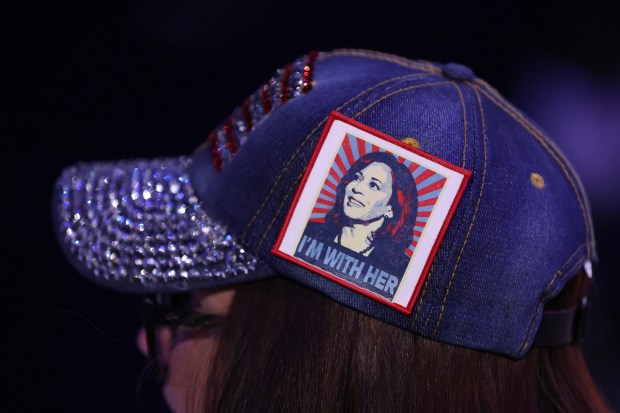
Attendees — some sporting campaign buttons and holding signs — immediately rose when Harris appeared on the screen. Numerous were teary eyed. Some held their hands to their hearts. And many stayed on their feet for more than 30 minutes as she spoke.
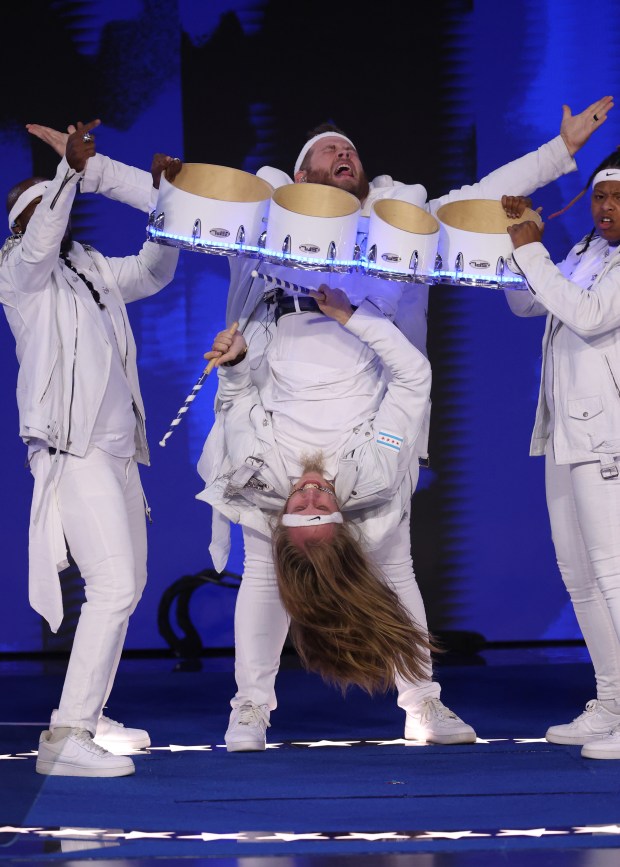
Harris’ speech brought to a close the every-four-year political spectacle — filled with energetic exuberance from thousands of delegates while calming the angst of many Chicagoans who had looked to the event with uncertainty.
In the end, party officials expressed happiness with how the convention was pulled off after they had to make a rapid change in programming to reflect Harris as the nominee. And fears of much hyped, large scale violent protests went unrealized and instead were limited to smaller physical confrontations with Chicago police.
Harris’ speech also formally launched the fall presidential campaign and a rapid sprint to the Nov. 5 general election. It also capped a quick and seemingly improbable turn of political events that propelled her into the spotlight.
Her acceptance speech comes just 56 days after the 81-year-old Biden’s halting and stumbling performance in a debate against the 78-year-old Trump forced the president into a defensive posture amid warnings from party leaders that both his reelection chances and those of Democrats’ down the ballot were in jeopardy.
And it was only 32 days ago when Biden announced his surprise decision to drop out of the race and endorse Harris as his successor for the nomination. Democrats moved with alacrity to embrace her as the new candidate as well as her choice for running mate, Minnesota Gov. Tim Walz.

Now, the former district attorney from San Francisco, attorney general of California and U.S. senator who joined Biden on the Democratic ticket four years ago is in a historic position as the first Black and South Asian American female to become a major political party’s nominee — offering voters a new and younger choice in a race that had been destined to become a contest between the two oldest men to ever seek the presidency.
Biden and First Lady Jill Biden called Harris before she arrived at the United Center to wish her luck, the White House said.
As Democratic Party delegates awaited her convention closing night acceptance address, they and party activists also tackled how to transform an enthusiastic week of speeches, parties and pep rallies in Chicago into successful sales pitches for voters at home to win in November.
Vickie Vogel, 76, of Austin, Texas — a capital city referred to as the “blueberry in the apple pie” in reference to it being a Democratic enclave in a traditionally Republican state — said she knows the drill: knocking on doors and organizing phone banks as she has always done.
“It’s very hot in Texas right now, so we’re going to have to suck it up,” Vogel said of her voter outreach plans when she returns home.
“We’ve just got so much rural area. It’s hard to door knock in rural areas. I’ve done it. Spread out on a half acre, you walk a long ways and not see many people,” she said. “But you’ve got to have that personal contact. You do what needs to be done.”
Speaking to the New Hampshire delegation Thursday morning in a small, tightly packed ballroom, Gov. JB Pritzker acknowledged the jubilant feelings inside the United Center but offered a caveat.

“This is not going to be easy. It’s a lot of fun over at the United Center, and we feel the momentum of it all, but it’s going to take a lot of work. Seventy-five days. Seventy-five days, not too many,” he said.
Later, speaking to the Nevada delegation, Pritzker likened the sprint to the Nov. 5 general election to European snap elections.
“When we get back, I know we’re all going to work, but then when you’ve got free time at night, on the weekends, we have to pick up the phone and make phone calls. We have to knock on doors. We’ve got to make sure people get out to vote,” he said. “We have to make sure they know that this is the most important election of our lifetime.”
State Rep. La Shawn Ford of Chicago compared the convention to “a charging station for your vehicle.”
“You have delegates from across the country here and they are getting charged up to go to work,” Ford said.
“Our job isn’t done when a convention is over. Our job continues until we get Kamala and Walz elected,” he said. “I think you just tell the truth and you tell people what’s at stake and when they find out the truth and get the Democrats’ message out, not only will Democrats vote for a Kamala and Walz ticket, independents and Republicans will vote for the Kamala Harris-Walz ticket.”
Former Illinois state Sen. Jacqueline Collins of Chicago said she thinks the message for departing delegates has been clear.
“Even though, through all the euphoria, the enthusiasm, many of the speakers are framing the work ahead. They’re saying that it is an uphill battle. And what that means is action. Action must follow. And let’s do what is necessary. Knock on doors. When we’re standing in line in the grocery stores, talking to our neighbors, picking up a phone,” Collins said.

“I think we’ve got the message that going forward, the work still yet needs to be done. And it is going to be an uphill battle. She is the underdog. We can’t be swayed by any distractions,” she said. “We know that the attacks are going to come as well. We need to be prepared for that. We need to quell any rumors that we might have. And for those young adults that are on social media, they have a role to play as well.”
Collins said Democrats learned a lesson from Hillary Clinton’s loss to Trump in 2016 — something former President Bill Clinton mentioned in his Wednesday night address.
“He said (there was) enthusiasm as well. And the polls were very good for her. But the work was not done on the ground, right? So, I think that’s what needs to be done. Again, I think everybody’s going to pull on that theme and challenge us to pick up the charge,” she said.
“Don’t be persuaded by the polls or the enthusiasm. Work has to be done. And the success comes from the ground troops.” she said.

State Rep. Eva-Dina Delgado of Chicago said sitting with her Illinois delegation colleagues on the floor of the United Center has been a “very infectious thing.”
“I’m in awe of all of the people who I’ve seen on the stage but also the people who I’ve got a chance to meet here during this process,” she said. “And so, it just gives you that extra push when you go back into the neighborhoods and you’re out knocking on doors or you’re out talking to people.”
Delgado acknowledged, “I’m going to come out of here sleep-deprived but reinvigorated to go out there and deliver the message — not only of Kamala Harris and Tim Walz but also of all of the Democrats that are running for office within the state of Illinois.”
U.S. Rep. Sean Casten of Downers Grove said he doesn’t need to replicate the convention’s enthusiasm for the newly minted ticket to his voters. He said it already exists outside the United Center.
“There’s just this amazing enthusiasm and folks who have wanted to come here and folks who are leaving here energized,” Casten said.
“I’ve gotten more and more requests from constituents back home saying, ‘I’m kind of feeling some FOMO right now. Is there any way you can get me into some of (these) parties? Can I go and be a part of this?’” he said, using slang for fear of missing out. “And there’s this wonderful momentum right now where the more that Harris feels, I don’t want to say inevitable, but likely and transformative and history-making, and something of joy, the more you have people saying, ‘I want to be able to tell my kids that I was there and I played a role and I participated.’”
Veteran U.S. Rep. Danny Davis of Chicago said that with Illinois’ traditional blue-state background in presidential elections, he’s shifting focus to the swing state of Wisconsin as he has done in the past.
“I’m trying to get my people to go to Milwaukee,” Davis said. “We go up on a Saturday morning, get there about 10, 11 o’clock, knock on doors until 4 or 5, get back on the bus. We’ve got at least two busloads lined up now ready to go.”
State Sen. Adriane Johnson of Buffalo Grove said she thinks ultimately that the convention message to sell about the Harris-Walz ticket is a simple one.
“Well, you know what? I feel like throughout this convention, we have resurrected hope,” she said. “And so just letting people know that we have incessant hope at this point, lots of joy.”
Tribune reporter Karina Atkins contributed.