Incumbent Elmhurst Mayor Scott Levin appeared to defeat challenger Mark Mulliner by a wide margin, taking 6,436 votes, or 71% of the 9,000 votes cast, according to unofficial results from April 1 voting.
Mulliner, the city’s longest serving alderman before leaving the City Council two years ago, drew an unofficial tally of 2,625 votes, or 29%.
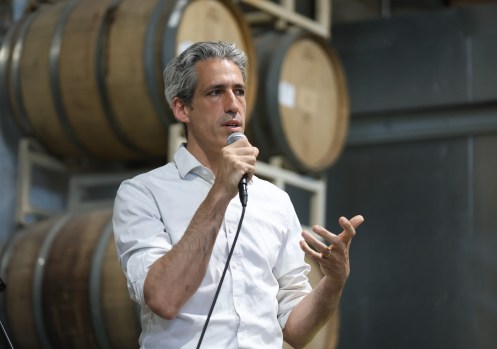
As his victory became apparent, Levin spoke about the factors behind his win at a local gathering with friends and supporters at Golden Boy Barbecue, 551 S York St. in Elmhurst.
“I’ve proven through my track record that I’m the right person to be mayor,” Levin said. “I also think it was a bit disingenuous (for Mulliner) to campaign saying you’re going to lower the water rates and reduce taxes. We’ve been very good stewards of tax dollars and we’ve only raised taxes infrequently when necessary.
“I stood behind what I believe in which is that we need a new police station and we can afford it and I’ve tried to run a campaign and run to serve as mayor by working for all the people in Elmhurst.”
Levin, finishing his first term after serving as 5th Ward alderman for more than a decade, said it was always his intention to run again.
“As a City Council, we’ve accomplished a lot and I’d like to keep things going,” he said in an earlier conversation with Pioneer. “Things are going pretty well – I’d like to keep on the track that we’re on right now.”
Mulliner, who was on the City Council for 24 years before losing a bid for reelection in the 7th Ward two years ago, focused his campaign on reducing costs for taxpayers and putting off major projects, including replacing the city’s aging and undersized police station and renovating the Elmhurst Metra station.
For Levin, the case for a new police station is clear.
“We started looking at this in 2018,” Levin said recently. “Anyone who’s looked at it has concluded it would be penny-wise and pound-foolish to look at remodeling (the present station.)”
Regarding proposed substantial upgrades to the city’s Metra station, Levin said during a January candidates forum the city had already secured grants for $35 million toward the expected $47 million cost for the project, with officials continuing to seek additional grant funding.
For the future, Levin said the city is working on revising its downtown plan, looking at downtown zoning and undertaking a housing study to look at options for affordable senior housing to help older residents.
Levin previously defended increases in city water bills, pointing out that the city water system is what’s called an enterprise fund, with water rates set to cover costs of the basic commodity, which comes from Lake Michigan through both the city of Chicago and the DuPage Water Commission. Rates are also set to cover costs of infrastructure, including treatment facilities, meeting state and federal mandates and funding reserves for such expenses as water main replacements.
“We charge what it costs to run it,” he said. “We’re planning for the future.”
Levin, like Mulliner, favored tax increment financing support for infrastructure for the proposed downtown redevelopment around the corner of First Street and Addison Avenue that would also be home for the nascent Elmhurst Center for the Performing Arts.
Levin has pointed out that city taxes are only about seven percent of property tax bills, with about 75% coming from Elmhurst School District 205. Levin said in the candidate forum that the only city property tax increases in the last 15 years have been to meet state-mandated increases in contributions to police and fire pensions.
“We are in good shape,” Levin told Pioneer in March. “Our finances are excellent.”
Voters agreed, it seems.
Graydon Megan is a freelance reporter for Pioneer Press.