But as state lawmakers negotiate the first state operating budget since the prison was shuttered, Gov. JB Pritzker’s administration is proposing that Stateville receive nearly as much funding as when the maximum security section of the facility was open.
The governor’s proposed operating budget for Stateville in the upcoming year is $148 million. That’s down from $159 million budgeted in the current fiscal year — and less than $150 million is expected to be actually spent — but more than the facility’s $146 million budget two years ago, when the maximum security prison was operational for the entire year.
Officials said the reason the proposed funding is in the same ballpark as recent Stateville budgets is in part because of the increased population of the two remaining facilities on the Joliet-area campus, a reception and classification center and a minimum security unit.
Illinois Department of Corrections spokesperson Naomi Puzzello said that as of May 14, more than 1,400 people were housed at the two Stateville facilities that remain open. At this time last year the population of Stateville, which still included 430 people in the maximum security prison, was about 1,550, Puzzello said.
The population of the Northern Reception Center, or NRC, which has a capacity of 1,900 and houses people coming from county jails and court in northern Illinois before they’re sent to another IDOC facility, fluctuates widely, Puzzello said.
All facilities on Stateville’s campus remain under one line item in the current budget. Before the maximum security facility was closed, the John Howard Association pushed for that facility and NRC to be separated in budgets and other reports, said Jennifer Vollen-Katz, executive director at the prison watchdog John Howard Association. Without that separation, and given the population fluctuations at NRC, it’s hard to know whether the budget allocation is justified, she said.
“By grouping them all together, it’s much harder to understand what’s going on administratively in each of the buildings,” she said.
Asked about the Stateville budget, Democratic state Sen. Rachel Ventura, whose district includes Stateville, said IDOC “reallocated staff to fully support” the NRC, which is part of the reason funding is at relatively the same level.
“With Stateville empty and the NRC now fully staffed, we can focus on rebuilding Stateville into a state-of-the-art facility centered on rehabilitation,” Ventura, who has pushed for better quality of life at Stateville, said in a text message. “Investing in better living conditions and meaningful programming is essential to reducing recidivism and improving outcomes.”
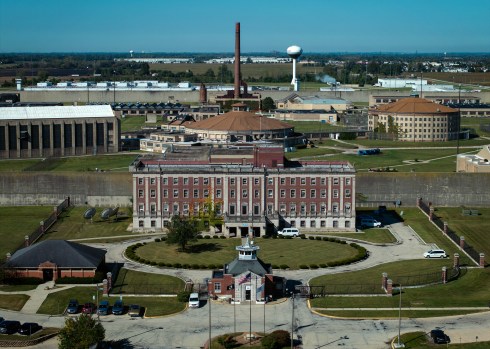
A birds eye view of the Illinois penitentiary at Stateville shows the circular roundhouses on Oct. 1, 1934. (Max Kolin/for the Chicago Tribune)
Warden John L. Whitman, Supt. Green and Supt. of Construction Yardley, as they inspect the new Stateville Prison in Joliet, Illinois, circa 1924. (Chicago Tribune historical photo)
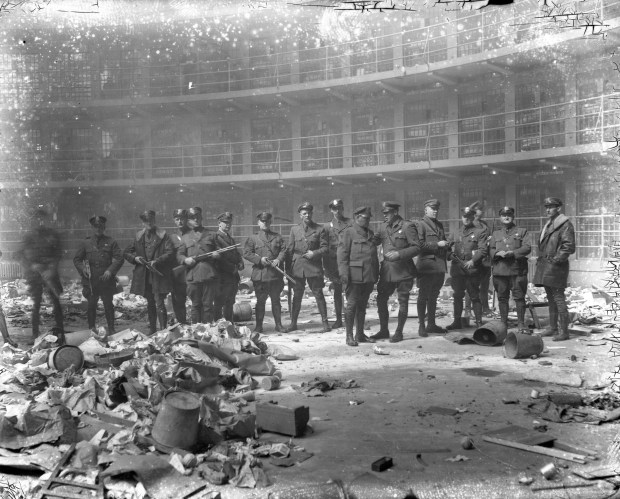
State highway police officers help restore order in the circular cell blocks at Stateville Prison after 1,500 convicts rioted, lighting several buildings on fire, on March 18, 1931. Three convicts were shot during the rioting, one of them was gravely wounded with a bullet to the abdomen. (Chicago Herald and Examiner)
National Guardsmen restore order in the circular cell blocks at Stateville Prison after 1,500 convicts rioted, lighting several buildings on fire, on March 18, 1931. Three convicts were shot during the rioting, one of them was gravely wounded with a bullet to the abdomen.(Chicago American)
Warden John L. Whitman, Supt. Green and Supt. of Construction Yardley, as they inspect the new Stateville prison in Joliet, Illinois, circa 1924. (Chicago Tribune historical photo)
The rioting started in the furniture factory when it was set on fire by prisoners and equipment was demolished in the Stateville Prison Riot on March 18, 1931. (Chicago Herald and Examiner)
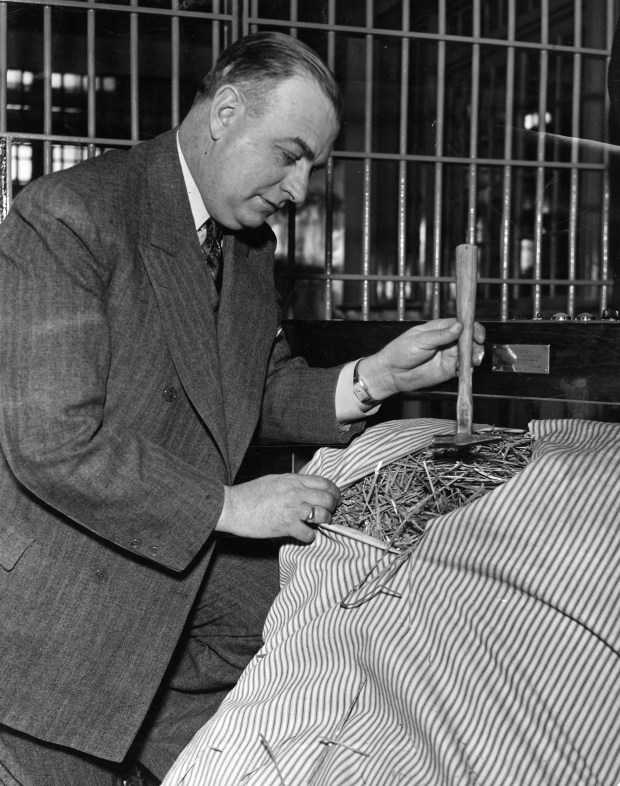
Warden Joseph Ragen shows how a hammer can be hidden in a mattress at Stateville Prison on Jan. 3, 1937. (Chicago Herald and Examiner)
A.M. Stash, a guard at Stateville, left, watches as a convict wipes down the electric chair on Jan. 3, 1947. The chair was transferred from the old prison in Joliet to the segregation building recently completed at Stateville. A heavy window separates it from the witness room in the foreground. (Ray Gora/Chicago Tribune)
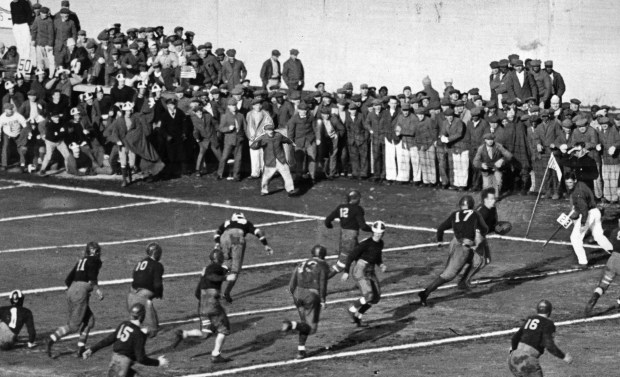
When the embattled Stateville football team took the field, the convicts, led by the diminutive cheerleader in the foreground, cheered mightily. This picture was taken just as one of the prison backs rounded the end for a good gain over the Cabery, Illinois team, circa 1932. The score was 0 to 0. (Chicago American)
Stateville prison guard Fred Dunn, H.P. Harrigan, Warden T.P. McCue, Warden Joseph Ragen and Capt. Joseph Dort (of guards) demonstrate the electric eye on a mattress on Jan. 3, 1937. (Chicago Herald and Examiner)
A photo diagram shows how Stateville Guard John Albert frustrated an over the wall escape attempt at Stateville Penitentiary, circa 1944. Desperate convicts from the Roger Touhy gang drove a truck to the wall, put up a ladder, but fled under a hail of bullets from Albert’s gun. One shot killed a fellow guard and wounded three convicts. (Chicago Herald-American)
Warden Joseph E. Ragen, left, and A.M. Stash, a guard at Stateville, examine an electric chair on Jan. 3, 1947, that was transferred from the old prison in Joliet to the segregation building recently completed at Stateville. The room in the background is for witnesses and is separated from the chair by heavy glass. (Ray Gora/Chicago Tribune)
Jack Epstein and Frank Harrison get socks ready for shipment at Stateville penitentiary on Jan. 11, 1946. (Jack Lembeck/Chicago Herald-American)
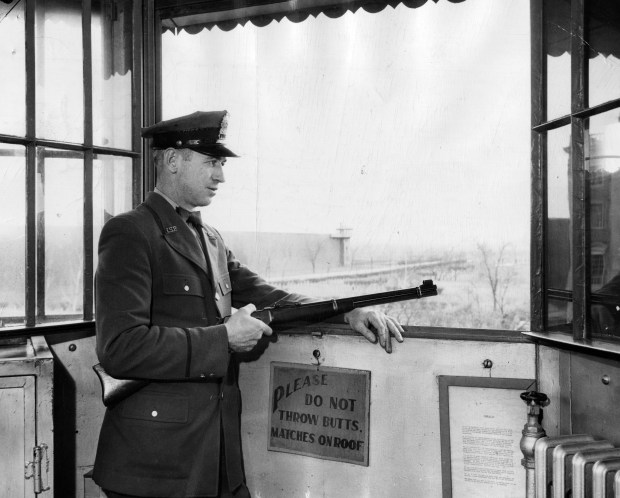
Stateville prison guard John Lahey keeps his eyes peeled from the tower window on April 10, 1950. (Arnold Tolchin/Chicago Herald-American)
A Stateville Penitentiary guard frisks an inmate on April 11, 1950. (Chicago Tribune historical photo)
Stateville prison guards Robert Grisham and Wayne Koepke shake down one of the cells in search for contraband on April 10, 1950. (Arnold Tolchin/Chicago Tribune)
Prisoners at Stateville work in line to shear the well kept lawn within the prison walls on June 29, 1955. The flower beds are also the work of the prisoners. (Dante Mascione/Chicago Tribune)
Varied diversions are available to inmates after they are locked in their cells for the night on April 10, 1950. They may listen to head-phone radios, read, play cards or chess, write letters, smoke or loaf until lights out at 9pm. (Arnold Tolchin/Chicago Herald-American)
Lt. H.W. McKnight checks a machine gun in the prison arsenal at Stateville on April 10, 1950. (Arnold Tolchin/Chicago Herald-American)
State Criminologist Dr. Roy G. Barrick, with other members of the state division of criminology, Wilson L. Newman, psychologist, Wilson M. Meeks of the parole board and Norman E. Kasch, sociologist, talk to an inmate on April 11, 1950, at Stateville Prison. (Arnold Tolchin/Chicago Herald-American)
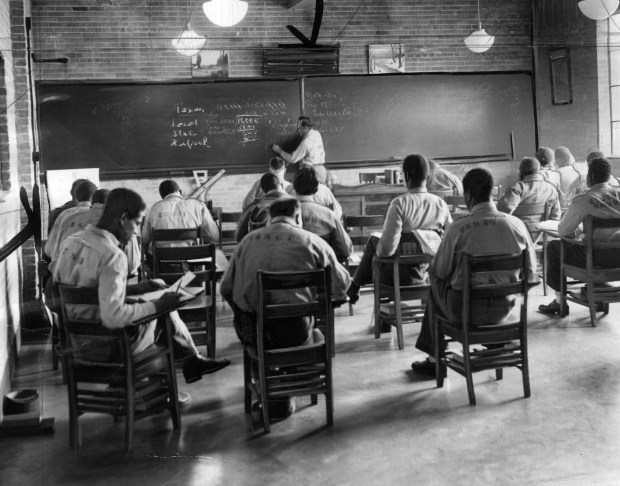
For many inmates at Stateville prison it’s the first first formal schooling they’ve encountered. In this photo, an eighth grade class is taught in April 1950. The teacher is an inmate. Vocational schools, as well as elementary, are open to prisoners and many acquire skills that help them find a place in society when they leave Stateville. (Arnold Tolchin/Chicago Herald-American)
Roger Touhy, 61, talks to reporter Mervin Block, right, about finally getting paroled while Warden Joseph Ragen, center, listens at Stateville Prison on Nov. 13, 1959. Touhy's attorneys convinced an appeals court that he'd been framed, and he was released in 1959. About three weeks after his release, he was murdered by mob hit men. (Chicago Tribune historical photo)
The malaria research ward in the infirmary of Stateville prison where many of the inmates have volunteered to be infected by a mosquito infected with malaria for research purposes on June 1, 1967. (Joe Mastruzzo/Chicago’s American)
1 of 23
A birds eye view of the Illinois penitentiary at Stateville shows the circular roundhouses on Oct. 1, 1934. (Max Kolin/for the Chicago Tribune)
Still, the increase in population at the NRC raises questions that “should better be explained” by IDOC, said state Sen. Terri Bryant of Murphysboro, a Republican who worked at the department for 20 years.
This year’s state budget is being put together amid Pritzker’s $900 million, yearslong plan to demolish Stateville and Logan women’s prison in downstate Lincoln and and replace them with new prisons on Stateville’s campus.
The state Capital Development Board in April named as construction managers a joint venture between Vanir, a California-based firm, and Chicago-based firm Milhouse. Vanir has recently provided its construction management services to San Quentin prison in California — a facility even older than Stateville.
The lawsuit over Stateville’s conditions that led to the prison being emptied before a deadline last September was settled last month.
The Stateville budget request reflects a $10.6 million reduction for salaries and the state’s contributions to Social Security, but a $100,000 increase for “commodities, reflecting rising costs for food, clothing and household items,” Puzzello said.
The bulk of Stateville’s budget each year goes to staff, contributions to Social Security and contracts, which could include health care and education.
The staff headcount at Stateville is projected to decrease by 10, to 872, in the coming year, according to the governor’s budget proposal. Much of the staff that previously worked at the maximum security facility has been transferred to the NRC.
James Soto, a former inmate at Stateville Correctional Center, addresses the state Commission on Government Forecasting and Accountability during a hearing on the proposed closure of Stateville Correctional Center and a multiyear rebuild, at the Clarion Hotel and Conference Center on June 11, 2024, in Joliet. (John J. Kim/Chicago Tribune)
James Soto, who was wrongfully incarcerated for 42 years and now advocates against building new prisons, including the rebuilding of Stateville, said he would expect the budget to be reduced by more than the governor’s proposal suggests.
“It should be far less, because you have no — zero — amount of people behind that wall. I don’t get it,” Soto said of the facility’s proposed budget. “It begs the question of, what are we doing here?”