


ST. LOUIS — There was no warning siren, only the sudden sound of what seemed at first like a locomotive speeding through her neighborhood a mile off Route 66.
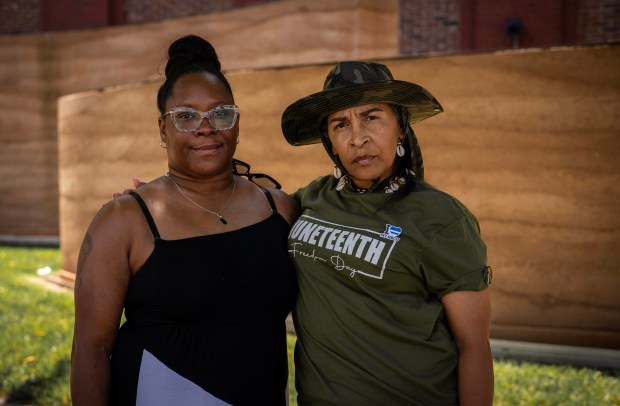
Lea Davis heard trees snapping. Glass shattering. The front door to her 122-year-old two-flat slammed open and shut. Open and shut. She thought to grab her partner, Reginald, who is blind, and run to the basement, but figured they might not make it in time. They could take shelter in the closet, she thought, or the bathtub.
“You didn’t have much time to think,” Davis, 55 remembered of that May 16 afternoon. “The only thing I could say was: Jesus, please save us. Please help us.”

Three minutes later, the rising cacophony silenced. Davis walked to the front door to survey the remains of her Fountain Park neighborhood.
“As you can see, that’s not very far away,” Davis said on a recent Thursday in June, pointing to a nearby pile of bricks that once formed the steeple at Centennial Christian Church, where her friend, 74-year-old Patricia Penelton, took her last breaths.
“It could have been us. Any of us.”
The EF3 tornado that tore through Davis’ neighborhood, its winds topping 150 miles per hour, cut a 23-mile path northeast across St. Louis and into southern Illinois. Five people in St. Louis were killed. Dozens more were injured. Thousands of buildings were destroyed or damaged.
A month later, the extent of damage and slow pace of recovery have once again put a spotlight on this city’s long-standing racial and socioeconomic demarcation known as the “Delmar Divide,” named for a main east-west artery called Delmar Boulevard that closely parallels a stretch of an early Route 66 alignment.
Follow our road trip: Route 66, ‘The Main Street of America,’ turns 100
South of Delmar is largely home to white residents. Neighborhoods to the north, like Fountain Park, are largely home to Black residents.
“The great Delmar Divide has been synonymous with all of the state, local (and) federal funding going to projects, plans, development, all south of Delmar Boulevard,” said north side native Cheryl Nelson, 61. “Under numerous administrations, the north side of St. Louis has been devastated.”

Nelson’s friend and co-worker, Justina Cramer, said her rental home in the O’Fallon neighborhood first sustained brick and roof damage. The initial repair estimate came in at $50,000.
While she and others waited for help from the local, state and federal government, the condition of her 109-year-old home deteriorated. Twice, she said, the blue tarp meant to protect her roof blew away in severe weather. The ensuing water damage caused portions of her ceiling to collapse. Her kitchen cabinets fell from the walls.
Two weeks after the tornado, President Donald Trump approved Missouri Gov. Mike Kehoe’s request for federal assistance, local media reported.
“Now we’re dealing with: Do FEMA or don’t do FEMA?” said Cramer, 43. “They’re not paying much.”
Cramer is staying with her daughter for the time being. Some of her neighbors, she said, are living in tents in their front yards, in part to guard their homes against thieves looking to swipe copper wiring or historic St. Louis red bricks.
“I’m going to stay rooted in St. Louis city,” she said. “Where we go from here is not a monetary value. It’s not a building. It’s a community effort and us being there for each other because St. Louis city was not there for us.”
Over in the Fountain Park neighborhood, an orange sticker on Davis’ front door marks that her home has been condemned. An electric company technician recently came and asked if she wanted the lights turned back on. But with water seeping from light switches on the wall, she knew that would likely start an electrical fire.
Davis and her partner moved in with her son, for now. A man who lived in her building set up a tent on the front lawn. She wants to apply for Federal Emergency Management Agency relief funds but needs to replace her identification card, which was lost in the storm. And to do that, she needs a copy of her birth certificate.
“I don’t know how we come back from this one,” she said.

Across the street sits the neighborhood’s namesake park, with its fountain and an empty granite pedestal where a bronze statue of Martin Luther King Jr. — reportedly the only King statue in the state — was felled by the storm.
The day of the tornado, members of the Party for Socialism and Liberation’s St. Louis chapter came out to help with cleanup. Other nonprofit groups soon joined and have had a daily presence in the park ever since. They’ve provided food, water, ice, clothing, basic medical care, art therapy, acupuncture.
Their effort has been renamed the 314 Oasis. On that Thursday in June, Dr. LJ Punch and another volunteer filled small vials with lavender oil — aroma therapy for care kits. Nearby, a man sat in a chair under a tent providing much-needed shade from the summer sun.
About a month before the tornado, Punch’s nonprofit, Power4STL, learned it lost a roughly $1 million federal Department of Justice grant as part of the Trump administration’s federal funding cuts.
The 314 Oasis effort is currently without funding, he said.
“This is a moment of faith, to figure this out,” Punch said. “I just don’t think you can do this and then stop.”
Recently, representatives from FEMA reached out to Punch, he said, and asked if they could use one of 314 Oasis’ tents to help connect neighborhood residents to aid.
“When FEMA wants to borrow one of your tents, you say ‘yes’ because you want them here,” he said, pausing to let the irony of the moment sink in.
Read the twelfth dispatch, The last (or first) 300 miles in Illinois, here >>>