Sitting in the packed and tense cafeteria at George Westinghouse College Prep School in Humboldt Park, Marquis Griffin did not envision himself having to be at the school on a Tuesday night in July, his children in tow and anxious to run around.
But a lot is at stake for Griffin, his two sons and their mother if Chicago Public Schools fails to minimize its $734 million budget deficit. His boys, Marquis Jr., 7, and Myles, 5, who live with autism, risk losing the services the district provides for students with disabilities, including the specialized aides who may not be there come fall. The boys’ mother, DeAndrea Davis, is a special education classroom assistant, or SECA, who has seen her colleagues recently lose their jobs.
Griffin, Davis and their sons attended one of several forums CPS hosted at high schools around the city in recent weeks to hear stakeholders’ ideas on how to solve the deficit. The district must have a balanced budget by Aug. 28 — 11 days after the school year begins — and CPS officials have proposed options such as borrowing one-time loans and further reducing school programs or staffing.
Reductions of nearly 2,000 educators and staff members in the past month have already affected Griffin’s life. While his sons do not communicate in the same way most people do, they are happy and developing, Griffin said, something he partially attributes to the district’s specialized programs and educators.
CPS blames the shortfall on several factors, including historic pension obligations, increasing costs of maintaining CPS buildings, and the rising needs for required services for students with disabilities. To minimize the budget gap, the district is now weighing decisions that have the potential to shift the trajectory of student education across the district for years to come.
At the forum, community members shared their concerns and suggestions, including closing neighborhood schools with reduced student enrollment or cutting potentially unnecessary administrative positions.
The Chicago Teachers Union also advocated heavily for the state legislature and Gov. JB Pritzker to allocate more funding to CPS, an option that would require a special session. Pritzker said Wednesday at a news conference that he can’t say definitively if a session would happen and that the state cannot “backfill” funding lost by the federal government.
However, the majority of people called for no cuts in staffing and programs and for CPS not to take out any additional loans.
Participants also called for solutions beyond just taking out a loan or reducing resources. One participant told the crowd that people need to “embrace 21st-century solutions for this 21st-century problem,” and focus on getting city and state government officials to work with CPS to bring in more revenue.
Other community members advocated against what has become an albatross for the city and the district — how to pay for the additional $175 million in nonteacher pensions that the city has paid and now wants CPS to repay. This payment has been a source of friction between the city and the district for more than a year, leading to the firing of former CPS CEO Pedro Martinez. He was replaced by interim CEO Macquline King, a longtime CPS principal and a former senior education adviser to Mayor Brandon Johnson.


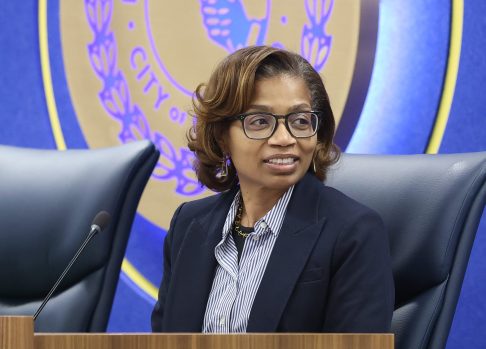
King chimed in at the meeting after tensions flared over solutions. King, who has helmed the district for just over one month, promised to be available for feedback while also urging the people who were present to work together.
“If this is how we represent children, I am concerned,” she said. “I brought this conversation to the community because as a parent, as a teacher, as a principal, as a citizen of Chicago, I felt we needed a voice. I know that different people have different opinions, perspectives and platforms, but you are here tonight to help provide insight and guidance.”
King added that while she is aware of a history of perceived shortcomings by CPS, she wants to work with the community collectively to solve the deficit problem.
“I’m trusting you to come to this table with support,” King said. “I can’t do it alone. What can we do and agree upon for our children? What do we have for the children? This is what’s happening inside, what do we expect on the outside?”
With the budget deadline creeping closer, attendees in the Westinghouse cafeteria questioned why the meetings with community members are happening now instead of months or years ago.
Griffin echoed the widespread sentiment and frustration from parents and community members at the meeting that the budget deficit is a repetitive problem that seems to have no permanent solution.
“We can talk about numbers, budget, this, dollars, dollars, dollars, numbers, numbers, numbers, numbers,” Griffin said. “Numbers (are) not going to matter when these kids not even really going to get no type of future, brother.”
The district has more than $9 billion of existing long-term debt requiring over $800 million in annual debt service payments, according to a CPS budget presentation. And without additional revenue or cuts to balance this year’s budget, the deficit will balloon to $1.3 billion by 2030, according to budget documents obtained by the Tribune.
With the rising need for services for students with disabilities cited as a driver of the shortfall, some community members said it seemed contradictory given the recent layoffs of paraeducators like special education classroom assistants.

Speaking on behalf of her collective table, former CPS special education paraeducator Nikebia Brown-Joseph said the district should explain the deficit in a way that does not make any group seem expendable or worth cutting.
“All of our students and all of our staff deserve to be fully funded, especially our students who do need extra services,” she said. “Our students who are in temporary living situations, our students who need English learning services, our students who have disabilities and all of our students deserve after school programming, because small cuts to those things today do result in big problems for our students tomorrow.”
CPS is not taking into account the concerns of special education students as it tries to balance the budget, according to Sharina Ware, a CPS special education case manager.
“We have so much wasteful spending at the middle management level, and we’re not looking at those positions that are redundant and not really having an impact on our school community like our paraprofessionals who just had basically a massacre,” Ware said.
For Davis, the mother of Marquis Jr. and Myles, the cuts to special education are personal, professional and financial. She’s worked as a special education classroom assistant for nine years. “Honestly, no cuts are going to be good cuts,” she said.
While his sons enjoy their summer, playing outside with bubble machines and basketballs, Griffin worries for their futures. Myles and Marquis Jr. are unaware that budget cuts could impact their classrooms in the fall.
“It just hit home even more that I happen to be parents of two kids with special needs, Griffin said. So it’s like: All right, guys, figure this budget crisis out, but don’t take from them.”