
Discussion about the lack of affordable housing often leads to pleas for allowing a smaller second house to be built on the same lot. Although Valparaiso already allows these accessory dwelling units in parts of the city, they’re not being built.
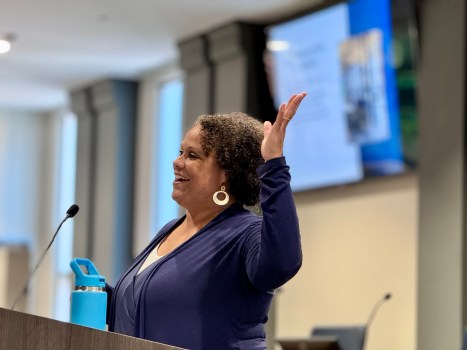
“Density by design is not only beautiful, but it’s also affordable,” Housing Resource Hub founder and CEO Heather Presley-Cowen said at Tuesday night’s housing symposium at Valparaiso City Hall. These accessory dwelling units allow parents to live near adult children but in a separate home.
“We’ve had these options since 2009, but they’re not being taken,” said Jennifer Gage, senior planner in the city’s planning department.
New subdivisions typically are zoned to allow these ADUs to be built, she said, but developers aren’t taking advantage of them.
“There’s a space for it, but nobody’s taking it up,” Planning Director Bob Thompson said.
“The idea is that you set the expectation when you are designing the development that you or your neighbors have the availability,” Gage said. “It’s not all zoning, zoning, zoning.”
“An ADU could look like a carriage house. It could look like a house from ‘Happy Days’,” Presley-Cowen said.
It’s designed to be small, typically a single bedroom, living room and a small kitchen, typically 20% of the size of the larger home on the lot, Gage said.
Councilwoman Barbara Domer stayed in one of these recently while visiting family in Nashville, Tennessee. It was a converted garage with a large bedroom and small kitchen, she said. Access to the ADU was from the alley behind the houses.
“Why couldn’t we move the fence line to allow for one car to be used in that ADU,” Domer asked.
“That absolutely, that alleyway, that’s exactly what we’ll be looking at for sure,” Gage said.
But converting a garage isn’t as easy as it might seem, she noted. Most garages are not built to be inhabitable. Many aren’t built with freeze/thaw consideration for foundation. Many aren’t suitable for adding a second story, either. “There’s considerable work involved.” Public safety has to be considered as well as rushing to provide a related living space.
Thompson addressed the issue of potentially adding ADU options for historic downtown neighborhoods. “We need to be careful how it’s done” so downtown’s character isn’t negatively affected, he said.
Among the considerations is parking. So many places downtown, parking on the street for more than three hours can earn a parking ticket. Even where that’s not the case, the available parking is already taken up by most of the residents. “Great idea, but it’s really going to have to be looked at and examined,” Thompson said.
“What we have is a vision and then compliance,” Presley-Cowen said. “That’s exactly the kind of stuff you do.”
“It’s a whole education is what I’m saying. It’s a whole program,” she said.
ADUs are allowed in Valparaiso’s general residential zones but not in a neighborhood conservancy zone.
Like many communities, Valparaiso is facing a shortage of housing — not just affordable housing, but housing across all income levels.
“There’s a huge gap in the middle of the market,” Councilman Robert Cotton said.
“The hardest group to serve is no doubt the middle-income worker,” making $60,000 to $150,000, he said.
Cotton cited a 2013 housing study and subsequent ones that said the housing stock for the local service industry — teachers, firefighters, police officers and people in that income segment — was relatively stagnant. “If it was relatively stagnant then, it’s dead today,” he said.
Builders are generally erecting expensive homes because the profit is greater at that end of the market.
Valparaiso Community Housing Partners, the ad-hoc committee Cotton is helping lead, aims to create a nonprofit agency to help Valparaiso encourage builders to address that “missing middle.”
“The city doesn’t build any houses,” he emphasized. “We’re not doing anything that’s wild or off the beaten path.”
Filling the gap in the continuum of price points will encourage people who can afford a bigger home to move on up, freeing up less expensive homes for others, Presley-Cowen said.
Encouraging infill development is generally part of a municipality’s push to create affordable housing, but Valparaiso doesn’t have much undeveloped land, Gage said.
“We are really trying to address what has been a longstanding and unattended need,” Cotton said. “Affordable housing is not optional. It’s essential.”
“The workforce must be able to afford to live in communities where jobs are being created,” he said.
Over the last decade, home prices have risen 90%. At the same time, the housing shortage worsened. “Houston, we have a problem,” Cotton said.
“We need to build the right amount of houses, so we need to know who are those buyers and renters,” Presley-Cowen said.
Plan Commission President Matt Evans said “related living” is the keyword to use when discussing how to stimulate the appetite for ADUs. Stimulating demand then involves discussing families’ needs so builders don’t erect homes that people won’t buy.
Tuesday’s housing symposium followed one in May intended to roll up shirtsleeves to begin addressing the housing shortage.
Presley-Cowen, who is facilitating the effort, said the group ideally will identify and launch one or two projects to serve as a catalyst for future development. The most recent symposium brought together policy and finance experts, developers, Realtors and interested community members.
Doug Ross is a freelance reporter for the Post-Tribune.