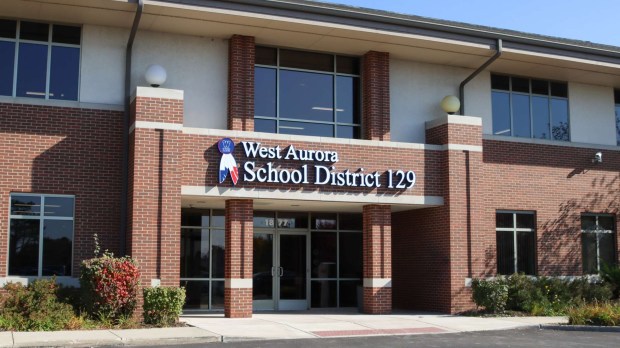

West Aurora School District 129 is looking to install more solar panels, this time at its transportation facility in North Aurora.
The school board recently authorized the district’s administration to execute documents and invest $250,000 as a “downpayment” to lock-in the availability of tax credits for a proposed solar panel canopy project at the facility.
The Federal Investment Tax Credit for solar projects has a “safe harbor” provision that permits school districts to secure tax credits by showing “continuous progress” toward the completion of a project.
The proposal is to install a canopy with solar panels at the school district’s transportation facility in North Aurora, officials said.
“By investing in equipment and design costs now, we demonstrate how the project is moving forward towards our final install in the summer of 2026,” West Aurora School District Associate Superintendent of Operations Angie Smith told The Beacon-News.
“The solar panels will help offset the cost of electricity needed for our EV buses. The EV buses already will save us operating costs versus gas buses. The solar panels will reduce that cost further,” Smith said.
However, to lock-in the availability of tax credits for solar projects, the district is facing a “compressed timeline” due to incentive changes associated with President Donald Trump’s “Big Beautiful Bill,” Smith said.
The proposed solar canopy project would provide power to the district’s EV buses. The school board last year decided to add some electric school buses to the fleet. The plan to bring in 27 electric buses to replace some older diesel models is part of the district’s ongoing efforts to be environmentally conscious and reduce energy costs, district officials said.
“In order to maximize our potential credit for the solar canopy project for next summer we need to have made a significant investment by mid-August,” Smith told The Beacon-News.
The tax credit is estimated to be more than $525,000, officials said.
It is the district’s intent to install solar panels at the transportation facility next summer. However, in order to take advantage of the safe harbor provision, the district is required to expend funds by Aug. 15, Smith said.
“I know it is a very tight timeline,” she told board members.
Part of the difficulty is that there are some different interpretations as to when certain things in the bill take effect. Specifically, do things take effect within a certain number of days after Trump signed the “Big Beautiful Bill” on July 4, or later than that.
In order to be “completely conservative and protective as possible,” consultants have recommended the district have money spent by Aug. 15, Smith said.
“For this project, the tax credits are roughly $525,000. In addition, the district would be eligible for Illinois Shines solar program tax credits that will be about $35,000 a year and a ComEd inverter rebate of about $65,000 a year,” she said.
Smith said when you add together all the credits, rebates and incentives, “this roughly $1.8 million project will cost the district about $100,000 and that’s before utility savings.”
“This is a project that will pay for itself, but we are not in our typical timeline,” she told the school board. “Typically, I come to you in the fall and say here are the projects we are going to do. Then we come back to you with bids.
“For this one, if we are going to protect the tax credit, we are asking you to give me the authority to sign paperwork necessary to execute a safe harbor plan. We will then come back to you in the fall or spring and review the normal process,” Smith said
“We’re basically spending on the front-end for design fees and some of the materials,” Smith said.
The administration will come back to the school board to discuss labor and construction-related matters for the project, she said.
“I know it’s a little bit awkward but what we are doing is protecting roughly half-of-a-million dollars,” Smith said.
The school board authorized the district expend $250,000 towards the project
The school board essentially is putting “a deposit down” to secure solar power for the transportation facility, Smith said. It basically protects the possible tax credit.
“If we didn’t do it, we run the risk that by the time we go to apply for a tax credit, it might be nothing,” she said. “The district is trying to receive the most tax credit.”
Linda Girardi is a freelance reporter for The Beacon-News.