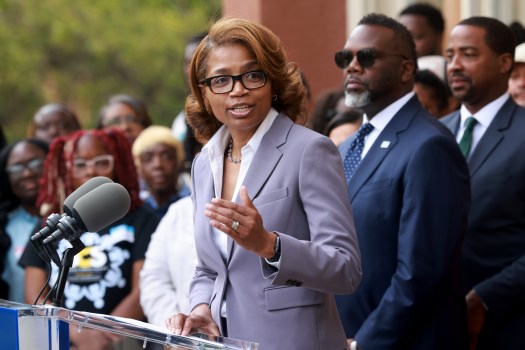


Chicago Public Schools interim chief Macquline King is resisting pressure from Mayor Brandon Johnson to make a controversial pension payment and borrow millions of dollars to settle the district’s budget, a notable twist in what has become a deeply uncertain budget cycle for the fourth-largest school district in the nation.
Several city officials met with CPS leadership last Thursday without King to lay out recommendations aimed at helping her close a $734 million deficit by the end of August, according to several board members who spoke to the Tribune.
Among their suggestions was taking out a $200 million loan and asking for new state revenue, while accepting responsibility for a controversial $175 million pension payment, previously covered by the city. King initially opposed all of their major proposals, board members who spoke to the Tribune said.
King held meetings with aldermen and state representatives Tuesday, but did not discuss budget specifics or the $175 million pension payment, according to those who attended. It’s not clear whether the district plans to avoid borrowing altogether or do a smaller amount than previously proposed.
But King’s resistance to the city’s proposals could have far-reaching consequences, not just for the district’s financial outlook, but for its political future. Johnson, a former teacher and longtime Chicago Teachers Union organizer, has strongly supported borrowing as a way to avoid deeper school-level cuts to staffing and classroom services. His appointed school board president, Sean Harden, has echoed that stance.
Critics warn the city’s proposed loan — likely a high-interest, long-term borrowing plan — could further harm CPS’ already fragile credit rating.
The school year begins Aug. 18, the first time in recent memory that the district will open classrooms without an approved budget in place. CPS must lay out a budget proposal at a school board meeting on Wednesday, with a final vote expected later this month.
CPS and King did not immediately respond to requests for comment.
At an unrelated Tuesday news conference, the mayor criticized the intense scrutiny on the loan as “the focal point for a couple of people” while taking care to avoid delving into its merits.
“No parent has ever come up to me and asked that question. Not one,” Johnson shot back when pressed about the $200 million borrowing plan. “This is about the long-term solvency and sustainability of a school district that overwhelmingly services working people, overwhelmingly brown and Black. … How much more can Black and brown people tolerate in terms of things being snatched away from them?”
Still, the mayor confirmed that “everything” was on the table when asked about the loan.

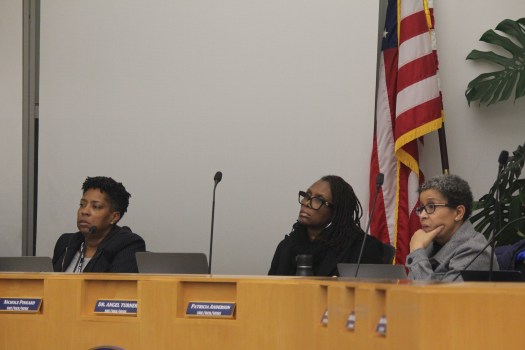
With the majority of the school board aligned with Johnson and a former city official at the district’s helm, it might seem the mayor’s budget strategy would face little resistance. But the path forward is murky. Board members, both aligned and not aligned with the mayor’s agenda, are split on how best to handle the district’s budget challenges.
For months, observers have closely watched King’s approach to tackling the district’s fiscal crisis. She stepped into the role in June following the departure of former CPS CEO Pedro Martinez, who clashed with Johnson over similar fiscal strategies during contentious contract talks with the teachers union last fall. This will be the second time that CPS leadership has taken a stand against the mayor’s borrowing requests, after the mayor’s handpicked board resigned en masse last October amid controversy about a loan.
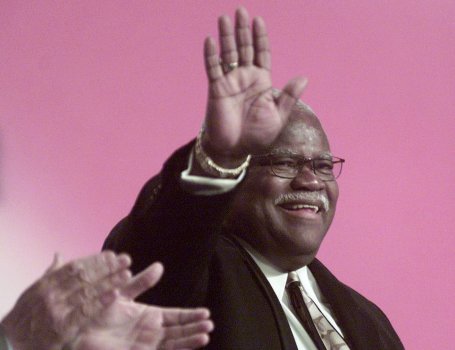
Though tensions ran high between the mayor and CPS leadership last year, Johnson struck a conciliatory tone Tuesday, calling King “certainly qualified to lead in this moment.”
The latest chapter in Chicago’s waning days of mayoral control over CPS comes after the drama over Johnson’s handling of the district dominated his second year in office and dealt him heavy political damage from opponents and progressives alike.
How the mayor chooses to navigate this incoming storm of fiscal conundrums — which he often reminds the public did not start under him — could have far-reaching impacts for his electoral future as well as the city’s and district’s financial course.
For now, tensions between the mayor and his interim chief, King, have not reached the point they were last year, when Johnson began a monthslong process to fire Martinez. Asked whether King or the future permanent CEO could go the route of Martinez, the mayor said “no.”
As Chicago’s former senior director of education policy, King was the only final candidate for interim CEO with City Hall ties — leading some to believe she might back Johnson’s CPS budget approach. The mayor still holds control over the majority of the partly elected, partly appointed school board until 2027, when it transitions to a fully elected body.
A hybrid board, disentanglement
The hybrid school board is the result of 2021 state legislation that sought to disentangle CPS finances from city finances, a prospect that has become harder to realize as board members look to aldermen to unlock funds earmarked for specific projects in special taxing districts, hoping to use the money to close a budget gap of hundreds of millions of dollars.
Currently, King is hoping to secure about $100 million more than the $300 million the district received last year from aldermanic allocations in those taxing districts, according to board members.

Another complication is the $175 million pension reimbursement to the city for nonteacher employees, which was formerly the city’s responsibility and got pushed to CPS under former Mayor Lori Lightfoot. The district is not required to make the payment by state law. It didn’t make the payment last year due to its financial constraints, and the city had to eat the costs.
In the past, aldermen — facing their own budget constraints — have threatened to reduce funding from their taxing districts to the district if the CPS didn’t step up on the pension obligation.
Following King’s inclination to push the payment back to City Hall, the mayor’s office scheduled several budget briefings with CPS, CTU and the principals’ union to meet with groups of state representatives and aldermen on Tuesday, according to an email reviewed by the Tribune. The goal of the briefings was to “facilitate a conversation about how to address the deficit and maintain the staffing our schools need.” In the email, King’s first name is misspelled.
As news of the briefings emerged, a former labor ally of Johnson’s issued a letter to aldermen and school board members accusing him of excluding the union.
“The Mayor’s office can keep us from the table, but our voice will not be silenced,” Service Employees International Union Local 73 President Dian Palmer wrote on Monday.
SEIU was invited later that night, Palmer said, adding that she spoke at Tuesday’s briefings to say she stood by her letter — and to warn the district against more borrowing.
“The rumors of loans, I’m very, very afraid of, because when they come back to be repaid, it’ll come back on the backs of low-wage earners,” Palmer told the Tribune. “I’ve taken out loans. I’m sure you have too. When you start making those payments, it’s not the $500 you borrowed. It’s $589.”
Other aldermanic sources who attended Tuesday’s briefings said city and district leaders avoided addressing borrowing or the pension payment, saying that the purpose of the meeting was to discuss savings, not budget specifics. Slides obtained by the Tribune from the briefings show that King is eyeing $126 million in cuts, mostly to the central office.
After King took over for Martinez in mid-June, CPS has already chipped away at the district’s budget gap through finding efficiencies — cutting hundreds of custodians, ending hot lunch programs, eliminating crossing guard positions and downsizing staff at the district’s central office.
Board member Ed Bannon of District 1 on the Far North Side said the state needs to step in further, pointing to research — first reported by the Sun-Times — that CPS has only 73% of the funding it needs to give students what it deems an “adequate” education.
“You don’t pay a mechanic 73% of the job, and expect your car to run,” Bannon said. “You don’t pay a roofer 73% of what they charge you, and expect your roof not to leak.”
The relationship between board members and state officials will be even more important moving forward, said Illinois Democrat Rep. Ann Williams, who helped draft the school board legislation and attended one of Tuesday’s briefings.
“Having a cohesive ask or plan would be helpful as we have those conversations,” said Williams.
For now, board members and Chicago officials remain far from having a cohesive plan. Without borrowing, King’s remaining options to address the shortfall come down to further cuts, refinancing existing debt or getting more money from the city and state. Both depend heavily on negotiations that are still taking shape.
Johnson, meanwhile, did not back away from the city’s position, maintaining that CPS is expected to handle the pension payment.
“Well, that’s certainly the expectation,” he said.