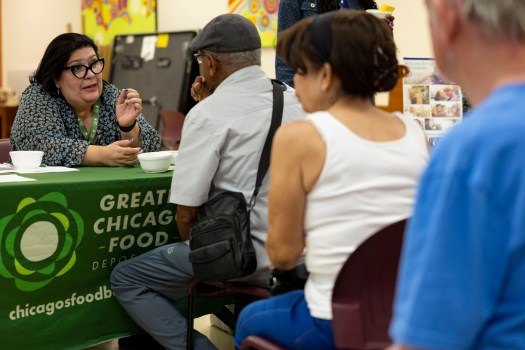

As an outreach coordinator for one of the Chicago area’s largest food banks, Joann Montes is already seeing an impact from President Donald Trump’s reductions to public assistance programs even before those cuts take effect.
Anxious older adults who for years received what were once called food stamps are approaching Montes at senior centers to ask if those benefits will continue and whether they’ll have to return to jobs “to be able to feed themselves.”
“Our folks who are 60 and older are asking questions about whether they’re going to be able to receive SNAP,” Montes, who works at the Greater Chicago Food Depository, said about the Supplemental Nutrition Assistance Program. “Will they have to go back to work?”
A little more than a month after Trump signed into law a sweeping Republican domestic package that expanded work requirements for SNAP benefits to previously exempt groups such as adults ages 55 to 64, the state and people receiving benefits are getting ready for a recalibration.
Democratic Gov. JB Pritzker’s administration is sprinting to figure out how to avoid a potential $700 million price tag by changing operations to achieve a level of payment accuracy that the vast majority of states currently do not meet. At the same time, Illinois also must handle the federally mandated work requirements on new groups that experts say could lead to people losing benefits.
“It would be almost easier if the federal government just did what they set out to do, which is say, ‘You are no longer going to be eligible for this program.’ But instead, they are putting states on the front line to create bureaucratic barriers to turn individuals and families away,” Grace Hou, the deputy governor covering health and human services, said at a panel discussion in Joliet on Friday. “These cost savings in the Trump spending bill will result in families getting kicked off their benefits because they can’t manage the red tape.”
In all, about 1.9 million Illinoisans receive aid through SNAP, which provides assistance for low-income families to buy food. The program’s benefits have been fully funded by the federal government for six decades, while the administrative costs have been split between the federal government and states. Monthly benefits in Illinois among people receiving assistance averaged $192 for each member of a household in fiscal 2024, or $6.33 per day, according to the Center on Budget and Policy Priorities, a progressive think tank.
But state officials say the changes written into the new federal law could place hundreds of thousands of Illinoisans at risk of losing those benefits. That jibes with a recent Congressional Budget Office report that estimated about 2.4 million fewer Americans will receive food assistance as a result of the new work requirements.
“Here the state is with less money and more challenge, going to have to take lemons and turn it into lemonade,” said Danielle Perry, vice president of policy and advocacy at the Food Depository, which, on top of its work as a food bank, helps people apply for and keep SNAP benefits.
The GOP-led megabill that Trump signed into law July Fourth extends tax breaks that were set to expire and expands spending for the military and border security, funded in part by cuts to SNAP and Medicaid.
“Illinois’ goal is to mitigate to the greatest extent possible the impact of the Trump spending bill on the SNAP program, and try to mitigate the harm it’s going to wreak on poor families across the state,” Hou said in a separate interview with the Tribune. “Our administration is going to do everything in our power to quickly put our structures in place to protect Illinois families.”
Among the biggest reasons Illinoisans might get cut from SNAP is because of the key provisions in the megabill that initiate new work requirements for recipients who were previously excluded. The GOP bill expanded work requirements for able-bodied adults ages 55 to 64 — the cohort Montes was referring to — and those with dependents age 14 and older, among other groups.

About one-third of SNAP recipients in Illinois are in a household with someone older than 60 or who has a disability, according to the progressive CBPP. What’s more, many Illinois SNAP recipients have been exempt from work requirements altogether for years because of a waiver tied to unemployment in the state. But that exemption is expected to end this year, as the new bill hikes the state unemployment threshold.
States are awaiting guidance from the federal government on the new work requirements, including the timeline for implementation.
“This will create a constant churn of applications as people fall on and off eligibility,” Illinois Department of Human Services spokesperson Rachel Otwell said in an emailed statement.
Illinois has already included funding in its budget for about 100 new caseworkers and operations staff with IDHS to begin addressing the added paperwork that is expected to be created from the new requirements, as well as changes to Medicaid.
Officials with the Pritzker administration said they anticipated earlier this year that they would need additional staff even without knowing the specifics of the Republican-led tax bill. Now, the department is looking into the number of additional staff it might need to deal with SNAP changes, according to the governor’s office.
Beyond that workload, Illinois faces potentially hundreds of millions of dollars in added costs.
The Republican-led bill raises the administrative levy for states, which in Illinois would mean spending an additional $80 million, according to the governor’s office. Those costs are expected to kick in October 2026, according to the Center for American Progress think tank.
Plus, any further improvements to computer or communications systems will likely cost even more, at a time when the state will likely be looking to keep costs down, said Jeremy Rosen, director of economic justice at the Shriver Center on Poverty Law.
But most crucially, Illinois could be on the hook for an additional annual $700 million bill to pay for some of the benefits, according to the governor’s office, though that contribution could be eliminated if the state manages to bring down a measure known as the payment error rate.
The combination of costs and new requirements puts the state in “a terrible position,” said Alicia Huguelet, a senior fellow at the CBPP who previously worked as a program administrator at IDHS.
As one of several factors that experts use to gauge the success of a state’s SNAP program, the payment error rate isn’t a measure of fraud, but rather overpayments or underpayments commonly resulting from mistakes by applicants, staff or computer systems.
Illinois’ error rate is among the 15 worst in the nation, though Pritzker has defended it as comparable to other large states.
“We are working very hard to make sure that we’ve got a process for determining the eligibility of people, making sure we hit the error rate that we need to as best we can, and we’re working very hard every single day to effectuate that, but it’s going to take money to do that,” Pritzker said Wednesday, noting to reporters at an unrelated news conference in Springfield that the new requirements do not come with funds for implementation.
Efforts to lower the payment error rate can result in people being removed from the food assistance program, Rosen and other experts said — an outcome the state says it’s trying to avoid.
Still, starting in October, the state said it will be in a yearlong sprint to bring down the error rate measure ahead of cost-sharing measures that go into place after the year is up. If the rate comes down below 6% — from more than 11% currently — by fall 2026, then Illinois could avoid the more than $700 million burden, which would take effect starting in fall 2027.
The state has said it can’t cover that expected contribution, which is close to the looming transit fiscal cliff or the entire amount by which Illinois increased its operating revenue for the current fiscal year.
To bring down the rate, IDHS is using an existing contract with Deloitte to diagnose exactly where those mistakes happen and what changes could be made to the program, according to the governor’s office, which did not provide an estimated timeline on those efforts. IDHS is also reviewing its own policies to see how it could reduce the error rate, according to the state.
Close to half of the payment errors in Illinois come from inaccurate wage and benefits data, including errors in what people report as their income, the state said. As a result, the governor’s office said Illinois is exploring whether it could implement more stringent verifications in some areas, rather than relying on self-reporting, which is typically faster.
But trying to bring down the error rate while also needing to implement new work requirements poses a major challenge, experts and the state said.
“If the application process is more stringent … it will be definitely a challenge,” said the Rev. Gary Gaston, CEO at Lessie Bates Davis Neighborhood House, a social services organization that Pritzker visited earlier this summer to highlight the challenges to SNAP. “People have gotten acclimated to the current process. Any new processes that will be put in place could be challenging.”
In the East St. Louis area where Gaston works, people might have difficulty finding work to meet the new requirements, and in some cases also face a lack of transportation options to make appointments, he said. On top of that, the area is already considered a food desert, with no major grocery store in the city — “a double whammy,” he said.
Demanding more information and verification up front can make it harder for people to access benefits, which is likely to result in some people losing benefits, Rosen at the Shriver Center said.
The Pritzker administration, for its part, argues that the loss of benefits that could come from efforts to reduce the error rate is an intentional move by the Trump administration to reduce benefits and, in turn, lower the cost of the program to the federal government. Still, the state said it’s working to reduce the rate in a way that keeps as many people as possible from losing benefits, as lowering the measure is the only way to avoid the massive potential $700 million bill.
“We want to make sure that we’re actually delivering to the maximum number of people that need SNAP,” Pritzker told reporters Wednesday at the state fair, emphasizing that both underpayments and overpayments are considered errors. “Republicans don’t care that we’re under-providing. They just want to cut everybody off of SNAP, and that is why they’ve set this SNAP error rate so low.”
Haywood Talcove, CEO for government at LexisNexis Risk Solutions, said he wants to see Illinois and other states simplify their application process for benefits — in an effort to both reduce fraud and improve the experience for people who need benefits — from lengthy paperwork with many self-reported boxes to basic identification information and verification.
Republicans have cited fraud and waste as reasons to crack down on parts of the benefits program, and Talcove, who is based in Washington, testified at a Republican-led congressional hearing this year about benefits fraud.
If states are pouring millions into benefits and changes to the program, Talcove said, “I’d like you to fix it, please.”
The governor’s office has noted that SNAP fraud is not the same as the error rate and that any fraud comes out of $4.7 billion in SNAP benefits that the state issues each year. Statewide, Illinois found about 0.07% of SNAP cases had an intentional program violation, which would have resulted in an IDHS penalty and potentially a court penalty, according to the governor’s office.
Additionally, there were more than 23,000 claims that benefits were stolen from recipients last year and an estimated $12.5 million in that type of fraud, according to a report from IDHS to the General Assembly.
Rosen of the Shriver Center said the state should aim to get the information it needs, “without being in a world where we make people bring so much stuff so often that they fall off the program.”
“Because inevitably somebody’s kid gets sick, so they miss the appointment, and they can’t take the three-hour bus ride to get to the office, the website doesn’t work and they can’t upload something. Those are not good reasons for people to be cut off who are eligible,” he said.
In six years at the food bank and more than two decades working in social services, Montes said SNAP has felt “stable, as far as the rules are concerned.”
Now, even the work requirements by themselves are “going to isolate many people from food, from accessing food, just that alone,” she said. “Personally, it scares me.”