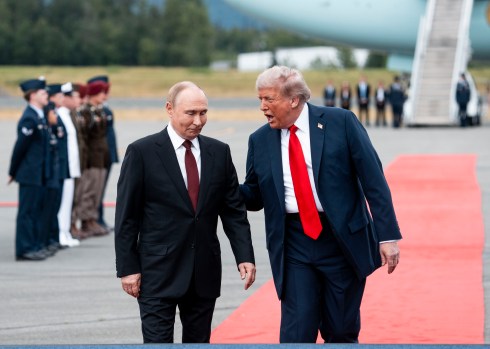

I watched with morbid curiosity last week’s predictably orchestrated presidential sashays down the red carpet at the airport in Anchorage to initiate the overhyped and underwhelming Ukraine summit.
Tall, puffed-up Donald Trump ambled purposelessly, and short, bantam rooster-like Vladimir Putin strutted purposefully. My stomach turned as they shook hands before their three-hour closed-door meeting and nothingburger media follow-up, which offered only five minutes of drivel in Russian from Putin and Trumpian platitudes from Trump.
My innards weren’t roiled by low expectations toward the summit — that was a given — but by the long list of Putin critics and political opponents who have died under mysterious circumstances over his murderous decadeslong reign. These Russian victims are unfamiliar to most Americans, perhaps including our own president, who shook hands warmly with his brutal Russian counterpart before and after their pre-summit stage show.
The victims include:
- Sergei Yushenkov, a liberal politician who was shot dead in Moscow in 2003.
- Yuri Shchekochikhin, an investigative journalist and a member of the Russian parliament who died suddenly in 2003 of a mysterious illness resembling poisoning.
- Viktor Yushchenko, a Ukrainian presidential candidate who was poisoned with dioxin during an 2004 election campaign, perhaps by Kremlin operatives.
- Paul Klebnikov, an American-born editor of Forbes Russia who was gunned down in Moscow in 2004 after investigating oligarch corruption and the brutal crackdown on breakaway efforts in Chechnya.
- Anna Politkovskaya, an investigative journalist and fierce critic of the Chechen wars who was shot dead in her Moscow apartment building in 2006 by attackers who were convicted without ever revealing their motive or sponsors.
- Alexander Litvinenko, a former Kremlin officer who exposed corruption and accused Putin of staging terror attacks, was fatally poisoned with polonium-210 in 2006. A British inquiry found it was “probably approved” by Putin and security chief Nikolai Patrushev.
- Natalia Estemirova, a human rights activist documenting Chechen abuses who was kidnapped and murdered in 2009.
- Alexander Perepilichnyy, a whistleblower in a case against Russian officials who collapsed while jogging in England in 2012. Traces of a rare poison plant were found in his stomach.
- Boris Nemtsov, a former deputy prime minister and opposition leader who was shot near the Kremlin in 2015. Chechen hitmen were convicted, but the masterminds remain unidentified.
- Nikolai Glushkov, an exiled Russian businessman and Putin critic who was found strangled in his London home in 2018. United Kingdom police ruled it murder and suspected Kremlin involvement.
- Zelimkhan Khangoshvili, a former Chechen commander opposed to Moscow who was shot in broad daylight in Berlin in 2019. German courts said the murder was ordered by Russian insiders.
- Imprisoned dissident leader Alexei Navalny, whose death from “cardiac arrest” in 2024 may have been precipitated by his hunger strike and a high dose of the nerve gas he was allegedly subjected to a few years earlier.
- Yevgeny Prigozhin, the Wagner mercenary leader-turned-critic of the Kremlin who was killed in a 2023 plane explosion two months after leading a mutiny against Russia’s military leadership.
- Several other exiles in London — oligarchs and defectors — who died under mysterious circumstances in the early 2000s. Officially ruled suicides or natural causes; many suspect Kremlin involvement.
- Sergei Skripal, a Russian military intelligence officer-turned-British MI6 double agent who survived a Novichok nerve-agent poisoning along with his daughter in 2018.
These are the Russian dissidents Putin allegedly targeted at home and abroad for aggressively opposing his autocratic kleptocracy.
This is how Josef Stalin, Mao Zedong, Pol Pot, Idi Amin, the Assads and even Saddam Hussein governed — ruthlessly and lawlessly, brazenly murdering opponents.
It makes Trump’s craven pardons of the Jan. 6 rioters look like child’s play and his coddling handshake with Putin even mote appalling.
This hit list, by the way, compiled through internet searches, is regrettably incomplete. Russia has a long pattern of extrajudicial killings and suspicious deaths of critics, especially journalists and former intelligence officers, but assigning blame is difficult in many cases because of Russian state security.
And yet, on American soil, our president treated a KGB-trained assassin and executor of heinous war crimes — including rapes, child kidnappings and torture — in Ukraine, a sovereign nation he illegally invaded, as an equal negotiating partner.
Anyone whose stomach didn’t turn as this national and global made-for-TV faux summit unfolded hasn’t paid enough attention to the war in Ukraine or Putin’s history.
Putin, by the way, isn’t overly worried about our sanctions because there are a dozen workaround strategies for selling Russian oil and natural gas and importing vital goods and services. And he is counting on our continued reluctance to expropriate the $300 billion in offshore Russian assets that could help rearm and rebuild Ukraine.
Would he and Russian consumers like to see McDonald’s and Starbucks back in Moscow? Sure, but not enough to undermine Putin’s ultimate goal: reclaiming at least parts of Ukraine and other pieces of the Soviet Empire lost at the end of the Cold War capitulation he has labeled “Mother Russia’s greatest tragedy.”
So we don’t have any viable carrots or sticks, other than a commitment, in partnership with our NATO allies, to provide Ukraine with enough offensive and defensive weapons to push Russia out of Ukraine and win the war, or at least enough political, military and diplomatic security guarantees to make any peace agreement sustainable.
Is either a pipe dream? Wishful thinking? Pie in the sky? Maybe.
And also highly unlikely, given Trump’s ambivalence and dubious European resolve. So the war is likely to go on until Ukraine agrees to concede territory in exchange for security guarantees.
That would be a painful outcome, but arguably a lot less embarrassing and humiliating than watching our president, flawed as he may be, treating a murdering despot as an equal.
Andy Shaw is a semi-retired Chicago journalist and good government watchdog.
Submit a letter, of no more than 400 words, to the editor here or email letters@chicagotribune.com.