Pass by a 7-Eleven in the city, and you might hear classical music pouring from the speakers outside — a tactic deployed by some store franchisees to shoo away loiterers.
A former 7-Eleven at Southport Avenue and Clark Street flips that script. Here, classical music invites you inside — and to come as you are, whether in business casual or your midnight-Slurpee-run clothes.
Welcome to The CheckOut, Chicago’s newest music venue. The enterprise is a project of Access Contemporary Music, a nonprofit founded by composer Seth Boustead. ACM is already behind the street fair Thirsty Ears, the Sound of Silent Film Festival, and a music school with three outposts in Ravenswood, Avondale and Rogers Park, along with a host of more sporadic projects. Owning a proper venue is a logical next step, however daunting that prospect may be in 2025.
Boustead isn’t so easily deterred. Years of tussling with the old landlord, working with the 46th Ward toward a liquor license, and old-fashioned elbow grease — ACM was on the hook for new plumbing and years of (very stinky) deferred maintenance — finally paid off this summer. The venue had a series of soft openings last month, then, on Sept. 13, inaugurated its opening festival with a salute to Uptown, featuring saxophonist Amos Gillespie and his uniquely scored quartet.
Walking into the smart new space, one wouldn’t readily guess its former identity. But the CheckOut team left some clever Easter eggs: menus shaped like chip bags, a bell that dings upon entry and churning slushie machines, doling out contents spiked or not. (Just don’t call them “Slurpees,” because, you know: copyright.) Even the square frame of the former 7-Eleven sign, left hollow and rusting since it closed in 2018, has been repurposed into a marquee.
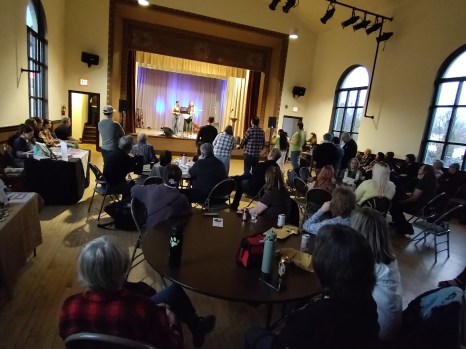
On Sept. 13, it read “SOLD OUT.” About 80 attendees milled around the bar or claimed one of the many bistro tables facing the “Nighthawks”-esque windows. (Capacity at most concerts will be about 70.) A carousel of visuals, including street photography by Bob Rehak, flickered on one wall, while the other proudly displayed vinyl records that could only be found at a venue like this: Tōru Takemitsu, Morton Subotnick, Terry Riley, Kurt Weill.

Then, the lights went down, the slushie machines wound down, and Gillespie, flutist Priya Fink, clarinetist Richard Zili and cellist David Keller filed onstage. “Onstage” is a manner of speaking: the “stage” is just whatever patch of floor isn’t covered in chairs and tables.
Though mixed in style, most of the featured composers took Uptown as their muse. For pianist and Ear Taxi curatorial director Amy Wurtz, inspiration came via Emil Ferris’ graphic novel “My Favorite Thing Is Monsters,” set in 1960s Uptown. (Spreads from the novel, drawn to mimic sketches in a spiral notebook, were projected during the piece.) For Sara Ritch, it was late nights at the Green Mill, and the omnipresent hum of neon signs. For Gillespie, it was a church sign, bearing a simple declaration: “We serve soul food.”
Like others on the program, composer Angelo Hart has been in the ACM fold for years. He taught piano and jazz at ACM years ago, even before the 7-Eleven at 4116 N. Clark shut down. Though he now teaches full-time at Lane Tech, he’s remained “connected” with Boustead and ACM’s programming.
He dedicated his “Embrace,” performed for the first time that evening, to his son, Bryson Hart, born the month prior. The short piece captures an infant’s wide-eyed purity, saxophone and flute trading off the melody over a warm bed in the clarinet and cello. In its final moments, the piece shrinks down to a duet between flute and cello, the flute fading away over the cello’s gently rocking open strings.
Just that morning, the venue had made a last-minute installation of hanging acoustic panels to dampen the sound. For this mixed winds-and-string ensemble, that resulted in a focused, clean acoustic — not boomy, despite the space’s reflective surfaces and open-concept interior.
Hart, for one, was pleased with the sound.
“I’m a musician myself, so to not be playing it, to be able to take a seat back and experience it that way — that’s been amazing,” Hart said.
For a venue banking on niche genres — contemporary classical music, plus occasional jazz and cabaret offerings — the CheckOut’s greatest challenge will be netting a wider patron base. Its opening program seemed to deliver on that front. Approachability prevailed, with quartet musicians trading off introductions to each piece and Boustead happily adopting the role of jocular emcee.
“Give it up one more time for Amos Gillespie!” Boustead declared after the first movement of the final piece, Gillespie’s “Soul Food.” Gillespie reminded him there were two more movements, and after much “ope”-ing and laughter, we were off again.
Far from being awkward, it felt like a side-splitting mix-up among friends, the kind that gets mythologized and teasingly resurrected every few years. Which meant, somewhere along the line — who knows exactly when? — the CheckOut had become A Hang Out. Quite a feat for night one.


Another promising detail: As far as I could tell, the opening night audience had little overlap with the classical and jazz regulars in the city. Those I spoke to were largely from Lakeview or the surrounding area, and simply came to suss out a new venue — like a young couple from Edgewater who had vowed to hear more live music in 2025, or the 70-year-old Uptown composer who had gone on a cruise with an in-law of Boustead’s and wanted to see the venue in action.
Another attendee, Sean Webby, 61, told me he lives just a few blocks from the CheckOut. Webby used to pass the shuttered 7-Eleven — vacant and moldering since closing in 2018 — on walks to Wrigley Field, or while pulling a Divvy bike from the docks next to the parking lot.
When he read that the 7-Eleven would soon open its doors again as a concert venue, he thought it was “the coolest idea.” It reminded him of living in Brooklyn in the 1990s when reimagined DIY spaces were everywhere.
“There’s sometimes a sense these days that art is a luxury. And I really don’t feel like it is,” Webby says. “Chicago deserves not just the Chicago Symphony Orchestra and the (Art) Institute. It deserves little tiny places in abandoned 7-Elevens … That bubbles up and makes the whole community better.”
The CheckOut continues 7:30 p.m. Sept. 19 with the Black Oak Ensemble’s “Working,” inspired by Studs Terkel. Tickets $23; full schedule and more information at thecheckout.org
Hannah Edgar is a freelance critic.
The Rubin Institute for Music Criticism helps fund our classical music coverage. The Chicago Tribune maintains editorial control over assignments and content.