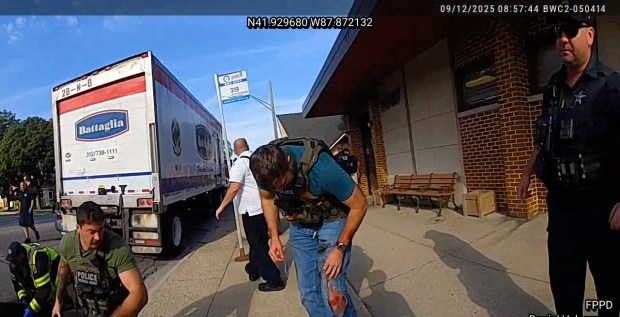


In the chaotic first moments when Franklin Park police officers arrived at the scene where an ICE agent fatally shot a man after allegedly being dragged by his fleeing vehicle, they found a pair of agents hunched over Silverio Villegas-Gonzalez.
“He tried to run us over,” one agent says.
A few minutes later, as officers began to canvass the scene, one agent — sporting bloody knees and hands — described his injuries as “nothing major.”
DHS officials originally said that agent was in critical condition following the Sept. 12 traffic stop and subsequent shooting.
In a statement released shortly after the shooting, DHS officials said Villegas-Gonzalez, 38, “refused to follow law enforcement commands and drove his car” at officers trying to conduct a traffic stop, striking one of the ICE agents and dragging him “a significant distance.”
Though it only shows the aftermath, the body camera footage from Franklin Park police offers one of the only glimpses into what happened, given that the ICE agents involved in the shooting were not wearing body cameras. And while it seemingly contradicts at least in part ICE’s original account, the shooting itself was not captured.
Video from a nearby nail salon also captured part of the incident, but the camera angle failed to show the officer who was allegedly dragged and fired the fatal shots.
The Tribune has also reviewed other footage from a private surveillance camera across the street that appeared to show that officer running alongside the man’s car as he tried to flee. But the images are blurry and far from conclusive.
The body camera footage, released to the Tribune following a Freedom of Information Act request, also recorded confusion among Franklin Park officials about which agency would investigate the shooting — a question that’s still open almost two weeks later.
The controversial shooting spurred calls for a vigorous and transparent investigation by figures including Gov. JB Pritzker and Mexican President Claudia Sheinbaum. And on Tuesday, Illinois Democrats led by U.S. Sen. Dick Durbin wrote to U.S. Secretary of Homeland Security Kristi Noem asking for transparency and urging her to end what they called “dangerous operations” in the Chicago area.
Given the lack of ICE body camera use, experts familiar with federal policies and practices — especially now under the Trump administration — said they were not optimistic that the public will get a full accounting of the shooting.
Still, the Franklin Park body camera provides the best look yet at what unfolded in the northwest suburb.
In a statement, DHS officials said that one of the officers fired at Villegas-Gonzalez, whom officials said was a Mexican national in the U.S. without authorization, “fearing for his life.”
When a Franklin Park police officer asked the agents if they were OK, one federal officer appeared to give a double thumbs-up in response. Both agents deemed the bloodied knee and cut-up hands on the officer apparently dragged to be “nothing major.”
Later, a Franklin Park police officer describing one of the agent’s injuries said he had a “left knee injury, some lacerations to his hands.”
The injured agent is shown on body camera footage looking at his hands and shaking his head. One of the legs of his jeans is ripped open, showing a bloody knee.
According to the footage, officers first found the pair of agents bent over Villegas-Gonzalez and apparently doing chest compressions, near the intersection of Grand Avenue and Elder Street around 8:56 a.m.
“He tried to run us over,” one agent says.
“Are you guys good?” the officer asks.
“Uh-huh,” an agent says, nodding. He appears to give two thumbs up.
Several other officials came over to talk to the agents while paramedics took Villegas-Gonzalez to an ambulance.
DHS officials said in a statement Friday that the agent who shot Villegas had worked for ICE since 2021 and that this was his first time firing his weapon in a use of force incident. The agency didn’t immediately respond to a request for comment on the body camera footage.
A man who was driving a truck that Villegas-Gonzalez hit within moments of the shooting told police that the agents pulled Villegas-Gonzalez over and cut him off.
“The two officers got out, ran to his car, tried to pull him out,” the man said. “He backed up. I was already pulling to the side. He crashed into (my truck). He was trying to escape from them.”
The driver wasn’t sure when Villegas-Gonzalez hit his truck, but told police he heard at least one shot. An autopsy by the Cook County medical examiner’s office later ruled that Villegas-Gonzalez died as a result of multiple gunshot wounds.
The private surveillance footage from across the street, meanwhile, showed the man’s white truck with blue logo drive past and slow down near an intersection. Seconds later, Villegas-Gonzalez’s car can be seen backing up and accelerating forward as a person runs alongside the driver’s side door.
Another person, presumably the other officer, is seen running after the car after it leaves the frame.
The video is from too far away and is too grainy to determine if the person is being dragged, and there is no audio so no gunshots could be heard.
The killing sparked immediate protests around the Chicago area as citizens, politicians and advocates condemned the Trump administration’s crackdown on immigrants in the U.S. without legal permission, now in a second wave in the Chicago area which officials have dubbed “Operation Midway Blitz.”
The body camera footage captures a conversation between Franklin Park police Director Michael Witz and Officer Thomas Ferris about whether Illinois State Police or Franklin Park would investigate the shooting.
“It’s their guys who shot,” Witz says. “You know what I’m saying?”
“Public Integrity?” Ferris asks.
“It’s their guys. It’s not our guys.”
Although officials with the FBI were seen at the site of the shooting, sources Tuesday told the Tribune it was DHS that was handling the follow-up investigation, including whether the officer was justified in opening fire.
On Tuesday, DHS Assistant Secretary Tricia McLaughlin said in a statement that every use-of-force incident or discharge of a firearm “must be properly reported and reviewed by the agency in accordance with agency policy, procedure, and guidelines.”
But McLaughlin did not confirm her agency is taking the lead.
“All shootings are initially reviewed by the appropriate federal, state, local, or tribal law enforcement agency principally charged with first response to the incident,” the statement from McLaughlin read. “Following a review of the incident by the appropriate investigative agency, ICE will conduct an independent review of the critical incident.”
Most federal agencies are not broadly using body cameras, which sets them apart from many local agencies that have embraced the technology in recent years.
Cameron McEllhiney, executive director of the National Association for Civilian Oversight of Law Enforcement, said last week she was not hopeful that the public will get a robust accounting of the shooting in Franklin Park, given that there is no body camera footage and no mandates for information to be released.
“For the most part, there has never been the type of civilian oversight that we see at the local level,” McEllhiney said of federal law enforcement agencies.
Though a May 2022 executive order signed by President Joe Biden mandated that federal agencies update or create policies around use of body cameras, among other policing reforms, President Donald Trump rescinded the order upon taking office.
Since then, some federal agencies have quietly stopped body cameras. ProPublica reported in May that the Drug Enforcement Administration shuttered its program. Citing multiple sources, NewsNation reported earlier this year that Border Patrol agents stopped wearing cameras.
Even during the Biden administration, ICE acknowledged in a news release that it did not have the resources “to (issue) cameras to all ICE law enforcement personnel.”
McEllhiney noted that body cameras, when used, can offer a nearly complete picture of a shooting, as it generally includes the perspective of the officer involved as well as other responding officers. Use of such cameras can protect law enforcement themselves, as well as the community, she said.
“I do think that sometimes people have a misperception that oversight is anti-law enforcement when in reality … oversight works to provide better policing for communities which benefits police and the people they serve,” she said.
By contrast, in the city of Chicago, policy dictates that footage from CPD body cameras and related police records are published within 60 days of a police shooting.
According to DHS reports, ICE agents recorded 78 instances of use of force during the 2023 fiscal year, including two fatalities. In 2022, the agency recorded 55 incidents, four of them fatal.
A policy memo dated February of 2023, DHS defines justifiable use of force as when “no reasonably effective, safe and feasible alternative appears to exist.” The 13-page policy memo further says that agents may only use a level of force that is “objectively reasonable” in light of the specific facts on the ground.
In particular, the policy notes that DHS agents cannot shoot at the driver of a moving vehicle unless such a use of force would be justified under the overall policy.
It also says that agents must not shoot at moving vehicles as a warning or to disable the vehicle, except in some limited circumstances such as in certain maritime or aviation scenarios.
Per the memo, agents must consider the risk to bystanders when using force in this type of scenario.