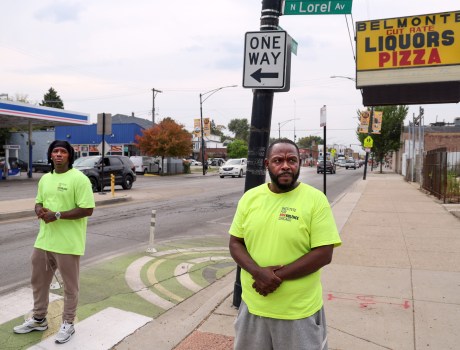
“Bully” and “Breezy” are well known in Austin.
Both men are from the area, and both work for the Institute for Nonviolence Chicago, one of the city’s street outreach organizations aimed at reducing gun deaths.
Bully and Breezy keep busy.
Between the two of them they carry at least five cellphones, checking in regularly with a network of colleagues — more natives of Austin, men who’ve spent time in prison — who serve as extra eyes and ears, monitoring the entire neighborhood for problems that could lead to violence.
“We’re like ‘The Avengers,” Bully — born Marcus Simpson — told the Tribune last week. “We get everybody from every neighborhood to have a little fun and we come together. That’s how we got the violence down.”
Year over year, gun violence in Chicago has declined sharply — a 29% decline in homicides and a 34% drop in total shootings through mid-September, according to CPD. But despite the gains, the city’s decades-old struggle with violence was once again thrust into the spotlight this year as President Donald Trump has threatened a National Guard deployment.

Mayor Brandon Johnson — who, with his family, has lived in Austin for more than 15 years — has consistently rejected the idea. His view comes even as Police Department figures show Austin has not seen the same progress as other parts of the city. Since 2022, the level of killings in the neighborhood have kept relatively stagnant.
“If President Trump wants to help make Chicago safer, he can start by releasing the funds for anti-violence programs that have been critical to our work to drive down crime and violence,” Johnson said in a statement last month. “Sending in the National Guard would only serve to destabilize our city and undermine our public safety efforts.”
Last weekend, at the memorial for slain conservative activist Charlie Kirk, Trump claimed that Kirk asked him to “save Chicago.”
“We’re going to save Chicago from horrible crime,” Trump said.
To Johnson, that effectively means more Bullys and Breezys, not troops on the street.

Some dollars have flowed in. A recent boost in city, state and private funding has allowed the institute to grow its network of peacekeepers. The men in the program have four 8-hour shifts each week, earning $100 per day, Bully said. Their histories and connections to the neighborhood are often assets.
“We look for guys that are still in it, but on the cusp of change,” Bully told the Tribune. “A lot of us, we helped tear the neighborhood down so we want to help bring it up.”
Stubborn crime in Austin
After a huge spike in 2020 and 2021, Austin has still averaged about one homicide per week since the start of 2022. Through mid-September, Austin has recorded 40 killings in 2025, according to CPD.
Most recently, on Monday afternoon, a 35-year-old man was shot to death as he sat in a vehicle near Lake and Central avenues, according to CPD. Records show the man had a litany of prior drug arrests, but the most serious charge came in 2014 when he was accused of taking part in a home invasion that left an 18-year-old man dead on the Southwest Side.
The man pleaded guilty to home invasion in 2023 and was given credit for more than eight years spent in Cook County Jail. Illinois Department of Corrections records show the man was paroled Sept. 16 — just one week before he was killed.

In January, a longtime neighborhood drug dealer was shot to death near Washington Boulevard and Laramie Avenue, police and court records show. A few weeks later, a man linked to several robberies was shot and killed near Lake and Central.
Another man was killed near Hubbard Street and Lavergne Avenue in April, about a year after he was arrested with an untraceable “ghost gun.”
On the other hand, drug-related overdose deaths in Austin — and Cook County overall — are down sharply, according to data from the medical examiner’s office. What’s more, through mid-September, CPD officers have made nearly as many drug-related arrests in Austin as they did throughout all of 2024, records show.
The mayor and CPD
The mayor’s stance on policing in his neighborhood has not been without controversy locally.
Addressing reporters about policing last week, Johnson paraphrased a 1967 speech delivered by the Rev. Martin Luther King Jr. during the height of the Vietnam War. King said, in part, “The final phase of our national sickness is the disease of militarism.”
“I am trying to eradicate the sickness from this city and from this country,” Johnson said. “Jails and incarceration and law enforcement is a sickness that has not led to safe communities.”
Johnson’s remarks, predictably, irked many law enforcement supporters.
John Catanzara, president of the union that represents rank-and-file Chicago police officers, traveled to the block in Austin where the mayor and his family live to record a video message to union members.
“Behind me is the mayor’s house. Three squad cars blocking it, patrolling it, protecting it for him and his family. Yet he calls law enforcement ‘a sickness,’” Catanzara said. “What a hypocrite piece of garbage. And the sooner he is gone, in March of (20)27, the better.”
“Shame on Mayor Johnson for thinking he has anything to do with” Chicago’s decline in gun violence, Catanzara added. “The men and women of this Police Department have everything to do with it.”
Johnson declined to comment for this story.
On the street
The Institute for Nonviolence Chicago’s peacekeepers, clad in green vests, are stationed at intersections across the neighborhood. In the morning, the priority is making sure kids get to school safely.
After classes begin, they may pass out food and check in with the neighborhood’s homeless residents. In the afternoon, they’re back at their posts during school dismissal.
The West Side has for decades been the epicenter of the city’s narcotics trade, which, in turn, fuels much of the area’s violence.

Last Friday afternoon, a dozen or so addicts were hanging out in a vacant lot on Central Avenue. Bully and Breezy call the spot “Zombieland,” and they were greeted warmly by those congregated.
One of the men in the lot, “J Slim,” credited the violence prevention workers for not passing judgment on those struggling with addiction.
“We support ‘em because they do make it safer,” he said. “They’re guys from around here and they know how it is out here. They know how to talk to us without making us feel like we’re nothing.”
“They feed us, they take care of us,” another man in the lot, “Sincere,” added. “A lot of addicts and homeless people get judged. We’re all not bad people, we’re going through something.”
Near a gas station at Chicago and Lockwood avenues, Breezy — born Travaris Brown — stressed the communal bonds of the neighborhood.
“Austin really is a family,” he said. “Austin’s really one of the only neighborhoods where there’s still, like, leadership.”
That familiarity can be a double-edged sword, though, and it’s a major difference from the gun violence that plays out on the South Side, Bully said.
“That’s one thing, the difference between out West and out South,” he explained. “A lot of times when you go out South there will be kids and girls getting killed. The difference out here, most people that get killed (are) the people they were looking for.”
“Everybody knows everybody, so everybody knows who they’re looking for.”
And the cycle would continue just days later.
About 10:30 p.m. Wednesday, two people — a 52-year-old woman and a 25-year-old man — were shot and critically wounded, according to police, in a shooting near the “Zombieland” vacant lot.