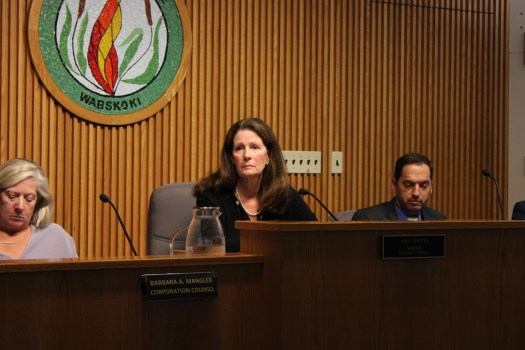

Skokie trustees and Mayor Ann Tennes took a second look at proposed rules and regulations for short-term rentals, including Airbnbs and other short-term stays, at the Sept. 15 Village Board meeting after discussing them previously.
The proposed new regulations for short-term rentals, created by village staff after the first wave of feedback from the Board of Trustees, include proposals to mandate seven-day minimum stays, limit bookings to eight a year, increase registration fees and disciplinary fines and require short-term rental owners to primarily live in the property they rent out.
Whether they agreed or disagreed if it was a good or bad thing, trustees said the new regulations could effectively eliminate short-term rentals as a business model in Skokie. Village staff estimate that there are about 15 to 30 short-term rentals in the village.
The meeting’s public comment period for short-term rentals took place before trustees considered the matter, with some residents wanting more stringent rules and an Airbnb owner looking for a little more flexibility.
Sheila Lakhani, who is part of the Lakhani Hospitality group that owns various hotels in Skokie and the Chicago area, told Pioneer Press she owns three single-family homes she rents out on Airbnb.
Days before the meeting, Lakhani told Pioneer Press the cap on eight bookings a year was “ridiculous” and could put her out of business.

Lakhani shared a letter she wrote to the Village Board. In it, she said her Airbnbs have served families who celebrate weddings and graduations, and also serve people who receive extended medical treatment.
Lakhani also said she is in favor of other rules the village is considering, including a minimum multi-day stay, and accountability for rude guests. She said she does not allow parties, she screens guests interested in staying, enforces quiet hours between 10 p.m. and 7 a.m. and monitors who comes in and out of her properties via a security camera at the entrance.
During the village’s discussion, Tennes said her north star is “preserving the quality of our residential neighborhoods.”
“Quality of life for residents… is my primary goal, ” she said. “I know there are other primary goals… There’s issues regarding housing stock… those are all valid and appreciated.”
Tennes, who previously voiced support for a 30-day minimum stay for short-term rentals, said a seven day minimum stay was not long enough. She said she also wanted to revisit the booking cap and registration fees and fines, but did not specify whether she wanted a proposal that was more restrictive or more flexible.
Trustees continued to have split views on how or if short-term rentals can continue to operate in Skokie.
“To me, a short-term rental — just because it’s a rental — doesn’t mean it’s housing,” said Trustee Gail Schechter, an affordable housing advocate. Her comments clashed with those of Trustee Lissa Levy, who said that short-term rentals are a vital part of Skokie’s housing mix.
When asked by Trustee Keith Robinson why the staff’s proposal was for seven-day minimum stays and a cap on eight bookings a year, Johanna Nyden, the village’s community development director, said the village’s staff investigated why people stay at a short-term rental in Skokie to begin with. Nyden reported that some of the more common stays were for hospital visits, visiting family members or being in Skokie for business.
“We’re not a destination, (or) a tourism hotbed,” Nyden said earlier in her presentation to village staff. “We’re not Vail, Colorado, we’re not the Florida Keys… I’m not saying that to minimize anybody’s experience next to an STR, but we are not,” she said.
The cap on eight bookings a year is to balance the village’s proposal requiring short-term rental owners to live in the property they rent out, Nyden said.
Trustee Alison Pure Slovin spoke in favor of short-term rentals, as she has done before.
“I really don’t like that we keep describing bad actors,” she said, referencing complaints from trustees and residents who live next to the Airbnbs that have been used for parties.
“We all have neighbors that are permanent neighbors that maybe also are bad actors. So I don’t like putting it as residents and non-residents… because you don’t know who’s going to be buying that home or renting that home next to you that is a permanent resident of Skokie.”
Pure Slovin was also skeptical of the eight booking cap on rentals. “A lot of people who do come in, as was pointed out, come in for a long wedding weekend or for the Jewish holidays or for Thanksgiving,” she said. “If I owned a property, and I was limited by eight (bookings) and I’m only doing five-day or seven-day rentals, then it’s not economically feasible for me to own that property as well.”
Trustee Jim Iverson echoed that the cap on bookings could effectively eliminate short-term rental owners from making a profit in Skokie, but was in favor of the proposal. “I think (the impact) is largely going to be in residential neighborhoods, and so I think the limits are quite good.”
Tennes closed out the trustees’ deliberations, saying it was a good discussion.
“We’re getting there. This is a difficult, complicated issue. As we’ve heard, there are a lot of different sides to it, so I’m proud and pleased that we’re being thoughtful and appreciate the staff work that’s going into being responsive,” she said.