On the Amazon website, you can order a book titled “Republic of Fear.” First published in 1989, it’s about Iraq under Saddam Hussein, but the title applies to what America is becoming under Donald Trump: a country where only those who submit to his every demand can feel safe.
That group would not include the inhabitants of Portland, Oregon, and the surrounding county, where Trump got just 17% of the vote last year. The president has ordered the deployment of National Guard troops, who are authorized to use “full force” to combat “domestic terrorists” and “protect War ravaged Portland” — the 72nd most violent large city in America.
Past presidents have sometimes employed fierce martial rhetoric to deter foreign adversaries. Trump directs it at American cities and citizens, treating opposition as insurrection.
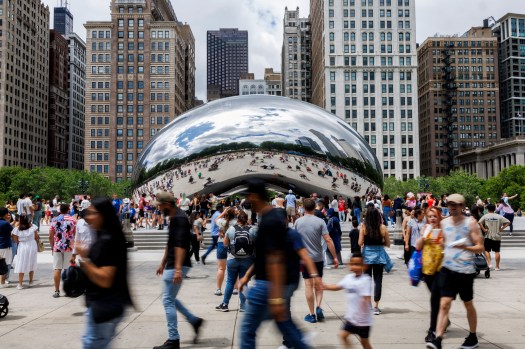
There are moments when Trump’s ostentatious efforts to sow fear are so absurd as to be comical, as in Chicago this past weekend. One scene featured burly Immigration and Customs Enforcement and Border Patrol agents in masks, body armor and camouflage fatigues haplessly chasing a food delivery guy on a bicycle, who had yelled “F— Trump” at them. He got away.
Then there was the spectacle of other agents wielding assault rifles as they cruised on boats down the Chicago River, apparently expecting to find undocumented immigrants training for a triathlon.
Karl Marx wrote that history repeats itself, “the first time as tragedy, the second time as farce.” But the Trump administration has shown it can combine the two right from the start.
Swarming Washington’s Lincoln Memorial and Chicago’s Magnificent Mile with armed agents in combat regalia can’t possibly be the most efficient way to apprehend foreigners who lack legal status. But it’s a pretty good way to do what Trump wants, which is to instill panic in anyone who might possibly stand in his way.
His deployment of National Guard soldiers in Los Angeles and Washington, D.C., was not designed to stop crime so much as it was to dramatize the danger of incurring his wrath. Likewise his threat to send troops to Chicago, which he underlined with his Truth Social post warning, “Chicago about to find out why it’s called the Department of WAR.”
Trump claims to be trying to bring peace and order to Portland and other cities, but he behaves like someone who’s itching for a fight. As Democratic U.S. Sen. Jeff Merkley of Oregon said, the president “wants to stoke fear and chaos and trigger violent interactions and riots to justify expanded authoritarian control.” If violent protests don’t erupt, Trump can say he deserves credit for ensuring order. If they do, he can claim they show the need for the crackdown.
The militaristic methods are partly meant to desensitize the populace to draconian methods — part of the administration’s assault on peaceful protests, independent journalism and even stand-up comedy. They also aim at frightening anyone who might do anything that Trump might find objectionable.
He has already cowed media companies and universities, using federal regulatory power and funds to force surrender. Law firms have rushed to appease him, promising nearly $1 billion in free legal services to help Trump’s preferred causes. Congress, under GOP control, has given up any idea of acting independently. All these institutions have absorbed the message that resistance is suicidal.
When Trump employs the language of war, it’s worth remembering that he isn’t bound by considerations of legality, much less humanity. This is the president who pardoned a Navy SEAL convicted of war crimes whose own men reported him. Trump shipped migrants to the Guantanamo facility that was built to hold foreigners accused of terrorism.
He has ordered the military to slaughter people aboard boats in the Caribbean that he claims, without evidence, were smuggling drugs. Brian Finucane, a national security attorney at the International Crisis Group, told NPR that to target and kill “another person outside an armed conflict, there’s a term for that, and that term is murder.”
This homicidal policy is bad enough when applied indiscriminately to foreigners on the high seas. But it’s not hard to imagine Trump using similar tactics for “armed conflicts” he pursues at home. He is enamored of brutal methods, and it’s folly to hope he wouldn’t use them against Americans. In his speech to senior military officers on Tuesday in Quantico, Virginia, Trump said armed troops were needed in American cities to combat “the enemy from within.”
Trump, keep in mind, has accused a long list of opponents of “treason” — including former President Barack Obama, former House Speaker Nancy Pelosi, former Republican U.S. Rep. Liz Cheney, Democratic U.S. Sen. Adam Schiff, former FBI Director James Comey and all the members of the congressional committee that investigated the Jan. 6 attack. The punishment authorized by federal law for that crime, as Trump well knows, is death.
His critics warn that Americans should be very afraid of what Trump is doing. On that point, he couldn’t agree more.
Steve Chapman was a member of the Tribune Editorial Board from 1981 to 2021. His columns, exclusive to the Tribune, now appear the first week of every month. He can be reached at stephenjchapman@icloud.com.
Submit a letter, of no more than 400 words, to the editor here or email letters@chicagotribune.com.