
Cook County Public Defender Sharone Mitchell Jr. and a coalition of legal groups and social service organizations are petitioning Chief Judge Timothy Evans to enter a general order prohibiting warrantless immigration arrests in or around courthouses.
Court facilities have historically been spared when it comes to immigration enforcement in order to create conditions in which defendants and witnesses are likely to show up for appearances. But sightings of federal immigration agents have increasingly been reported in and around area courthouses.
In the petition, the attorneys wrote that court operations have been “significantly and negatively impacted by ICE’s enforcement,” citing a common law privilege against arrests within courthouses.
During a news conference Wednesday outside of the county’s domestic violence courthouse at 555 W. Harrison St., attorneys, social workers and legal advocates decried tactics by Immigration and Customs Enforcement agents while calling on Evans to take steps to protect court buildings so individuals can access their right to justice and due process.
“We are asking Chief Judge Evans to do the right thing and to please protect that right by signing the general order,” said Alexa Van Brunt, director of the Illinois office at the MacArthur Justice Center.
In September, officials of President Donald Trump’s administration announced the so-called Operation Midway Blitz, a ramped-up immigration enforcement operation that has resulted in arrests around schools, workplaces and other venues, as well as courthouses.
On multiple occasions, immigration agents have been spotted around the domestic violence courthouse, raising particular concern about a chilling impact on people seeking orders of protection.
Among the groups petitioning are the MacArthur Justice Center, Chicago Alliance Against Sexual Exploitation and Cabrini Green Legal Aid.
A statement from a DHS spokesperson said that making arrests near courthouses is “common sense.”
“It conserves valuable law enforcement resources because they already know where a target will be. It is also safer for our officers and the community,” the statement said.
Enforcement of this type of general order would be difficult, especially when agents make arrests outside of the courthouses, but the petitioners said such an order, if enacted by Evans, would offer important guidance to county workers. They also noted that warrantless stops and arrests are limited by a 2022 court settlement in federal court in Illinois.
Attorneys and advocates described the impact on Cook County courts, saying they have worked with clients who are forced to make difficult decisions about whether to pursue charges in a criminal case, seek orders of protection, appear for court dates and participate in civil issues such as housing and eviction matters. They argued that the tactics by the federal agents actually make local residents less safe.
“We cannot solve or reduce crime if the families fear the very systems meant to ensure their safety,” said Carla Gutierrez, vice president of programs at Mujeres Latinas en Acción. “This climate erodes trust and isolates survivors and creates more barriers to healing and justice.”
Some county officials have spoken out in recent weeks about their concerns around the issue, including Mitchell, State’s Attorney Eileen O’Neill Burke and County Board members.
Cook County commissioners recently called on other county officeholders to help sound the alarm if federal immigration agents turn up at county courthouses and other public facilities.
But Evans, who is in his final two months as chief judge, has been largely silent on the matter. A request for comment from his office was not immediately returned.
After nearly a quarter of a century leading the Cook County judiciary, Evans last month lost reelection as chief judge to Judge Charles Beach, who will take over on Dec. 1.
The petition lists numerous sightings of federal immigration agents in or near courthouses, including the Daley Center, the Leighton Criminal Court Building, the Domestic Violence Courthouse, and the branch courts at 111th Street.
The groups also raised concerns about ICE agents wearing masks and refusing to identify themselves when in or around county buildings. In one instance last month, an individual called 911 when they saw an agent — in plainclothes without any identifiers — outside of the domestic violence courthouse with an “assault-style rifle.”
“When there are armed agents outside of our courts who are unidentified and carrying weapons, it impacts everyone who wants to use our court system,” said Sharlyn Grace, senior policy adviser with the Cook County public defender’s office.
Though Department of Homeland security officials have often touted that they are arresting the “worst of the worst,” in one case a woman arrested at the domestic violence courthouse had no criminal convictions, and was present for court for a pending misdemeanor domestic battery case that was dismissed.
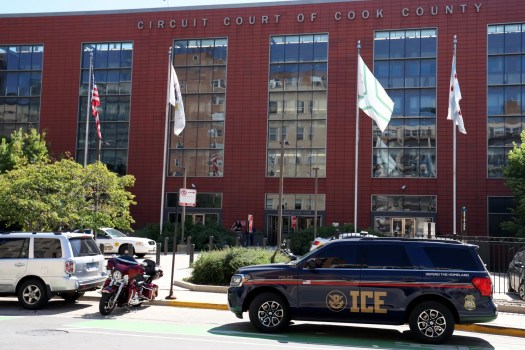
“In addition to entering Cook County court and arresting people at and around the courthouses, ICE agents park their vehicles in prominent positions outside of court facilities,” the petition says. “This has struck fear in the immigrant community and undermined trust in the legal system.”
The groups said they are concerned about the impact “on access to justice in Cook County writ large.”
The petition says Evans’ office has administrative power to adopt its own rules in the form of general orders.
In New York, lawmakers passed legislation to prohibit ICE from making civil arrests at state and municipal courthouses without a judicial warrant.