Mayor Brandon Johnson said the city is considering legal action Friday after the White House froze $2.1 billion in federal funding for two major Chicago transit projects over an investigation into racial preferences in contracting, the latest fusillade in President Donald Trump’s escalating campaign against blue cities and states during the U.S. government shutdown.
Early Friday, White House budget director Russ Vought said the Trump administration will withhold the money from the Chicago Transit Authority’s years-in-the-making Red Line Extension to the Far South Side as well as its ongoing Red and Purple Modernization project on the North Side. The announcement comes amid broader funding fights waged by the president on Democratic-led areas, including over what his administration has described as antiwhite discrimination.
Vought posted on X Friday the money was “put on hold to ensure funding is not flowing via race-based contracting.”
“Illinois, like New York, is well known to promote race- and sex-based contracting and other racial preferences as a public policy,” a statement from the U.S. Department of Transportation read. “These critical reviews are intended to ensure no additional federal dollars go toward discriminatory, illegal, and wasteful contracting practices. … The American people don’t care what race or gender construction workers, pipefitters, or electricians are. They just want these massive projects finally built quickly and efficiently.”
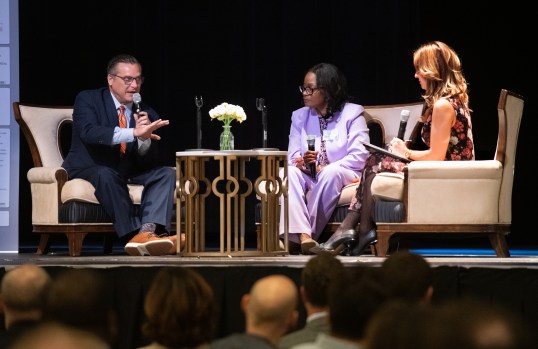
At an unrelated news conference in Lakeview, the mayor confirmed “the legal route, absolutely” is on the table to unfreeze the funds and defended the city’s contracting practices.
“Look, there’s no secret here that I’ve worked hard to make sure that we have a diverse pool of contractors, and that we ensure that the communities that we are investing in, that those communities get to play a part in the development of those communities. It’s only fair,” Johnson told reporters. “This is not just an egregious act. He is working outside of the parameters of what our ordinances and our state law provides for minority- and women-owned participation.”

Johnson also said Trump was “deranged,” while sidestepping questions on what this grant suspension means for the Red Line Extension’s construction timeline. The mayor did not elaborate on whether it was possible for the transit agency to secure funding through alternate means to keep the project afloat.
“We’re going to do everything in our power to ensure that construction continues,” Johnson said. “The South Side has fought for this for 50 years, and we have finally delivered it, and after 50 years of struggle to make sure that the South Side is prioritized, this president is now going to try to disrupt that? Not under my watch.”
At a Regional Transportation Authority meeting Friday, acting CTA President Nora Leerhsen declined to comment on the issue when asked by a member of the RTA board about potential plans to put pressure on the federal government to unfreeze the funds.
“I’m not going to comment on the current status of news today with regards to federal funds,” Leerhsen responded. “RTA and the agencies always work together on major issues affecting our region.”
The agency later issued a statement that read, “The Chicago Transit Authority is in receipt of the letters from the Federal Transit Administration, which we are currently reviewing.”
The pause threatens a plan to build four additional stations along the Red Line, stretching the transit line south by 5.6 miles to 130th Street in what former CTA President Dorval Carter said in January would “undo nearly 60 years of racial inequity in transit.”
At the time, city officials maintained the project’s $1.9 billion in federal funding — the largest transit infrastructure grant in CTA history — would be protected from attacks by the incoming Trump administration via an agreement signed by the Federal Transit Administration.
“I can just tell you if history is any any indicator of this, historically, there’s never been a situation in which a full-funded grant agreement has been reneged on by the federal government,” Carter said in January when asked whether there was any possibility the White House could claw back that money.
He described the FTA agreement as “a unique legal document that basically makes the commitment going forward.”
That has apparently changed. This week, amid the U.S. government shutdown that the White House has blamed on Democrats, the Trump administration has moved to begin whacking away at federal aid for Democratic-run cities and states, under the direction of Vought. The president has cheered on these efforts, posting a video Thursday evening of himself as a hooded reaper and wielding a scythe.
Carter would go on to step down from helming the agency three days after his public assurances over the CTA’s federal grants, capping off a tumultuous chapter in the first half of Johnson’s term that saw transit advocates sour on the embattled CTA president — though clinching the Red Line Extension funding was broadly seen as the biggest feather on his cap.
The DOT statement links to the CTA’s diversity programs for “Disadvantaged and/or Small Business Enterprises” in citing its review of contracting practices for the two CTA projects. The agency requires small and Disadvantaged Business Enterprise participation, or DBE, for both the construction of the project and professional services, which are governed by the federal Department of Transportation.
The projected DBE goal for CTA projects with federal funding is 21% between 2025 and 2027. To qualify for certification, businesses must be 51% owned and controlled by socially and economically disadvantaged individuals — Black, Hispanic, Native American, Asian-Pacific and Subcontinent Asian American.
The CTA has set a goal for 25% of design and 22% of construction contracting to be awarded to DBE firms for the Red Line Extension specifically and a requirement that joint venture partners provide a mentor/protege program for DBEs. As of August 2024, that total expected DBE spend for designing and building the RLE was $767 million, according to the CTA.
CTA awarded the design and build contract for RLE to Walsh-VINCI Transit Community Partners, which includes Walsh Construction, VINCI Construction, EXP, Systra, and local DBE firms Toro, Atrium, Riteway-Huggins, Brown & Momen and GMA.
Trump has made racial preferences a recurring touchpoint in his second term as part of a culture war against “diversity, equity and inclusion” practices that Republicans say discriminate against white Americans. Johnson, who has made no apologies about uplifting Chicago’s Black community, has been a prime target. Caught in the middle of this constant tug-of-war between the freshman progressive mayor and the president is roughly $3.5 billion in federal funding the city receives.
The U.S. Department of Justice launched an investigation in May into City Hall’s hiring practices after Johnson delivered public remarks emphasizing how many Black people he’s hired in his administration. In April, Johnson also vowed to go to court to protect hundreds of millions of dollars in federal money for Chicago schools if Trump followed through on a threat to revoke the funds from districts that promote diversity, equity and inclusion practices, though his office later walked that statement back.
CPS magnet schools are currently in danger of losing federal funding under an investigation by the U.S. Department of Education’s Office for Civil Rights over whether the district’s policies to provide support for Black, transgender and gender-nonconforming students are discriminatory to other students.
Of course, the Trump administration has also threatened to freeze Chicago’s funds before and not followed through, such as when the president posted on Truth Social that he is working to “withhold all Federal Funding” for sanctuary cities, without naming which ones. But the suspension of the CTA’s federal grants for at least the duration of the Trump presidency could be the death knell for the Red Line extension.
Construction was slated to begin later this year, but the project has been mired in ever-increasing price tags that have pushed the city to find additional funding outside the federal grant, including through more bonds. A new estimate last summer put the project at $4.8 billion before financing costs, about $1.16 billion over earlier projections.
The project, discussed for more than 50 years, has the potential to be a major investment in the Far South Side. The CTA has touted the project’s ability to boost equity, save commuting time between the Far South Side and the Loop, improve connections to the neighborhoods and promote economic opportunity and sustainability.
Ald. Anthony Beale, 9th, whose ward is the main beneficiary of the Red Line extension, was nonplussed at the announcement.
“Everybody anticipated that,” he told the Tribune Friday morning. “I’m not the least bit concerned about it because I know that project is going to get done. We waited for it, we have a contract. If (Trump) tries to hold the money to leverage his negotiations, it’s just a tool. I’m not the least bit concerned about the project being completed.”
The CTA has acquired dozens of properties to make way for the extension, and are actively clearing land. “It’s moving forward,” Beale said. “I feel real good about it.”
Dick Durbin, Illinois’ senior U.S. senator and the No. 2 ranking Democrat in the chamber, took to the Senate floor Friday to decry the Trump administration’s actions as “illegal” and “vindictive” after residents of the Far South Side were at last promised a Red Line extension.
“For decades, residents of the Far South Side viewed this extension as just politicians talking. … After waiting over 50 years, it was finally going to be a reality,” Durbin said. “However, guess what? Today, a news flash from the Trump administration.”
Durbin, who plans to retire at the end of his term in January 2027, accused Trump of wanting “to punish states like Illinois and the people who live there because they didn’t vote for him in the last election.” The Red Line extension was largely viewed as his legacy project.

A broader modernization effort for the Red and Purple lines, which Vought said Friday was also being targeted, is intended to upgrade stations and remove a bottleneck where different lines intersect on the North Side. The CTA opened four renovated train stations on the North Side as part of that project this summer.
Vought made a similar announcement earlier this week involving New York, in which he said $18 billion for infrastructure would be paused, including funding for a new rail tunnel under the Hudson River. In New York’s case, Trump’s Transportation Department said it had been reviewing whether any “unconstitutional practices” were occurring in the two massive infrastructure projects, but said the government shutdown, which began Wednesday, had forced it to furlough the staffers conducting the review.
Yonah Freemark, principal research associate at the Washington, D.C.-based Urban Institute, pointed out that the diversity contracting rules the Trump administration is targeting “have been in existence since at least 1982.”
“The approaches taken by Chicago and New York are absolutely standard,” Freemark said. “The DBE policies that are under assault right now are standard for many states, including Republican-led states. So, one should ask, why are these projects being singled out?”
The Associated Press and Chicago Tribune’s Rick Pearson and Brian Rogal contributed.