Mayor Brandon Johnson called for criminal charges Tuesday against federal agents who violate his new executive order banning them from using city land to carry out their deportation operations.
Johnson’s call marked an escalation of his stance on how forces sent to the city by President Donald Trump should be treated. It came just as Texas National Guard troops arrived in the Chicago area.
“It’s a crime. Here’s the thing, anyone who commits a crime should be charged,” Johnson said when pressed on his stance during a Tuesday morning news conference. “I mean, isn’t that the basic rule of what they ostensibly refer to as ‘law and order’?”
But Johnson offered no specifics on how he thinks enforcement against such agents should work. And Chicago police Superintendent Larry Snelling said this week that cops will not and cannot arrest federal agents “because someone deems what they are doing is illegal.”
Asked whether executive order violations could be criminally prosecuted or whether the mayor’s office had reached out about it, Matt McGrath, a spokesman for Cook County State’s Attorney Eileen O’Neill Burke, said, “CCSAO does not have a role in enforcing municipal ordinances or EO’s, and there has not been any outreach on this from the mayor’s office.” He did not say whether the office is monitoring the federal deployment for any other potential civil or criminal violations.
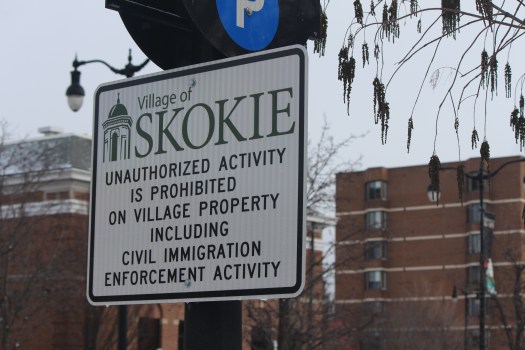
Johnson issued a new executive order Monday that he said prohibits federal immigration authorities from staging and carrying out operations on city-owned land, such as vacant lots and parking garages. He did not at the time give a clear answer when asked if police would be used to enforce the rule. Instead, he named the city Law Department as an enforcement mechanism.
“If someone is in violation of the law, we’ll take them to court,” he said Monday.
Hours later, Snelling told reporters: “We do not interfere with the duties and responsibilities of federal agents. We don’t have to agree with it. It doesn’t matter.”
Snelling warned more violence between protesters and federal agents will occur if the city does not share a clear stance on such arrests.
But Johnson Tuesday struck a different tone. Violations of his new order are not only civil offenses but criminal ones, he said.
“We’re going to see people in court,” he said. “As far as other authority that allows for us to be able to enforce this ordinance, we’re exploring.”
Johnson said the agents should be charged “by the entity they are violating, the city of Chicago.” He did not give a clear answer when asked if he wants O’Neill Burke to charge them. “I’m saying that they should be held accountable,” he said.
Johnson also struck a less conciliatory tone than Snelling when asked about the top cop’s remarks that “there are some things we can work on” regarding communication during chaotic scenes involving federal agents such as Saturday’s demonstrations in Brighton Park.
Conservatives have been in a furor after an internal dispatch from the department’s chief of patrol that read, “no units would respond” to a call for assistance from armed Border Patrol agents who said they were in the middle of a crowd about two hours after being targeted in two hit-and-runs, and shooting a woman allegedly trying to “box them in” during one of the crashes.
Snelling on Monday denied that officers had been told to stand down, but did concede, “I will say there was a lot of miscommunication, back and forth about what was really happening out there on the ground, and we need to do better.”
The mayor, who appointed Snelling, denied that Chicago police did anything wrong. He pinned blame on a non-communicative and overly aggressive federal government.
“We had to put this clear protocol in place so that everybody knows that when our Police Department shows up, their first job is to make sure that that scene is protected. … In the event that scene begins to become clear that this is an ICE operation, obviously without a criminal warrant, our local law enforcement will not dub as federal ICE agents.”
Chicago’s Welcoming City ordinance prohibits local police from assisting federal immigration authorities with operations, but they are still obligated to respond to enforce the law and respond to potential illegal action. Johnson indicated Saturday’s internal CPD message of “no units would respond” was “necessary to reassure people that we are following the local ordinance.”
Johnson continued to further blast Trump’s efforts to send federalized National Guard troops and ramp up deportations in the city throughout his Tuesday morning news conference. He argued the president’s actions are an effort to strike fear into “Black and brown and Asian people” who are gaining power.
“They want those families to be afraid because they see the tides are turning, that you have more conscientious people who understand our collective responsibility from one to another,” he said. “It’s white men who are afraid of people being educated. That’s what they are afraid of. It’s why they’re sowing seeds of division within communities. They’re afraid of us uniting.”
Chicago Tribune’s A.D. Quig contributed.