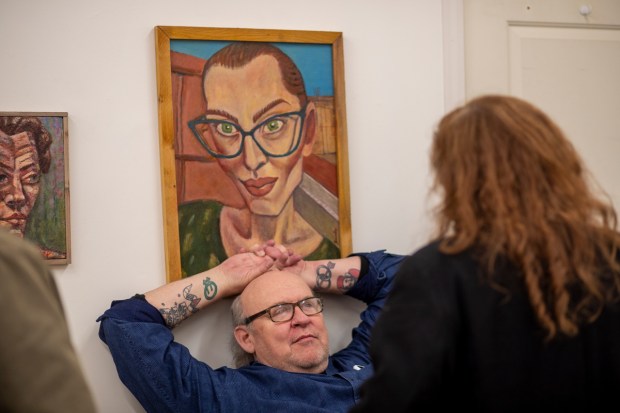


If it is possible to take the measure of a person by how the internet responds to their death, then Tony Fitzpatrick was a giant.
Thousands of memories and good wishes and stories have been pouring forth since Fitzpatrick, a man boundlessly creative in many realms — visual arts, theater, film, radio, literature and random conversations — died Saturday morning at Rush Medical Center in Chicago. He was 66.
His wife, Michele, was with him and said the cause of death was a heart attack. Their children were there too, son Max and daughter Gaby (Gabrielle).
“He was the love of my life. I am so incredibly grateful to have been able to share the past 35 years with him,” Michele Fitzpatrick said Sunday. “He was such an optimist, always on the phone, checking in with all of his friends and family, wanting them to know that he loved them. He wanted to share his success with others and mentored so many young artists. I have been overwhelmed by the number of people reaching out to me, telling me they would not have a career if it had not been for Tony.”
Max Fitzpatrick, an actor and filmmaker who co-hosted a podcast with his dad, said, “My dad was my world. I attached my string to him and went wherever he could take me. He showed me an entire world that said it was possible to be anything you want to be so long as you do it with charm, humor, creativity and style. His work ethic was second to none when it came to his art. All of his work was an adventure, and I will never forget him pulling me to the side and telling me stories for every single detail of one of his pieces.”
Fitzpatrick had been in the hospital for four weeks, awaiting a double lung transplant. He was palpably optimistic as he entertained the nurses on the intensive care floor with his stories and welcomed a steady stream of visiting friends and admirers.
“Without fail, every night Tony was in the hospital, his friend Dave Bonomi, the owner of Peanut Park, sent dinner for the entire nursing staff in the ICU at Rush,” Michele said.
As he recently told an old friend, “It seems like everybody wants to wish me well.”
The people visiting took photos with him, listened to what he thought of contemporary politics and politicians (as usual, not much) and heard him talk enthusiastically about the future.
“His health? He put up an honorable fight, never gave up,” Max said. “He can now rest with Studs Terkel, Mike Royko, Nelson Algren and Lin Brehmer as one of the greatest Chicago storytellers there ever was. He did everything and he did it his way.”
Anthony Fitzpatrick was born in November 1958, the fourth of eight children of his mother, Annamae, a writer, and his father, James, a burial vault salesman, whom the young Tony would often accompany on drives across the city as he sold vaults, embalming fluid and insurance. “He gave me stories, insight and love,” he would recall.
Born and raised in the western suburbs, Fitzpatrick was a relatively aimless and hard-drinking young man.
Those who knew Tony then found him a little angry, a bit crazy, searching for ways to express himself. He would find it first in art, as in the crude but striking drawing he handed to a Tribune reporter at a 1981 memorial service for the recently deceased and by then nearly forgotten writer Nelson Algren, held at Second City. “This was drawn with old cigarette butts,” he said.
What academic training he had in the arts took place at the College of DuPage. As he said about the school some years ago, “So much of my creative life began here. I did my first acting here. I started to seriously write poetry here. I made art here.”

His distinctive collage style of art would go on to be coveted by collectors and museums, but he told the Tribune in 1995 that he was made to feel like an outsider. Galleries had ignored his work, he said. “I don’t mind a guy looking at (my work) and saying, ‘It’s not for me.’ Hey, it’s America. But they wouldn’t even take a look.”
He would band together with other independent-minded young artists — among them Chicago artist Tim Anderson — and stage independent exhibitions, such as the “Cold House” show in the former Soo Terminal south of Roosevelt Road. In time, he created his own space, the World Tattoo Gallery at 1255 S. Wabash Ave., the first of what would be a series of spaces where he showed his work but also gave wall space, and recognition, to a vast number of upcoming artists. He would warm to some gallery owners, showing (and selling) his work in New York and New Orleans. His work graced album covers and museum walls.

He stopped drinking, married Michele in 1991 and dove into life with stunning energy.
Fitzpatrick believed in the power of working across different media, and acted and wrote prose and poetry. Algren’s influence was everywhere in his early writing: the grittiness, the love-hate relationship with Chicago. His first published poem, written for the bygone literary magazine Nit & Wit, was called, appropriately enough, “Algren Street.”
His theater pieces were often autobiographical. “Stations Lost,” about his travels to Istanbul, played in Steppenwolf’s Garage Theatre in 2011. A Tribune review described it as 105 minutes of monologues, travelogues and musical interludes that “does not feature conventional theatrical rhythms. Rather, it ebbs and flows, amping up and cooling off. There’s food for thought, but the whole collage-like affair is also remarkably relaxing.”

His voice was common on radio stations, especially WLUP. He could be found at poetry slams and on stages and screens, in such films as “Primal Fear,” “Mad Dog and Glory” and “Philadelphia,” and most recently as a security guard in the “Patriot” TV series.
A mural he created in honor of former Steppenwolf Theatre artistic director Martha Lavey, titled “Night and Day in the Garden of All Other Ecstasies,” was installed in 2021 on the exterior of the theater’s expanded campus on Halsted Street. Although he said later that summer that a show at the Cleve Carney Museum of Art in Glen Ellyn would be his final solo museum exhibition, he continued to show his work at his Dime Gallery on Western Avenue in the Wicker Park neighborhood.

He was as busy as ever these past weeks. “I flew in from Florida to see him Thursday,” said his younger brother Kevin, one of the seven surviving siblings. “He said, ‘Well, OK, I can fit you in between two and three that afternoon.’”
On Oct. 4, he “hosted,” via Zoom, the opening of his new art exhibition, “Songbirds and Crucifixions” at Great Lakes Tattoo. He was giving interviews about his new book, a spectacular 113 pages titled “The Sun at the End of the Road,” published by Eckhartz Press. Some consider it a memoir and indeed that is one element. But here is how Fitzpatrick put it: “Here is some of what I remember, some of what I have learned and damn near all of what I love — birds, stories, people and dogs.”
He was planning to appear in a play based on his new book as part of Steppenwolf Theatre’s LookOut series. There has been talk of some sort of theatrical tribute.
“There isn’t a museum, nor a stadium, not even an ocean large enough to fit all the words I’d write to describe my father, who was beloved by everyone he knew. He had a million best friends,” daughter Gaby Fitzpatrick, a filmmaker and activist, said Sunday. “He was my best friend. My confidant. He made everything we did together feel like a sort of expedition. Dinners. Art openings. Walks to the Humboldt Park lagoon. When I was a teenager, I was in trouble all the time. With everyone except for him. For I could do no wrong in his eyes. I swore, spat, smoked and shoplifted, and I was still his shining star.
“I have never felt alone in this life, because I have always had him. And I will never lose him. And he and I will always be a part of this great big world.”
A memorial service is being planned.