
Editor’s note: This is Part 2 of a two-part series on crime solutions from Katie Hill and Jens Ludwig of the University of Chicago Crime Lab. Read Part 1 here.
Some of our fellow Chicagoans have come to think of our local criminal justice system as a “sickness” to be “eradicated.” Last week, we argued that we should be thinking about enforcement and root cause efforts as complements, not substitutes. But progress on that front will also require some clear-headed thinking about what we mean by “root causes.”
One thing we’ve come to hear a lot here in Chicago is some version of “we’ll never end gun violence until we solve the problem of poverty.” That would be depressing if it were true because, given the difficulty of solving poverty and its geographic concentration, it would be condemning the city to decades more of uncontrolled gun violence.
Luckily, that is not true. Ending poverty is neither necessary nor sufficient for solving the problem of gun violence in Chicago. And there are other root causes that are much easier to solve that are at least as important.
When we look at the rate of shootings per capita across Chicago’s 77 neighborhoods, we can see that all the rich neighborhoods are safe, while all the areas with high rates of gun violence are poor. But it is not true that every poor area has lots of shootings. Gun violence is not just a mechanical function of poverty.
The data suggests that what distinguishes similarly poor neighborhoods that have higher versus lower rates of gun violence is not just neighborhood poverty but also neighborhood vibrancy — the degree to which neighborhoods have more people out and about. This is what urban planner Jane Jacobs famously called “eyes upon the street”: people available to step in and interrupt the arguments that too often escalate into shootings.
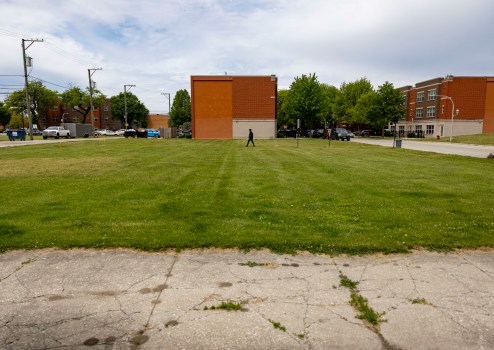
This is good news, in the sense that increased neighborhood vibrancy is much easier to achieve than eradication of poverty. There is a growing body of research from around the country showing that, for example, cleaning up vacant lots or fixing up abandoned houses gets people out of their houses into the community and generates surprisingly large changes in local gun violence, by as much as 30%. Adding street lighting can also help. So can making it easier to zone and build new commercial establishments. None of that is cost-prohibitive. Let the abundance agenda begin in our city’s most disadvantaged neighborhoods.
Put differently, if we’re taking a “root causes” approach, there are some underappreciated root causes that we can do something about.
Note also that solving gun violence by expanding the set of root causes we worry about isn’t ignoring the problem of poverty; it’s creating the conditions necessary to make more progress on the poverty problem. Our University of Chicago colleague Steve Levitt and University of California San Diego economist Julie Berry Cullen have estimated that every homicide reduces a city’s population by 70 people, leading more people to move out and fewer to move in.
There are many reasons Chicago’s population has shrunk by a million people since 1950, but the math suggests gun violence is among the more important ones. And this population decline has major downstream consequences: It’s why we struggle with so many underenrolled schools, why it’s hard to convince new businesses to open and stay in so many of our city’s neighborhoods, and why our city’s tax base isn’t close to what we need to pay our current bills, much less cover our unfunded pension obligations.
In terms of making our city much safer, root causes versus enforcement is simply not the right question. We need to get both sides of this right. Lord knows there is much more we can do to make our local criminal justice system better, but that needs to be matched with a sharper focus on those root causes that local government can do something about — now.
Katie Hill is executive director of the University of Chicago Crime Lab. Jens Ludwig is the Edwin A. and Betty L. Bergman distinguished service professor at the University of Chicago, Pritzker faculty director of the University of Chicago Crime Lab and author of “Unforgiving Places: The Unexpected Origins of American Gun Violence.”
Submit a letter, of no more than 400 words, to the editor here or email letters@chicagotribune.com.