
WASHINGTON — President Donald Trump has long wielded sharp rhetoric as a political weapon — who can forget “Crooked Hillary” Clinton or “Sleepy Joe” Biden? — but in his second term, the president’s language and that of his top aides has taken an even darker turn.
Rather than just suggesting Democrats and other opponents are incompetent, Trump and his supporters have increasingly cast their critics, including other elected officials, as illegitimate and even dangerous. Just in the past few weeks, they’ve described Democratic senators who continue to reject a Republican budget deal as negotiating like “terrorists” and said those attending Saturday’s nationwide anti-Trump “No Kings” rallies “hate America.” The president himself went so far as to say last week that Democrats follow “the devil’s ideology.”
Perhaps nowhere in the country has Trump focused his efforts to discredit his opponents more than on the Chicago area, where his Department of Homeland Security called some protesters in suburban Broadview “antifa-aligned rioters,” referring to the nebulous but global anti-fascist movement the administration recently designated as a domestic terrorist organization. Trump and other officials routinely ridicule and mock local and state politicians, with the president himself calling for Democratic Gov. JB Pritzker and Mayor Brandon Johnson to be jailed for undermining the Trump administration’s immigration efforts.
Trump and his Republican supporters justify their words by saying Democrats have amped up their own rhetoric. They point to examples of prominent Democrats vilifying federal Immigration and Customs Enforcement agents by referring to them as “slave patrols,” “fascists” or “the Gestapo,” the secret Nazi police. Pritzker has been particularly outspoken. The Jewish governor in a joint address to state lawmakers in February compared the Trump regime’s early actions to the rise of the Nazi Party in 1930s Germany.
But experts who study the backsliding of democracy around the world say the marked change in tone — along with aggressive tactics from the Trump administration — follows well-established patterns that authoritarian leaders in places like Hungary, Russia, Turkey and Venezuela used as they consolidated power.

“There has certainly been a shift since the first Trump administration, and even since the beginning of this Trump administration,” said Michael Albertus, a political science professor at the University of Chicago who studies democracy and dictatorship.
“(They) demonize their opponents and use this kind of ‘othering’ rhetoric that insinuates that opponents are not legitimate political opposition but rather that they’re trying to undermine the government, that they’re trying to undermine society in some way,” he said.
Those experts also worry that the words from Trump and his top aides carry greater significance than just political insults.
“He’s constantly using terms that are both dehumanizing and insulting, but also that have triggers in U.S. law,” said Nicholas Grossman, a political science professor at the University of Illinois at Urbana-Champaign. “You can’t shoot protesters, but you can shoot insurrectionists. So if you lie that protesters are insurrectionists, you’re granting yourself new powers.”
That idea of Trump sweeping up even more presidential power took on new dimensions late last month when he spoke to the country’s top military officers and suggested faulty leadership from “radical left Democrats” cleared the way for military takeovers of U.S. cities.
“The (cities) that are run by radical left Democrats — what they’ve done to San Francisco, Chicago, New York, Los Angeles. They’re very unsafe places and we’re going to straighten them out one by one,” the president told admirals and generals, in a sharp departure from his standard remarks. “This is going to be a major part for some people in this room. That’s a war too. It’s war from within.”

“We should use some of these dangerous cities as training grounds for our military, National Guard, but military. Because we’re going into Chicago very soon,” Trump said just days before he ordered National Guard troops be deployed to the Chicago area, an effort currently stalled but wending through federal courts. “That’s a big city, with an incompetent governor, stupid governor, stupid.”
Indeed, Pritzker has been a target of Trump’s escalating language for months now. A fellow billionaire and prominent Trump foe, Pritzker most criticized the president’s inflammatory rhetoric with fiery words of his own during a meeting with Democratic activists in Atlanta earlier this month.
“Trump’s treasonous words,” the governor said, “are leading to treasonous actions.”
“Beating back an authoritarian regime starts with the resistance that can effectively ridicule the opposition and look into the camera and say, ‘This guy is full of s—,” Pritzker said.

And a federal appeals court in Chicago rebuked the Trump administration Thursday for mischaracterizing its political adversaries to justify its attempt to deploy the National Guard to Chicago.
“Political opposition is not rebellion,” wrote the three-judge panel.
“The spirited, sustained, and occasionally violent actions of demonstrators in protest of the federal government immigration policies and actions, without more, does not give rise to a danger of rebellion against the government’s authority,” 7th Circuit Court of Appeals Judges Ilana Rovner, David Hamilton and Amy St. Eve said in their decision.
Included in the White House’s increasingly aggressive actions against political opponents are federal agents using helicopters and tear gas to carry out immigration raids in the Chicago area.
In addition, the White House is reportedly planning coordinated investigations into the finances of left-leaning groups, including ActBlue, a Democratic campaign finance operation, and Indivisible, a progressive grassroots organization. And while Trump’s previous calls to imprison political opponents such as Hillary Clinton came to nothing, his pursuit of political revenge in his second term prompted the indictment in the last few weeks of longtime foes former FBI Director James Comey, former national security director John Bolton and New York Attorney General Letitia James.
A new governing ethos
Now entering its third week, the federal government shutdown illustrates not only the administration’s dismissive approach toward Democrats — even when they need Democratic votes to reopen the government — but also the ratcheted-up language that Trump and his allies use to paint their opponents’ concerns as outlandish.
“The Democrats,” Treasury Secretary Scott Bessent told CNBC, “want to negotiate like terrorists.”
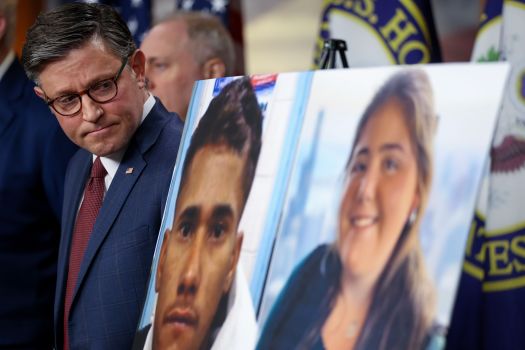
Republican House Speaker Mike Johnson of Louisiana, who has kept the House out of session since the shutdown started Oct. 1, added that Democrats were beholden to violent supporters in their own political base who he said were behind the “No Kings” demonstrations Saturday in Washington, D.C., and across the nation, including in Chicago.
“They have a ‘Hate America’ rally that’s scheduled for Oct. 18 on the National Mall,” Johnson said earlier this month during a Fox News interview. “It’s all the pro-Hamas wing and the antifa people, they’re all coming out. … It’s being told to us that they won’t be able to reopen the government until after that rally, because they can’t face their rabid base.”

U.S. Rep. Tom Emmer of Minnesota, another top Republican, said Democrats were trying to “score political points with the terrorist wing of their party” with the rallies.
While the rhetoric has hit many similar notes as the president, Trump’s actions have targeted Democratic priorities during the shutdown.
The administration put on temporary hold funding for critical, high-profile infrastructure projects in New York and Chicago, including the CTA’s Red Line Extension, and halted hundreds of clean energy projects in blue states, including $583 million for Illinois projects, as the shutdown began.
Trump hasn’t shied away from the political favoritism behind the decisions.
Democrats, he said, had given him an “unprecedented opportunity” to cut “the many Democrat Agencies, most of which are a political SCAM.” Last week, he started mass layoffs of federal employees handling disease control, housing discrimination cases and special education programs, among others, to push Democrats into supporting the GOP plan.
The administration posted notices on federal agency websites blaming “Democrats” or the “Radical Left” for shutting down the government.
Accusations of violence
Meanwhile, top Trump administration officials blame Democrats for the recent proliferation of political violence, including the killing of conservative commentator Charlie Kirk and last year’s failed assassination attempt on Trump.
“These are not lone, isolated events. This is part of an organized campaign of radical left terrorism,” said White House Deputy Chief of Staff Stephen Miller, one of Trump’s most trusted advisors. “It is structured, it is sophisticated, it is well-funded, it is well-planned. There is really no parallel like this to anything else in the country right now.”
Many researchers, though, have found that right-wing political violence has been far more deadly than left-wing violence in recent decades, although the overall numbers for both remain small.

Miller, who oversees domestic policy in the White House, has been among the administration officials most dismissive of Democrats, judges, protesters and other people who have tried to impede the administration.
“The Democrat Party does not fight for, care about or represent American citizens. It is an entity devoted exclusively to the defense of hardened criminals, gangbangers and illegal alien killers and terrorists,” Miller told Sean Hannity on Fox News in August. “The Democrat Party is not a political party. It is a domestic extremist organization,” he said, as he said Chicago officials had “handcuffed” law enforcement.
Miller later on social media accused a federal judge in Oregon — a former Republican prosecutor who was named to the bench by Trump in his first term — of “legal insurrection,” after she issued a temporary order preventing the administration from deploying National Guard troops to Oregon.
In a separate social media post, he accused Democrats of attempting to nullify Trump’s 2024 presidential election.
Since November, he wrote, “there has been a nonstop campaign of criminal obstruction, threats, harassment, doxing and grave physical attacks and riots against ICE agents — stoked endlessly by Democrats — to reverse the election result by violence. This large-scale political violence is domestic terrorism.”
A dangerous path
Jonathan Katz, who researches the characteristics of thriving democracies for the Brookings Institution in Washington, D.C., warned that “otherization” — rhetoric that paints political opponents as “less than” other citizens, as criminal, illegitimate or worthy of being targeted — is frequently used in societies that regress from democracy into authoritarianism.
“History is littered with delegitimization being used as a tactic,” he said. “Sometimes it is merely rhetorical bubbling, and sometimes it leads to a Navalny situation, where you have political opposition that is locked up.” (Russian dissident Alexei Navalny was an opposition leader and political prisoner before he died in 2024 under suspicious circumstances.)
Albertus, from the University of Chicago, said targeting free speech is common in countries where democratic institutions have been weakened.
“There’s no question that considering protest, not as a form of patriotism but rather as a form of illegitimate dissent, is very common among regimes or governments that have leaders with authoritarian tendencies,” he said.

But in the U.S. today, there is no evidence of a widespread conspiracy against the government, Albertus said.
“It’s not like you have a large-scale, organized set of agitators that are specifically attempting to use violence at these occasions. … These are peaceful protests about policies that are being implemented on the ground,” he said.
He said the Trump administration is “tilting the democratic playing field” by demonizing political opponents and ignoring legal constraints on executive power. It’s still conforming with many political and legal norms to keep the government operating smoothly, even as it makes moves that are “testing the boundaries of the rule of law and that move beyond the boundaries of law,” Albertus said, which is a common feature of “competitive authoritarian” regimes.
Grossman, the University of Illinois professor, said the Trump administration’s approach during the president’s second term has been that there is “no space for political opposition,” which is “why political scientists and others are using terms like ‘authoritarianism’ and ‘fascism’ or other words.”
He pointed to a famous saying from political scientist Adam Przeworski: “Democracy is a system in which parties lose elections.”
“Parties that lose an election,” Grossman said, “will take their case to the people and (try to) win the next election. Trump and the Republicans have not been operating that way at all.”
When Miller, the Trump advisor, dismisses the Democratic Party as a “domestic extremist organization,” he’s trying to shift the mindset of the public, the courts, Congress and the media to act as if the country is at war, Grossman said.
“When the way people are operating is in a war mentality, that gets rid of a lot of what we would consider the ‘legal niceties’ of peacetime. The ‘you’ve got to kill people before they kill you’ logic takes over,” he said.
And when Trump, Miller and other administration officials repeatedly lie about the state of affairs in Chicago, Portland or Washington, D.C., Grossman added, they’re trying to shift public perception.
“You get stories about ‘What can Trump do with the Insurrection Act?’ and that type of discussion,” Grossman said, “as opposed to what it should be: ‘The Insurrection Act doesn’t apply at all.’”

Grossman also dismissed the idea that comparing ICE agents to the secret police, or Gestapo, of Nazi Germany, amounts to a threat. Politicians frequently use over-the-top historical comparisons to attack their enemies, the professor noted, including Trump who during last year’s presidential campaign called former Vice President Kamala Harris a “communist,” a “Marxist” and a “fascist.”
Besides, Grossman said, Trump’s Make America Great Again movement does align with both historical and theoretical definitions of fascism.
“The United States has not had a secret police before,” he said.”Hiding their faces and violating rights and claiming that they can do all of this without needing warrants, without following proper legal procedures and due process, that is some real SS stuff. That’s an appropriate historical analogy even if it’s not identical.”
Katz from the Brookings Institution said preserving free speech and the freedom of assembly is not only important now, but it could have implications for the viability of midterm elections in 2026.
“You want to make sure that those voting in elections feel safe and secure to go to the polls, and in the same way you want the ability to have protests and to do it freely in a way that … reflects the right of Americans to speak out,” he said. “When people feel like that is threatened, it can have a chilling effect for people to engage in their democracy.”
Vock is a freelance reporter.