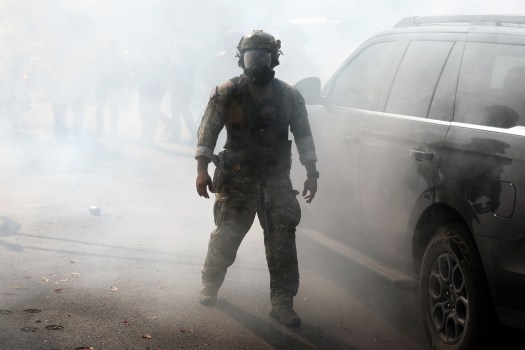

A pair of immigration officials testifying in federal court Monday defended their agencies’ use of force with protesters and media during the Trump administration’s ongoing “Operation Midway Blitz,” saying agents have been put in dangerous situations on the streets, pelted with eggs and rocks and forced to use tear gas and other tactics to get out of pop-up protests in dense neighborhoods.
But at the same time, the officials told U.S. District Judge Sara Ellis that all agents had been fully briefed on the judge’s temporary restraining order restricting the use of tear gas and requiring body-worn cameras for all officers in the field to be turned on during enforcement actions.
“We take these (temporary restraining orders) very seriously,” Kyle Harvick, deputy incident commander for Customs and Border Patrol, told Ellis, adding that in addition to being emailed to every agent in the field, Ellis’ orders have been discussed at length during daily morning briefings.
Harvick, who appeared in Ellis’ 14th floor courtroom dressed in full uniform, told the judge that 40 new agents were coming into the Chicago area Monday as part of a rotation of personnel and “the TRO will be in front of them.”
Harvick and his counterpart at U.S. Immigration and Customs Enforcement, deputy field director Shawn Byers, both were called into court to answer questions from Ellis, who said last week that she had “profound concerns” her orders were being violated, particularly during separate incidents in Albany Park on Oct. 12, and on the city’s East Side two days later.

Ellis’ questioned Harvick and Byers for nearly four hours during what was mostly low-key and non-confrontational testimony. At the end of the day, the judge said she was not quite satisfied with the limited information they had on some topics, but stopped short of finding that her restraining order had been violated.
Ellis did, however, order that the plaintiffs be allowed to depose two of the key figures in the immigration blitz: Border Patrol Cmdr. Gregory Bovino and Russell Hott, a field director for Immigration and Customs Enforcement who last week was redeployed to Washington.
The judge limited the questioning to two hours and told lawyers the topics would be limited to the specific allegations in the injunction request.
“Questions about the (Trump) administration’s goals and objectives about a stepped up immigration enforcement operation in Chicago? Not relevant,” Ellis said. “I don’t think it matters … what ideology is pushing this enforcement action.”
A daylong hearing on a more extended injunction is scheduled for Nov. 5.
Under questioning by Ellis, Harvick said he was told by the supervisor who was at the scene in the Albany Park incident that the protesters had been warned that tear gas was going to be deployed before the order was given to do so. He said the crowd was growing by the minute and trying to prevent the agents from leaving.
“The situation gets more and more dangerous the longer we are there,” he said. “It’s a dynamic situation, and speaking to my supervisor, the subjects that were blocking our egress had linked their arms together, which is active resistance. They were given lawful orders to get out of our way so we could depart and continue with our duties.”
Testifying about a similar incident Oct. 14 on South Avenue N, Harvick said agents conducting an immigration enforcement action spotted “some subjects suspected of being illegally present” and approached their vehicle on foot. The vehicle then drove at the agents’ parked vehicle nearby and struck it, leading them to follow and request backup.
Other units responded and “that is when an accident occurred,” Harvick said.

Video since released publicly showed the agents used a controversial and potentially dangerous maneuver known as PIT, striking the fleeing car from behind and causing it to spin out of control. Ellis did not ask any questions about the maneuver, however.
After the crash, “people came out of their homes and then more and more people started to come, and some of those individuals started throwing objects,” Harvick said, including “eggs, bricks and metal objects of some sort.” One agent was struck in the side of the head with an egg, he said.
In the ensuing confrontation with protesters, Harvick said, “lawful orders were given to move back, which were disobeyed, so much so that we had two vehicles’ tires slashed and a rear window was broken out.”
Harvick said the scene had become unsafe and an order was given to deploy tear gas.
At one point, Ellis asked Harvick why agents are often using masks during operations.

“I think mostly your honor it’s for doxing cases that we have experienced for agents or their families,” Harvick said.
So it is essentially to hide their identities? the judge asked.
Harvick replied sometimes it’s just because it’s cold outside.
In his testimony, Byers said there were no specific policies when it comes to how ICE treats members of the media, but acknowledged agents know it’s pretty much “hands off” as long as they are credentialed reporters or photographers.
“There are people with cellphones that call themselves journalists with no press credentials,” Byers said. “Different story.”
Byers’ testimony focused largely on the ICE facility in west suburban Broadview, which has been a flashpoint for protests where agents have deployed tear gas and other less-lethal munitions to disperse crowds. Byers said in Broadview, he has instructed agents to give three warnings before using such methods, first instructing protesters to leave and also explaining what might happen if they did not comply.
The judge questioned Byers about a controversial incident last month outside the Broadview building where Chicago Pastor David Black, of the First Presbyterian Church in Woodlawn, was hit in the head with a pepper pellet fired by agents from the roof. Video of the incident showed Black falling to the ground as others came to his aid.

Byers said the videos he’d seen on social media are misleading.
“So you believe that the videos have been edited?” Ellis asked.
“What’s not being shown is that he was being given multiple commands to remove himself from the property,” Byers replied.
Ellis asked both Harvick and Byers if they were aware of any agents who have been disciplined for a use of force violation during Chicago immigration operations. Both said they were not.
Ellis entered her temporary restraining order two weeks ago in response to a lawsuit filed by a consortium of media outlets. She called Monday’s hearing after the incidents in Albany Park and the East Side were called to her attention by the plaintiffs last week as potential violations.
“I live in Chicago if folks haven’t noticed,” Ellis said in court Thursday. “And I’m not blind, right? … I’m getting images and seeing images on the news, in the paper, reading reports where I’m having concerns about my order being followed.”
She also said she was upset over the government’s lack of response on the body camera issue. “This was not a suggestion, it was not a hint, it wasn’t a topic of conversation. It was an order,” she said last week.
On Friday, Ellis modified the restraining order to say agents “currently equipped and trained with body-worn cameras” must have them turned on when interacting with the public on immigration-enforcement missions.
Ellis had initially ordered Hott to court, but attorneys for the government later said he’s leaving his position in Chicago and returning to Washington, D.C..
“As long as I get the answers that I want,” Ellis said Friday. “I don’t want anyone to get up there and say, ‘I don’t know,’ or ‘Not my responsibility,’” she said.
jmeisner@chicagotribune.com