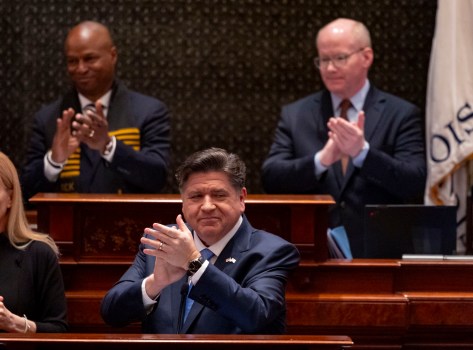
Mayor Brandon Johnson’s proposed 2026 budget fails to confront Chicago’s deep structural financial crisis.
Blaming President Donald Trump’s budget cuts for Chicago’s meltdown is political theater. The city’s chronic deficits are homegrown and fueled by reckless borrowing, bloated pensions and decades of unchecked spending.
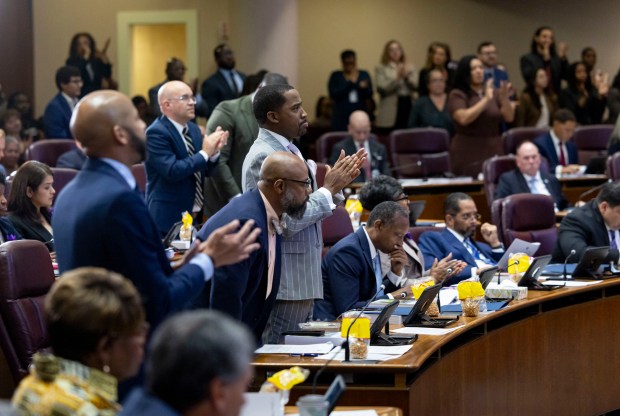
Last year, the City Council demonstrated that it could challenge the mayor’s fiscal agenda. It must do so again. Chicago doesn’t have a revenue problem; it has a spending problem. And there is a clear path toward fiscal sanity.
The one clear winner in the budget plan is Chicago Public Schools, which stands to gain a staggering $522 million from tax increment financing districts. The City Council must restore fiscal independence by ending Chicago’s role as a perpetual financier of the district, a pattern that began under Rahm Emanuel, continued under Lori Lightfoot and now has reached full capture under Johnson. CPS has roughly 45,000 employees — about one employee for every seven students. By contrast, the Chicago Police Department — routinely vilified by the Chicago Teachers Union — has around 11,500 sworn members.
The City Council should mandate that CPS use its TIF funding to offset city subsidies, relieving pressure on taxpayers while avoiding destructive tax hikes. These subsidies include $175 million for a municipal pension payment, $142 million for CPS debt service, $7.9 million for modern schools bond payments, $27 million for free or reduced CTA student fares, $11 million in city fee waivers and other city-funded services provided to CPS.
Rather than relying on city taxpayers, Johnson and the CTU should focus on achieving equitable state funding for the Chicago Teachers’ Pension Fund (CTPF). This has become even more urgent after Gov. JB Pritzker approved generous pension enhancements for police and fire, adding $11 billion in new pension debt and $60 million in annual costs to the city.
If the state funded Chicago teacher pensions at the same rate it does for other Illinois districts, the city could redirect the $558 million property tax levy now dedicated to teacher pensions to stabilize municipal employee funds — especially for police and fire — and free $170 million annually for classroom support.
Currently, the state covers only 32% of employer contributions to Chicago teacher pensions, compared with 98% for all other districts. This disparity is indefensible. Pension equity is not a bailout; it’s fairness. More importantly, achieving it doesn’t require the governor to increase overall K-12 spending — it only requires parity in how funds are distributed.
Pritzker, despite CTU criticism, has largely delivered on the union’s wish list — limiting charter growth, ending private school scholarships and restoring full bargaining rights. He should now reestablish the Chicago School Finance Authority, with full oversight powers over CPS budgets, contracts and management. Doing so would restore fiscal discipline and reduce CPS’s dependence on city subsidies.
City Hall must implement structural reforms:
- Return nonpersonnel and pension budgets to pre-COVID-19 levels.
- Apply zero-based budgeting across all departments, including CPS and the CTA, requiring annual justification for every expense.
- Phase out one-time expenditures funded by COVID-19 relief or TIF windfalls.
- Reform procurement processes. Nonpersonnel spending has ballooned by $3.3 billion since 2019.
- Maximize collections for city services, especially emergency medical services, which leave hundreds of millions uncollected.
- Pursue legal action to renegotiate the parking meter deal, already fully repaid to investors with 60 years still remaining.
- Consolidate pension investments under an independent board to boost returns and remove political interference.
- Conduct a full public safety audit to reduce police overtime and redirect savings toward restoring officer strength.
Additionally, Chicago must confront its ballooning litigation costs. The city should establish a dedicated litigation unit within the Law Department and seek state legislation to cap lawsuit payouts.
Finally, the City Council should create a permanent independent budget office modeled after New York City’s, with full staffing, audit authority and subpoena power. This office must ensure complete transparency and data access.






Paired with a truth in budgeting ordinance modeled after the federal Congressional Budget Office, the city would finally adhere to a predictable budgeting calendar — with mandatory hearings, regular reporting and published financial updates.
Now more than ever, the council must restore fiscal honesty, protect taxpayers and create the conditions for revitalization.
Paul Vallas is an adviser for the Illinois Policy Institute. He ran against Brandon Johnson for Chicago mayor in 2023 and was previously budget director for the city and CEO of Chicago Public Schools.
Submit a letter, of no more than 400 words, to the editor here or email letters@chicagotribune.com.