SPRINGFIELD — Amid growing public pressure for Illinois leaders to take a stronger stand against the Trump administration’s aggressive immigration enforcement in the Chicago area, the Illinois General Assembly early Friday approved legislation barring federal agents from making arrests near courthouses and allowing individuals to sue if their rights are violated during civil immigration arrests.
The legislation came in response to what one of the bill’s sponsors, Democratic state Sen. Celina Villanueva of Chicago, described as “the reality of the pain and the cruelty and the inhumanity that’s being inflicted on my community, on my district, on the communities in this state — that are also American — for the simple fact of looking the way that I do.”
“I’m going to fight back,” she said on the Senate floor late Thursday, shortly before the bill passed 40-18. The Illinois House passed the legislation 75-32 a little more than an hour later.
While supporters applauded the bill’s passage, even its key sponsor, Senate President Don Harmon, called it “imperfect.” But he said Democratic lawmakers in Springfield felt the need to act, as state and local officials have often felt hamstrung in countering the federal government’s often-aggressive tactics.
“I’m prepared for this law to be challenged, but I think we still have an obligation to try to do something,” Harmon, of Oak Park, told a committee hearing in Springfield Thursday. “There is no need for the same people who are charged with protecting our constitutional rights to violate our constitutional rights in the process.”
Under the bill, individuals could sue federal officers for knowingly violating the Illinois or U.S. constitutions during civil immigration enforcement. The bill would also codify a 1,000-foot “safe zone” around courthouses for people involved in court proceedings, free from civil arrests, in an attempt to limit potential disruptions to court activities.
U.S. Immigration and Customs Enforcement and Border Patrol activities in Chicago and the surrounding areas have come under increased scrutiny and criticism. In what the federal government has described as an initiative to deport the “worst of the worst” individuals who lack legal status, agents have repeatedly detained people first and sought information about them later, without immediate regard for citizenship or legal status.
The bill that passed Friday came together in collaboration with House lawmakers, the state attorney general’s office and the governor’s office, Harmon said on the Senate floor.
While Gov. JB Pritzker and lawmakers have used their bully pulpits to push back, and some legislators have at times taken an activist role themselves in opposition to the federal actions, the statehouse has little formal role in immigration policy.
In a sign of lawmakers’ frustration with the federal agents’ tactics, damages under the lawsuit provision could go up due to various factors. They include whether the defendant wore a mask; used crowd control equipment like tear gas; failed to identify themselves as a law enforcement officer; used a vehicle without an Illinois license plate; or failed to turn on a necessary body camera — all behaviors advocates and Democratic lawmakers have accused immigration agents of since the start of “Operation Midway Blitz” under the administration of President Donald Trump.
It doesn’t impede ICE from “doing its job lawfully,” Harmon told his colleagues on the Senate floor.
But in the floor debate Thursday, Senate GOP Leader John Curran, of Downers Grove, called those aggravating factors for damages a form of overreach.
“You are … teeing this up for the Supreme Court to set this aside. You’re actually making it easy on them,” Curran said.
Violators who arrest individuals improperly at or near a courthouse would face civil damages for false imprisonment and $10,000 in statutory damages, according to the bill. A judge will also be able to issue an order preventing arrest under the provision, according to the bill.
“When witnesses or parties don’t come to court, it doesn’t just affect them. It affects all of us,” Villanueva said.
In addition to the provisions on courts and private actions, the bill also asks hospitals, day care centers and higher education institutions to put policies on the books about how they would respond to the presence of federal immigration agents, following incidents of ICE activity at or near some of those locations across the Chicago area. It would also largely prohibit hospitals, day care centers and higher education institutions from disclosing the immigration status of patients, clients and students.
Hospitals would be fined $500 per day for noncompliance if they fail to meet the deadlines for developing their policies during the first quarter of next year. The higher education provisions on immigration status could be enforced through private lawsuits. And violations of the day care policy requirement would result in a licensing violation, according to the bill.
Democratic state Sen. Omar Aquino, of Chicago, sponsored the day care provisions after his child’s day care center went into lockdown because of nearby immigration enforcement activity, he said.
“Our kids were fine, but families were in fear because they didn’t know what to do,” Aquino said. “Here in the state, we must do something to make sure that no family feels that way.”
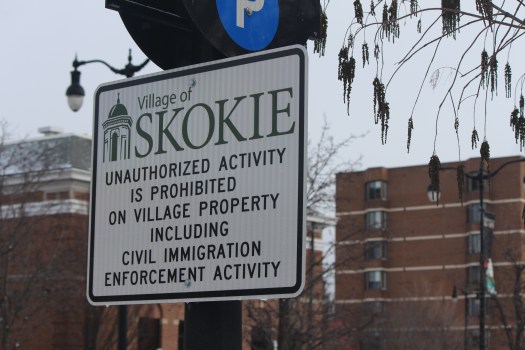
The package put forward this week doesn’t include a ban on masks for federal officers, as California enacted, or any expansions of Illinois’ existing law that generally bans local law enforcement from cooperating on civil immigration actions.
At a subject matter hearing on the legislation Thursday, representatives from local law enforcement pushed back on parts of the legislation, including the private right of action for constitutional violations, over concerns that local officers could get swept up.
“There’s going to be frivolous litigation that will be filed against state and local law enforcement officers,” even if it’s eventually thrown out, said Jim Kaitschuk, executive director of the Illinois Sheriffs’ Association.

Pritzker, for his part, on Thursday in his ceremonial Springfield office, called on top federal immigration officials, including the Border Patrol boss overseeing the Chicago operations, Gregory Bovino, to pause their activities for the Halloween weekend.
“Mr. Bovino, your operation has sown fear and division and chaos among law-abiding residents in our communities,” Pritzker said. “No child in America should have to go trick-or-treating in fear that they might be confronted with armed federal agents and have to inhale tear gas.”
At a news conference in Gary, U.S. Homeland Security Secretary Kristi Noem dismissed Pritzker’s call for the Halloween pause.
“The fact that Gov. Pritzker is asking for that is shameful and I think unfortunate that he doesn’t recognize how important the work is that we do to make sure we’re bringing criminals to justice and getting them off our streets — especially when we’re going to send all of our kiddos out on the streets and going to events and enjoying the holiday season. We want to make sure that they’re safe,” she said.
Chicago Tribune’s Rick Pearson contributed.