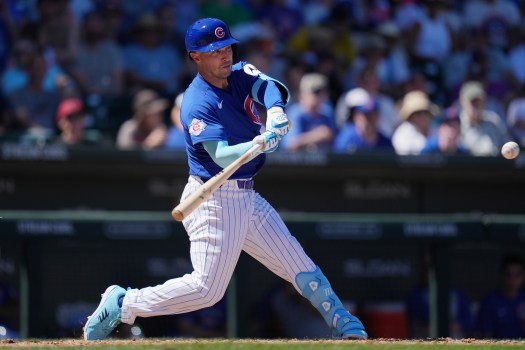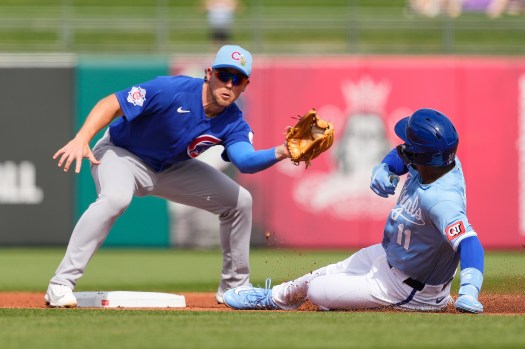


The Chicago Cubs defense became their identity over the course of a season that took them to the National League Division Series.
After producing the best defensive team in the NL this year, multiple Cubs were recognized for their individual performances.
Center fielder Pete Crow-Armstrong, left fielder Ian Happ and second baseman Nico Hoerner each won a Gold Glove Award at their positions Sunday night. Left-hander Matthew Boyd, third baseman Matt Shaw and catcher Carson Kelly were also Gold Glove finalists.
The Cubs had the most Gold Gloves of any major-league team this season and joined the San Francisco Giants as the only NL teams with multiple winners. Their 37 Outs Above Average (OAA) led the majors, and they were second (41) to the Toronto Blue Jays (45) in Fielding Run Value.
“We had an unbelievable defensive team this year, just all around,” Happ said Sunday. “We built off each other and kind of fed off each other in the energy, and it was a real source of pride amongst the group.”
LF Ian Happ, fourth consecutive Gold Glove Award

Happ became the first Cub to win four Gold Gloves since first baseman Anthony Rizzo (2016, 2018-20) and the first to win four in a row since second baseman Ryne Sandberg won nine straight (1983-91).
“Just being able to stack consecutive quality defensive seasons on top of each other is something I’m pretty proud of,” Happ said.
It has been a remarkable defensive journey for the infielder-turned-outfielder. From 2017 through 2021, Happ played multiple positions, including nearly 100 starts in the infield. He’s one of three outfielders in franchise history to win multiple Gold Gloves, along with Andre Dawson (1987-88) and Jason Heyward (2016-17).
Hoerner on watching his longtime teammate’s defensive progression: “There’s a real correlation between his ability to play infield and then how that shows up in the outfield. He has a strong arm, but he throws at a higher level than his raw arm strength because of his ability to use his feet and a quick transfer and be accurate, and he really limits guys’ ability to both advance bases but also just throwing to the right base at all times and throwing catchable balls, like it’s a huge deal and makes life a lot easier for us in the infield.”
Crow-Armstrong on playing next to Happ: “The position that he has to play at Wrigley for 81 games is a little ridiculous, the corners are so challenging. So four consecutive Gold Gloves from that guy playing in a ballpark in a left field like that, it’s no joke. Ian’s been huge. He put a lot of effort into learning left field.”
Happ pointed to how well he covered ground in left this year, which led to his Gold Glove Award, rather than the assists he racked up in previous years that had been the backbone of earning the honor.
“To do it a different way, just going out and catching the ball, it was a little bit of ebb and flow,” he said. “And just being able to go out and make those plays and feel like I had my feet under me the whole year and tracking balls down really well, I thought that was something that last year it felt like it was more arm-based. This year felt like I was back running balls down.”
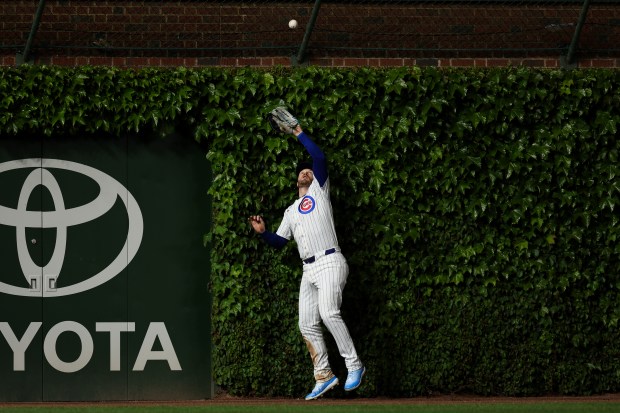
CF Pete Crow-Armstrong, first Gold Glove Award

Crow-Armstrong set a goal to win a Gold Glove this year — and every year of his big-league career — and the 23-year-old delivered an elite performance roaming center field.
“Having the defense recognized is important to me because of the story that it tells,” Crow-Armstrong said Sunday. “It’s such an offensive game right now and so centered around pitching and just nasty stuff. … The Gold Glove is the best way to recognize the impact that defense has on games when it may go unnoticed sometimes throughout the year, and I see now that you put a big enough body of work together, or you have just a clean slate like Ian, and the defense gets rewarded.”
He often made difficult plays look routine.
His 24 OAA tied for the most in the majors by any defender. On five-star catches, which occur on balls with a 0%-25% catch probability, Crow-Armstrong stood alone in converting the most difficult plays. He made an incredible 19 five-star catches and converted 59.4% of those chances. Each of those mark the most by a major-league player in a single season since Statcast first tracked those metrics in 2015.
Crow-Armstrong was proudest of his improvement in throwing decisions while crediting his work with third-base coach Quintin Berry to improve his pre-pitch setup and first step for taking his defense to the next level this year.
“The physical improvement this year coming in and really showing and drawing out a really good picture for me of how much better it could get,” Crow-Armstrong said. “I would say maturation, process-wise, the first step in the jumps got so much better and allowed me to get to the balls that I knew I could.”
Crow-Armstrong joins Bob Dernier (1984) as the only Cubs center fielder to win the award since Rawlings first presented it in 1960.
Happ on watching Crow-Armstrong’s evolution: “A lot of people talk about the athletic gifts and don’t give enough credit to the work and to the growth that he’s had over the last couple of seasons. He is a much better major-league center fielder now than he was when he first got here. … To watch him really be able to do that for a full season and not only make all the heroic plays that he can make but also the smart ones and the great decisions, it was a really fun 162 (games) to watch and one of the most impressive parts was he was out there every day. … He was an anchor out there for us.”
Hoerner on the work Crow-Amstrong put in: “For him to show up with a good version of himself every day, over six months and really not waver defensively at all, it was so impressive. … Especially with how metrics-heavy everything is now, you put him in some of those ballparks with huge gaps where he can really go and run, and I think you’d see even more of the runs saved.”
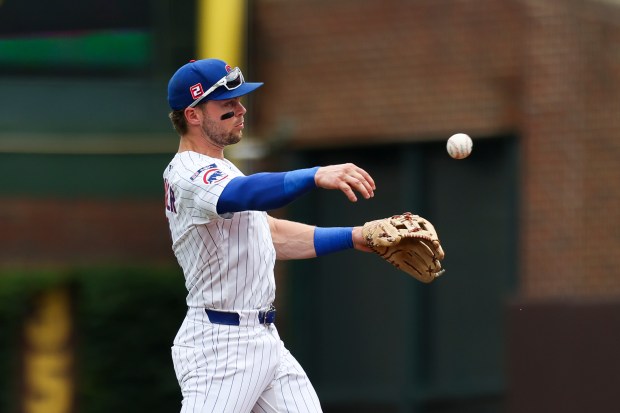
2B Nico Hoerner, second Gold Glove Award

A physically compromised Hoerner gutted through 2024 with an arm injury that required the flexor tendon to be repaired, setting up the 28-year-old to look more like the player who received his first Gold Glove Award in 2023.
An extensive rehab process that meant skipping the Tokyo Series trip had Hoerner ready for the domestic opener, and he reminded the league why, pre-injury, he had been one of the best defensive second basemen in the majors. He credited the July All-Star break for being a helpful midseason rest as he continued to get stronger and back into the flow.
“The real headspace for this season was playing second base, which is a little different than getting back to full-strength throwing,” Hoerner said Sunday. “Going through the offseason and the initial parts of rehab, it was really nailing second base first, and I’m really excited for this offseason to really get back to full strength. I’m excited to get into a throwing program (that) starts up in a couple of weeks and just really have a full time to get that under myself and not just be able to be a second baseman but really be the best athlete I can be.”
Happ on Hoerner’s dedication to coming back from last year’s surgery: “I knew how hard it was last year for him to go through that season without really being able to throw, not only not being able to throw in any of his work, knowing that if he had to let one go, it was going to hurt and knowing that he didn’t have the arm strength that he normally has. … Then to watch him go through his rehab, not be able to come to Tokyo and experience that with the team and how challenging that was for him, but stayed back to make sure that he was ready for opening day, was able to do that and to put up the season that he had — still didn’t throw pregame much in maybe until August — and to be able to do that and then put on that performance he did, it was just exceptional. I see the work that he puts in behind the scenes and his dedication to it.”
Crow-Armstrong on playing behind Hoerner: “A super intelligent and instinctual athlete, and then pairing that with the physical athleticism that he has is super cool. … The way Nico can make the plays that most guys can’t I think is probably what separates him. Watching from behind, my favorite thing that he does is go back on baseballs like softly hit line drives and pop-ups. The athleticism is my favorite part about Nico Hoerner as a baseball player and how he decides to use it.”
Hoerner, whose 14 OAA were best among big-league second basemen, committed only four errors in 156 games and tied for the fifth-most Defensive Runs Saved (17).