
A federal judge on Wednesday ordered government officials to provide immigration detainees enough food, water and bed space, among other remedies, finding that conditions at the U.S. Immigration and Customs Enforcement holding facility in Broadview do not “pass constitutional muster.”
A day after former detainees blasted the conditions at the west suburban facility, U.S. District Judge Robert Gettleman issued the temporary restraining order, which he said is meant to improve circumstances at the facility while also honoring the discretion of the federal government in running its institutions.
“Based on the record currently before it, the court finds that plaintiffs and members of the putative class have suffered, and are likely to suffer, irreparable harm,” the order says.
Following hours of testimony about dirty and unsafe conditions on Tuesday, Gettleman said the building is no longer just a temporary holding facility, and clearly was not built to accommodate the influx of detainees booked during the Trump administration’s “Operation Midway Blitz,” which has rained chaos on the Chicago area since September.
“It has really become a prison,” Gettleman said on Tuesday. “The conditions would be found unconstitutional even in the context of prisons holding convicted felons, but these are not convicted felons. These are civil detainees.”
The temporary restraining order followed a class-action lawsuit filed last week on behalf of two former detainees, Felipe Agustin Zamacona and Pablo Moreno Gonzalez, which alleges that a human rights crisis has been unfolding at the facility, where people are now held for days in a building without bed space or working showers.
“These are some of the most basic human necessities,” said lead attorney Alexa Van Brunt, director of the MacArthur Justice Center’s Illinois office, after the hearing. “If they can’t provide it, they can’t hold people there, full stop.”
The lawsuit also accuses government officials of blocking detainees from speaking with attorneys while agents pressure people in custody to sign deportation forms rather than fight their case before an immigration judge.
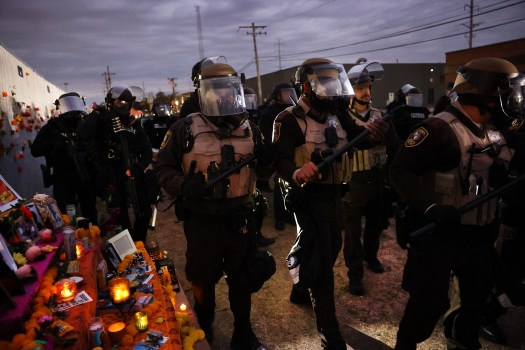
The order is the first measure bringing accountability to the facility, which attorneys have said operates like a “black site” where people are disappeared with few opportunities for contact with the outside world. The building has also become a flashpoint for frequent protests, where police and federal agents have clashed with demonstrators.
According to the order, the holding rooms must be cleaned twice a day and detainees held overnight must be provided with a clean bedding mat and enough bed space to sleep.
As federal immigration authorities sweep the Chicago area, the order likely puts a limit on how many people can be held in the facility overnight, as former detainees described holding cells with no room for everyone to lie down at night to sleep.
Government attorneys had objected to the restraining order, arguing that complying with a broad set of requirements would hamper its ability to enforce immigration law in Illinois. They also rebutted some claims from detainees, telling the judge that there is water on-site and some hot meals are distributed.

But five former detainees who took the stand — including a woman who appeared via video from Honduras — described being ignored when they asked for more water. They said more than 150 people were routinely crammed into holding cells, leaving little space to try to lie on the floor to sleep.
Meals consisted of three small Subway sandwiches each day, they testified, and detainees had no privacy around the dirty and overflowing toilets, which were mostly out in the open in the holding cells.
“I don’t want anyone else to live through what I lived through,” Agustin Zamacona testified Tuesday.
The judge stopped short of granting some of the plaintiffs’ requests, such as inspections of the facility, and he said he sought to make the order as “workable as possible” with a deference to the government’s ability to run itself.
But he said he found the witnesses who testified to be “highly credible.”
“People shouldn’t be sleeping in plastic chairs,” Gettleman said. “They shouldn’t be sleeping on the floor.”
During Wednesday’s hearing, the plaintiffs’ attorneys also laid out information they are seeking as litigation continues, including lists of detainees sent to Broadview, agency policies, receipts for provisions and supplies and video footage from inside the facility.