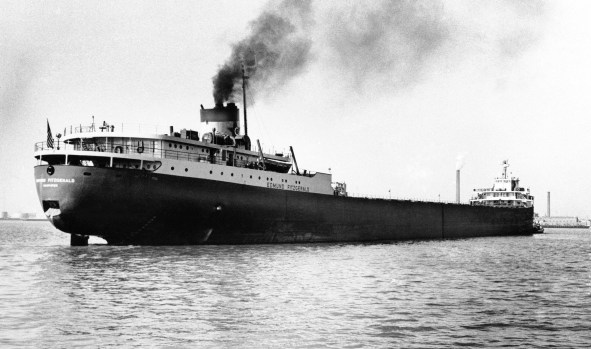

Monday marked the 50th anniversary of the loss of the freighter Edmund Fitzgerald to the storms of Lake Superior, a tragedy that reflects harshly on the impotence of humans and their machines before the power of nature’s wind and waves.
The loss of the Fitzgerald is a true-life mystery that has achieved an almost mythical level of cultural interest over the years. Much of that is due, to course, to Gordon Lightfoot’s haunting tribute: “Superior, they said, never gives up her dead, when the gales of November come early.” But it’s also notable for the uncommon bravery of a doomed crew that perished within an hour’s sail of safety. “The searchers all say they’d have made Whitefish Bay If they’d put 15 more miles behind her.”
The ship’s memory also reminds us about the Great Lakes as a critical conduit of national commerce, as well as an underappreciated part of our city’s economy.
The Fitzgerald’s fate played out against the backdrop of a vital water route that brings the products of the upper Great Lakes states to global markets. Now known as the Great Lakes Waterway, it flows from Lake Superior to the St. Lawrence Seaway, reaching over 100 ports, including Chicago, Milwaukee, Toledo, Detroit, Hamilton and Cleveland. The primary cargo carried on the waterway includes iron ore, coal, limestone and farm products.
At the time of its loss, the Edmund Fitzgerald was the vanguard of the fleet of freighters serving the waterway. The ship was built in 1958 and was almost 730 feet in length, roughly the equivalent of a 60-story office building. It drew nicknames such as “the Mighty Fitz” and “the Pride of American Side.”
On the afternoon of Nov. 9, 1975, the ship departed Superior, Wisconsin, with a load of taconite ore pellets, bound for Zug Island in Detroit. Later in the afternoon, it joined in route with another large freighter, the Arthur M. Anderson, headed for Gary.

The National Weather Service forecast predicted a large gale to pass south of Lake Superior. Ominously, the forecast was updated later that afternoon to project a storm path directly across the lake. Both captains adjusted their course to take advantage of Superior’s protective northern shore.
As the gale turned into a winter storm overnight and into the morning of Nov. 10, both ships confronted drastically deteriorating weather. Mountainous swells developed. By mid-afternoon the Fitzgerald began to list and shortly thereafter lost its radar. By late afternoon, the list had increased, as the ship encountered 60 mph winds and was taking heavy waves over its deck. At 7:10 p.m. came its last radio transmission, “We’re holding our own,” before it slid into the abyss.
Computer renditions of the Fitzgerald’s last hours are simply terrifying.
Three primary theories have arisen about the cause of the Fitzgerald’s sinking: that the keel had been punctured by grounding on a rocky shoal early in route, that critical deck hatches failed during the height of the storm and that the taconite ore cargo shifted during the heavy seas, leaving the bow unable to recover. A new book on the disaster, “The Gales of November” by John U. Bacon, seems to side with the rocky shoal theory.

Yet neither the passage of time nor advances in technology have been able to confirm the actual cause. “Of the big lake, they call Gitche Gumee, Superior, they said, never gives up her dead, when the gales of November come early,” Lightfoot sings.
And these Great Lakes tales call to mind Chicago’s long connection to waterway commerce. It’s rooted in the early days of shipping on the Chicago River and the Illinois-Michigan Canal. Lake Calumet Harbor was constructed in 1921 as a deep-water port, later to evolve into the Port of Chicago. The port links Midwestern interior waterways to the Great Lakes, primarily with bulk cargo of commodities, and is a driver to the city’s economy. The complex is best viewed from the Skyway’s Calumet River bridge (just let some else drive).
This week our weather changed. The soft October sun and the gentle autumn breezes joltingly gave way to cold, rain, sleet and snow. For as we Chicagoans know, as do the Great Lakes mariners, the gales of November sometimes come early.
And when they do, you’ll fumble for your coat, gloves and hat, cursing yourself for misplacing them at the state of last spring. But as you go out the door, head down against the rain, perhaps you’ll think of those sailors on the lake that morning, plying their important trade against the elements. And maybe you’ll pause to recall the Edmund Fitzgerald, and sigh in the knowledge that the “witch of November come stealin’.”
Michael Peregrine is a Chicago lawyer and a graduate of Oak Park High.
Submit a letter, of no more than 400 words, to the editor here or email letters@chicagotribune.com.