





WASHINGTON — President Donald Trump has been able to depend on the U.S. Supreme Court’s conservative majority to uphold his unprecedented broad use of executive power. But when it comes to sending the National Guard into Illinois, there are signs a Trump victory might not be a slam dunk.
Unlike in many of the administration’s other high-profile legal battles, the high court has moved cautiously on the Illinois dispute. The justices have given lawyers until Monday — two weeks after issuing their October order — to file additional briefs, a sharp contrast to the three-day turnaround the court allowed when the case first landed on its docket.
The Trump administration is asking the court to overturn lower court decisions that effectively sidelined National Guard troops from Illinois, California and Texas during the Trump administration’s immigration enforcement surge in the Chicago area. Trump’s Justice Department argues the lower court action “improperly impinges on the President’s authority and needlessly endangers federal personnel and property.” Citing potential violence, department lawyers urged the court to “grant an immediate administrative stay.”
But the Supreme Court is still considering the department’s request several weeks after it was filed.
Given the Monday deadline for additional filings and another week for responses, the justices indicated they would likely rule on the emergency application no sooner than mid-November. It’s a sign, court observers say, that the conservative majority on the court appears split on how to handle the case. Otherwise, the justices would have acted already.
The justices “do not appear to think that there is an emergency requiring their immediate action,” said Carolyn Shapiro, founder and co-director of the Chicago-Kent College of Law’s Institute on the Supreme Court of the United States. “They can and do act very fast. And they’re not.”
And what that means in the world outside the courtrooms is that the National Guard troops will stay off the streets until the middle of the month — and maybe longer.
The Trump administration’s efforts are being fought by lawyers for the Illinois attorney general’s office, which urged the Supreme Court to keep the ban on deploying the guard in place.
“The State seeks to protect its sovereignty, retain control over local policing, and protect the basic structure of American federalism from unprecedented intrusion,” they wrote.
The Illinois lawyers said the order didn’t prevent federal agencies from addressing violence “with as many federal law enforcement officers as they believe appropriate to advance their mission.”
‘Alarm bells’
The Supreme Court fight over National Guard deployments in Illinois is just one of a flurry of court cases in Chicago and around the country as the Trump administration has ramped up its high-profile immigration enforcement efforts.
In Chicago, those cases mostly have focused on the tactics used by Customs and Border Protection, Immigration and Customs Enforcement and other federal agencies.
But the issue before the high court could determine whether Trump can raise the stakes even further.
The last nine presidents — excluding Trump’s two terms — deployed troops for civil unrest or policing purposes only twice, according to Elizabeth Goitein, an attorney for the Brennan Center for Justice, a liberal legal advocacy group in New York.
“By contrast,” Goitein wrote recently, “Trump has either authorized or requested deployment of troops in American cities five times in four months. That fact alone should set off alarm bells.”
The long-standing practice of preventing the military from acting as a domestic police force, she said, “is one of the most important protections we have in this country for democracy and individual liberty.”
“An army trained to fight and destroy overseas enemies, if turned inward against the people, could become a powerful tool to suppress dissent and undermine rights,” she added.
Several prominent military officials, including former CIA Director Michael Hayden and former Army chief of staff George Casey, echoed those concerns in a friend-of-the-court brief.
“Strict adherence to this principle — that military personnel operating at the direction of the President and his subordinates may not engage in domestic law enforcement — has been a touchstone of Republican and Democratic administrations alike,” they wrote.
Done improperly, they argued, using National Guard troops for domestic law enforcement “poses risks to the core mission of the Guard, the well-being of the troops, and the safety of the communities they are committed to protect.”
They added that deploying federal troops for law enforcement purposes “should be a last resort to avoid the politicization of the military, which inevitably erodes public trust, hurts recruitment, and undermines morale. Peaceful protests of government actions are constitutionally protected speech deserving of the highest protection, not intimidation by the military.”
Dozens of mayors and other local officials from around the country also supported the ban remaining in place.

“The President has made plain his desire to treat American cities as military ‘training grounds,’” they wrote. “Since federalizing and deploying the National Guard in Los Angeles in June, the Administration has sent or attempted to send federal military troops into one community after the next — each time, widening the scope, duration, and reason for deployment.”
But the America First Legal Foundation, a conservative group founded by Trump adviser Stephen Miller, said the decision of when to call up the National Guard “is not reviewable in court.”
Even if it is, the group noted that Chicago police Superintendent Larry Snelling said protesters were “breaking the law” by boxing in federal vehicles.
“Surely the President may determine that regular federal officers are unable to execute federal laws in Chicago when even the Chicago Police Superintendent has acknowledged illegal obstruction of federal law enforcement,” its lawyers wrote.
Deployment orders
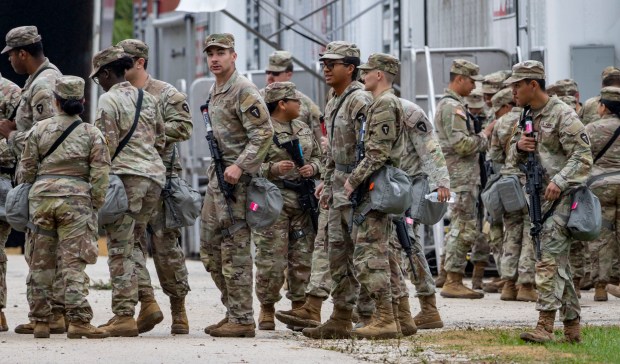
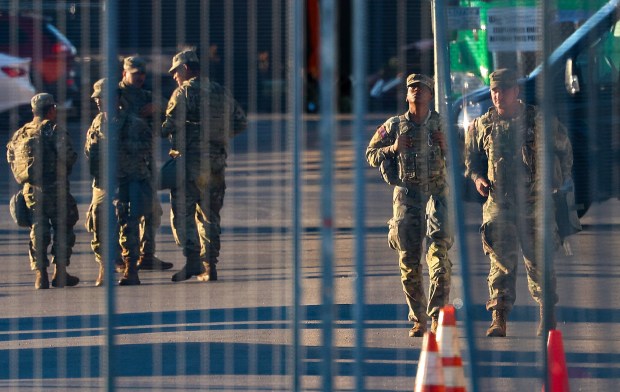
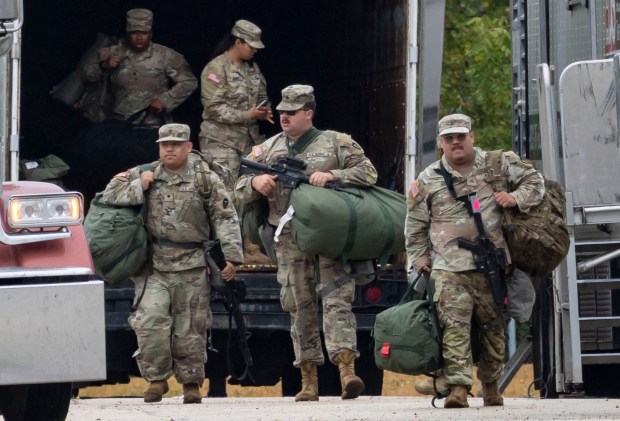
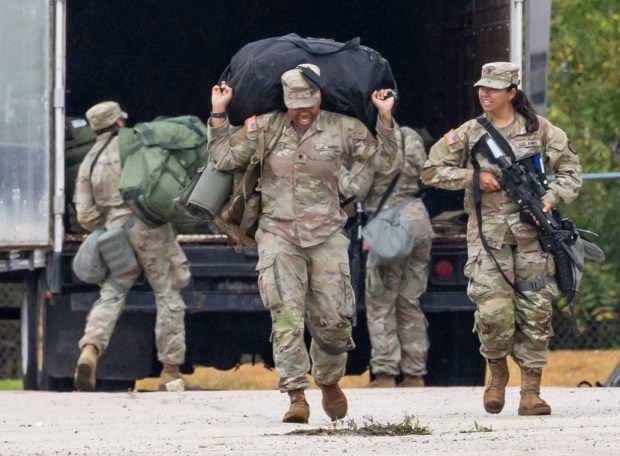
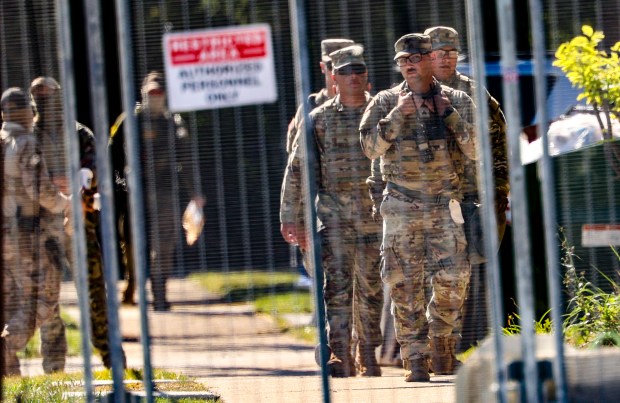
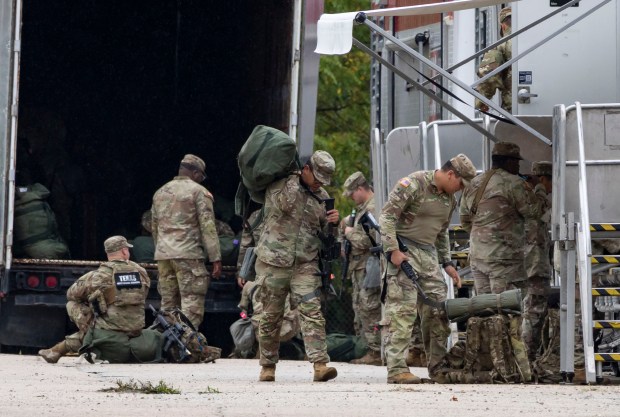
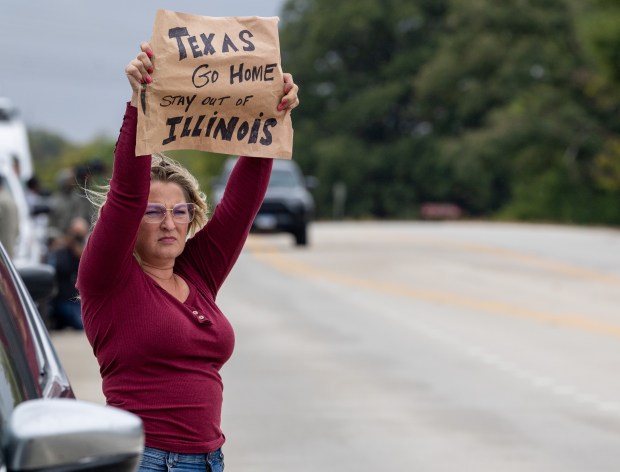
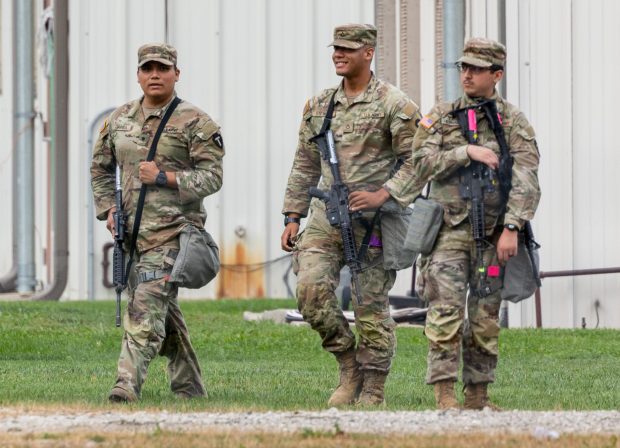
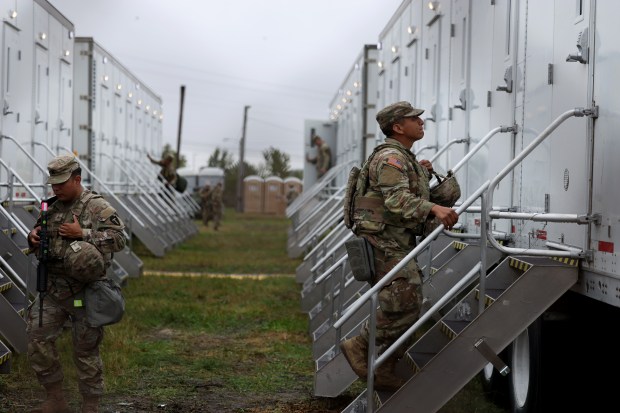
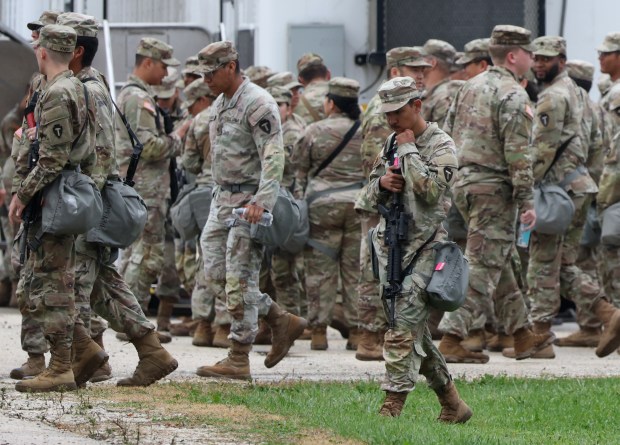
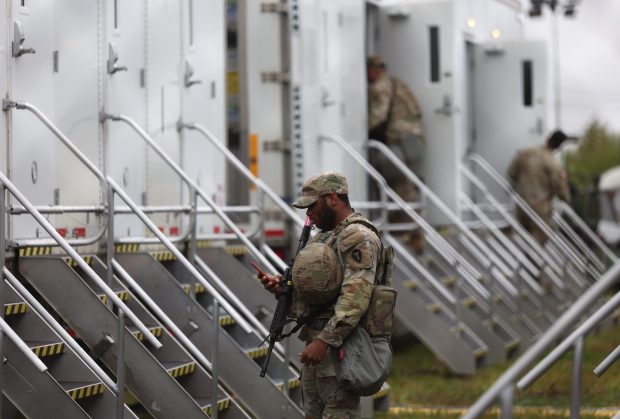
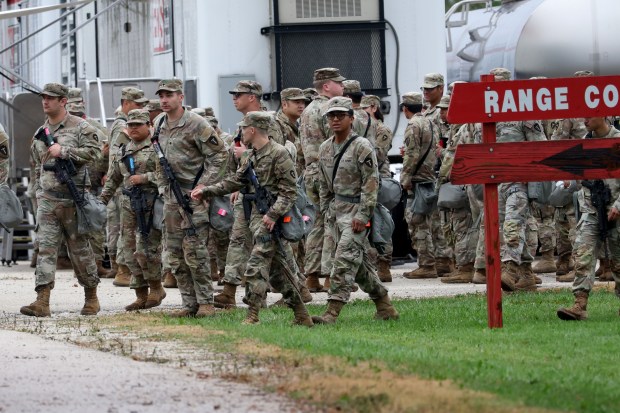
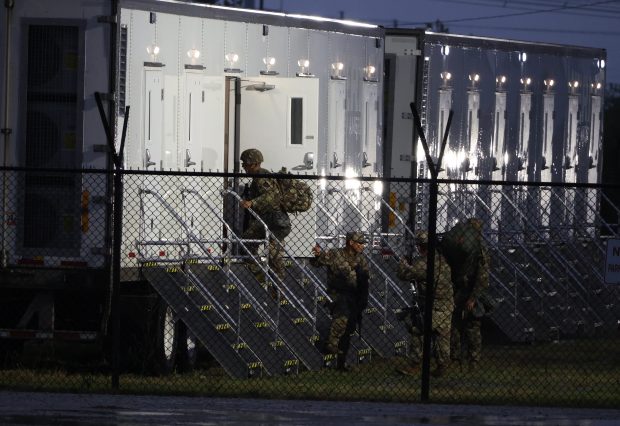
In October, Trump issued an order to put 300 members of the Illinois National Guard and an additional 400 members of the Texas National Guard and a handful of members of the California National Guard under federal control for deployment to the Chicago area, a move vehemently protested by Illinois Gov. JB Pritzker, who normally commands the Illinois Guard.
Pritzker and other Illinois officials sued to block the move, and U.S. District Judge April Perry issued a temporary restraining order on Oct. 9 barring the deployment of National Guard troops in Illinois.
Perry said there was no evidence of a “rebellion” in Illinois — or even the threat of one — among the legal grounds Trump cited for his order. The judge also found that the administration failed to show it could not enforce federal law without using guard troops, another legal condition the president invoked to federalize the guard.
A Chicago-based federal appeals court slightly revised Perry’s order, allowing the guard troops to remain under federal control but blocking Trump from executing their orders on Illinois streets.
The National Guard has been activated to Chicago 18 times from 1877-2021. Here’s a breakdown.
The Trump administration then turned to the Supreme Court, offering several reasons why it thought the lower court rulings were flawed and should be blocked.
In one of its several arguments, Justice Department lawyers said only the president has the authority to call up the National Guard for federal service and that Perry had no authority to intervene.
But Shapiro, the Chicago-Kent College of Law professor, said the court’s order for more information about how to interpret a key federal law suggests there may not be five justices who agree with the Trump administration’s more sweeping claims.
“Even the lower courts that have ruled against the president believe that the president is entitled to a fair amount of deference. I don’t think that’s a controversial view. But the (federal) government is taking the position that the president’s decisions in this are completely unreviewable,” Shapiro said. “I think that’s completely wrong, and it seems unlikely to me that there are five votes for that position, because if there were, they would have already granted a stay.”
Steve Vladeck, a professor at the Georgetown University Law Center and author of the “One First” newsletter about the Supreme Court, wrote recently that the court’s request for more briefs showed that some of the members of the court’s conservative majority might not be on board with some of the Trump administration’s other arguments, either.
The federal law Trump relied on to dispatch guard troops to the Chicago area allows such action when there is an invasion, a rebellion or a time when the president “is unable with the regular forces to execute the laws of the United States.”
A second argument the Trump administration is making is that the widespread protests against immigration enforcement actions in the Chicago area show that there is a “rebellion” that justifies sending in the guard.
But apparently there aren’t five justices on the court sold on that theory either, Vladeck noted, because otherwise they would have used that justification to block the lower court orders.
Instead, the justices sought more information about Trump’s third and final justification: that the president can’t enforce federal laws using “regular forces.” Specifically, the justices asked attorneys to clarify whether the term “regular forces” refers to law enforcement officers or to active-duty military personnel.
The request suggests the court is weighing an argument raised earlier by a law professor in a friend-of-the-court brief that the president can call up the National Guard only after efforts to use the regular military — not ICE agents or other law enforcement — to enforce federal law have failed.
“Whatever else might be said about the additional question the justices posed,” Vladeck wrote, “all of those are, in my view, good signs for Illinois.”
The role of ‘regular forces’
The six conservative justices have regularly sided with Trump on the “emergency docket,” since the president began his second term in January. The so-called shadow docket is a sort of legal fast track, where the court rules without oral arguments or the extensive briefing it uses in normal cases.
It often makes crucial decisions on the emergency docket — such as blocking lower court orders — with little or no explanation.
In recent months, the conservative bloc has used that tactic to overturn a lower court ruling that barred federal agents from stopping people suspected of immigration violations based on their skin color, language or occupation — a case that led to the term “Kavanaugh stops” after Justice Brett Kavanaugh defended the practice.
The conservatives in October also allowed the Trump administration to rescind the temporary protected status of 350,000 Venezuelans in the United States.
And on Thursday, the high court allowed Trump’s State Department to refuse to allow passport applicants to get a passport that reflected their gender identity, rather than their biological sex at birth.
So it was noteworthy when the justices asked the parties in the Illinois case to address the issue raised by Martin Lederman, a Georgetown University law professor who specializes in presidential authority over the military, who argued Trump could not deploy the National Guard to Illinois because he had not shown it was impossible to do so with the “regular forces” at his command.
The Trump administration referred to ICE, CBP and other federal law enforcement agents as “regular forces,” but Lederman said the term actually refers to active-duty, full-time members of the military.
The 1908 law that Trump relied on to call out the guard set out a clear order for how the president is supposed to deploy military units in response to an invasion, rebellion or other circumstances that prevent the enforcement of federal law, Lederman explained: first would come the regular military forces, then the National Guard, then volunteer forces.
“Because President Trump has not used regular military forces to assist or protect ICE in the Chicago area, he cannot — and he has not — determined that the executive branch would be ‘unable’ to execute any federal laws with the aid of such regular military forces,” Lederman wrote.
“Moreover,” he added, “it is difficult to imagine that the president would be ‘unable’ to ensure faithful execution of those laws if he were to first deploy regular military forces to assist ICE, assuming a sufficient number of such forces were available to perform that function.”
But that doesn’t mean Trump has the authority to call the military into Chicago, either, Lederman said. The president would still have to show that he had the right, under some other law passed by Congress, to deploy the so-called regular troops to the area.
“Congress designed the militia calling-forth authority to enable the President to use National Guard only in the same manner that he may make use of the regular military forces,” he wrote, “not as a backdoor that would invite the militarization of law-execution in cases where Congress has foreclosed the use of the standing Armed Forces themselves.”