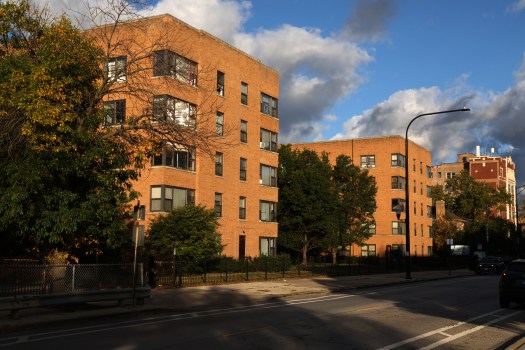

At least six Venezuelan nationals arrested in a controversial immigration raid on a South Shore apartment building in September are among hundreds who could soon be released on bond amid allegations that Operation Midway Blitz agents repeatedly violated a consent decree limiting warrantless arrests.
The immigrants from the Sept. 30 raid at 7500 S. South Shore Drive appeared on a list released Friday of some 614 arrestees identified in an ongoing lawsuit alleging the Department of Homeland Security ignored the terms of the 2022 in-court settlement that puts a higher bar on making arrests without a prior warrant or probable cause.
All six people from the South Shore raid who are on the list were confirmed to the Tribune by plaintiffs’ attorneys. They are all still in custody in the U.S. and were ranked in the “low” safety risk category, even by the government’s notably low standard.
The South Shore operation had been billed as an attempt to arrest gang members in the country illegally. But a low risk category indicates there is not only a lack of any serious criminal history in their background, but also no identifiable ties to gangs or other factors that would trigger mandatory detention.
The list was turned over by order of U.S. District Judge Jeffrey Cummings, who said he will grant a $1,500 bond to anyone who is still in custody in the U.S. and who is not confirmed by the government to be a safety risk or subject to a prior removal order.
Attorneys with the Department of Justice told Cummings on Friday they were not seeking to keep anyone marked “low” in custody, meaning the six are likely to be released on bond sometime this week, unless Cummings or the 7th U.S. Circuit Court of Appeals grants the government a stay on the order pending appeal.

The Trump administration has claimed the militaristic, middle-of-the-night South Shore raid, which included agents with high-powered weapons rappeling from helicopters and breaking down apartment doors, targeted known Tren de Aragua gang members and their associates.
The Tribune reported exclusively last month that no public criminal charges have been filed against anyone in connection with the raid.
Last week, ProPublica published a lengthy investigation that included interviews with several of the Venezuelan immigrants arrested that night, including three of the five on the list made public Friday.
One of them, Gabriel Enrique Gamarra Pérez, said in an interview with the outlet that agents showed him photos of about a half dozen men and asked if he knew them. Gamarra said one agent said about him and others he was with, “These aren’t the guys.”
Tren de Aragua is a gang known for its origins in a Venezuelan prison. President Donald Trump declared it a foreign terrorist organization earlier this year, reflecting his administration’s emphasis on deporting its members in the United States.
In the aftermath of the raid, though, it’s unclear how many — if any — of the 37 people ICE detained were gang members or associates.
Mark Fleming, the lead attorney in the ongoing consent decree litigation, said Monday the evidence trickling out about the raid shows it was “not about public safety or Tren de Aragua,” especially since most of the people arrested were already in civil immigration proceedings here.
“It doesn’t even seem to have been about criminal law enforcement,” Fleming told the Tribune. “It was about a show of force to feed the public perception.”
Cummings said he’d also order some form of monitoring of the arrestees, including electronic ankle monitors, pending the outcome of immigration proceedings. Most of those arrested were originally processed at the ICE processing center in west suburban Broadview, but have since been moved to jails around the country.
The judge also said he would not order the release of anyone who the government can show has a prior removal order or poses a significant risk to public safety.

The list released Friday showed only 16 arrestees had criminal histories, or about 2.6% of the 614 people. Five involved domestic battery, two were related to drunken driving, and one allegedly had an unidentified criminal history in another country.
One person was deemed a national security risk, another had a narcotics conviction, and five more had been accused of various forms of battery, including two involving guns, the records indicated.
No one had any convictions for murder or rape.
Meanwhile, the other 598 people on the list had no criminal history listed at all, yet 42 of those were still classified by the DHS as having a “high” security risk. The reasons for that assessment were not explained.
The government said in a supplemental filing later Friday that those with a high risk should remain in detention.
The people on the list were all arrested by agents with U.S. Immigration and Customs Enforcement prior to Oct. 7. In the coming days, the government was expected to produce a much lengthier list of more than 3,300 arrestees, including those arrested by Border Patrol later on in the operation.
Known as the Castañon Nava settlement agreement, the consent decree issued during the Biden administration bars agents from making warrantless immigration arrests unless they have probable cause to believe someone is in the U.S. unlawfully and that the person is a flight risk.
It was originally supposed to sunset in March. Instead, after the Trump administration began ramping up immigration enforcement efforts in January, lawyers for the National Immigrant Justice Center and ACLU alleged dozens of violations, mostly involving “collateral arrests,” or the detaining of individuals who are not targets.
In his Oct. 7 order extending the consent decree until February, Cummings said ICE had improperly told its field offices over the summer that the consent decree had been canceled. He also called into question the recent immigration raid on an apartment building in South Shore, where agents in military gear burst through doors and zip-tied residents regardless of citizenship.
And the judge also took particular issue with a practice by ICE agents of carrying blank I-200 warrant forms with them on missions and filling them out at the scene.
jmeisner@chicagotribune.com