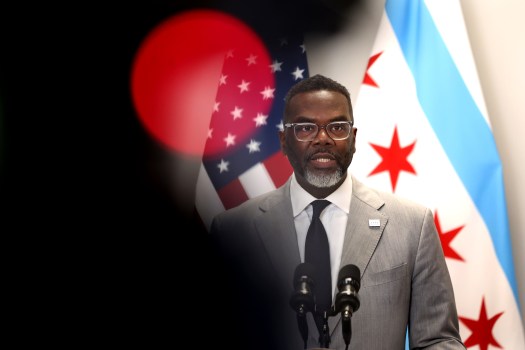
Mayor Brandon Johnson’s bid to revive Chicago’s corporate head tax is dead. The resounding 25-10 City Council Finance Committee vote Monday against the mayor’s revenue proposals should have made that clear.
Unfortunately, after the embarrassing rebuke, which carried distinct echoes of last year’s unanimous council vote against Johnson’s proposed $300 million property tax hike, the mayor seemed to struggle to wrap his head around the obvious reality, sounding like the Monty Python character shouting “not dead yet.”
“The corporate tax is in the budget,” a clearly frustrated Johnson told reporters after the vote. “It will stay in this budget.”
For those who’ve forgotten long-ago psychology classes, the famous Kubler-Ross stages of grief went like this: first denial, then anger and after that depression, bargaining and acceptance. The mayor seemed to exhibit the first two reactions in a single day.
Hopefully, we can proceed quickly to more constructive responses. Johnson’s budget is a non-starter. Twenty-five members voted against it, and there are plenty more not on the Finance Committee who won’t support it either. We’ve written repeatedly on why this jobs tax is such a terrible idea, so we won’t repeat ourselves here.
The key question is, what now? For a second straight year, the mayor has lost control of the budget process. But by law he must produce a balanced budget, and no matter who he blames for his predicament, it’s his responsibility to find a majority on the 50-member council to support one.
The mayor’s budget team initially projected the head tax would generate $100 million a year. Who knows if it would have really produced that much, but for budgetary purposes that’s the first hole that must be plugged.
The mayor’s opponents have called for more cost cutting. Under Johnson’s initiative, the city paid Ernst & Young more than $3 million to propose various options for efficiencies. The Johnson administration claims it has incorporated many of EY’s proposals, but they’ve left out any that would require significant sacrifice from the city’s mainly unionized workforce, which numbers more than 30,000. So the ones they’ve agreed to adopt save relatively small sums.
With the rejection of Johnson’s budget, it’s time to engage with the unions representing city workers.
That step should have happened weeks, if not months, ago, but the council’s clear message that the $1.2 billion budget deficit for 2026 can’t — and won’t — be filled by taxing job creators in Chicago leaves little choice now.
Nor, as a philosophical matter, should workforce concessions be off the table. Cities around the country, also led by Democratic mayors, have faced daunting budget deficits and haven’t hesitated to demand union concessions on behalf of taxpayers.
In Los Angeles, Mayor Karen Bass signed a budget that included about 600 layoffs, which she was able to rescind after unions agreed to other money-saving concessions to save those jobs. In San Francisco, Mayor Daniel Lurie’s finalized budget resulted in about 40 layoffs and the elimination of 1,300 positions.
And in Denver, Mayor Mike Johnston’s budget resulted in 169 layoffs while also imposing unpaid furlough days on thousands of city workers. Notably, Johnston’s furloughs exempted police officers and firefighters, jobs that Johnston said were “mission critical.”
None of these mayors wanted to take such steps. They did so because they understood the job of a big-city mayor means making hard decisions.
No one expects Johnson, who owes his 2023 election victory primarily to public-sector unions, to insist his political benefactors make sacrifices. But that’s what he should do. This moment requires leadership. If the mayor, having been rebuffed yet again by the council, isn’t willing to lead, he should leave it to aldermen to command the process.
Yes, we understand the Chicago Federation of Labor met with numerous aldermen in early October, as the budget process was about to get started in earnest, and read the riot act to them about asking workers to contribute to solving this budget emergency. But here in mid-November, the facts on the ground have changed.
If Johnson won’t do the job, we believe the council ought to identify a person who has enough goodwill with both unions and the business community to lead talks with the unions.
Who might that be? Ald. Pat Dowell, 3rd, who chairs the Finance Committee and voted against Johnson’s revenue proposal, comes to mind. Former Ald. Walter Burnett, who left the council this past summer, is another who could serve that role. We’re sure there are others.
And here’s the thing. The unions wouldn’t even have to agree to layoffs or furloughs to contribute mightily to helping with structural solutions to Chicago’s budget woes. The Ernst & Young report, as we’ve written before, identified up to $103 million in savings simply by bringing the gold-plated health benefits city workers get today in line with those received by employees of peer cities.
Look again at that number: $103 million. That’s more than the head tax was projected to generate.
Would such a concession be painful? Of course. But workers throughout the country, whether they get their health insurance through their employer or buy it via the Obamacare exchanges, are having to pay more in the form of premiums and out-of-pocket expenses. Taxpayers not on the public payroll aren’t likely to be sympathetic to arguments that city workers should be immune to what the rest of us are experiencing. And in many cases, experiencing to a far greater extent.
We’ve said before that the solution to the city’s budget crisis requires the burden to be shared. This adamant rejection of the mayor’s dramatically unbalanced plan by aldermen with ears to the ground makes clear this is the will of the vast majority of Chicagoans.
Submit a letter, of no more than 400 words, to the editor here or email letters@chicagotribune.com.