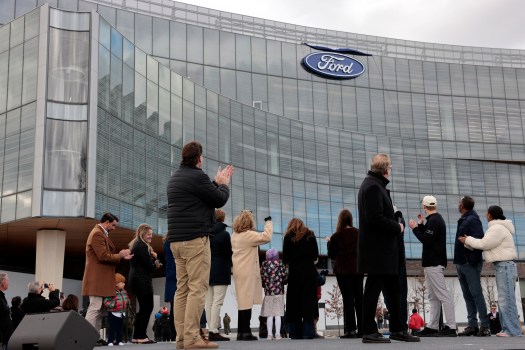

DEARBORN, Michigan — Hundreds of visitors on Sunday braved chilly temperatures to get the public’s first view of Ford Motor Co.’s new world headquarters, which aims to help the company compete for talent and technology leadership in a rapidly changing global auto industry.
Dubbed “the Hub,” the glass-faced building anchors a campus that fosters collaboration between employees across different teams, speeds up movement of people and vehicles, and helps attract top talent — attributes the automaker is leaning into as it competes against rivals increasingly focused on electrification, connectivity and self-driving technology.
“The way we’re going to work in the future is very different than the way we worked in the past,” Ford Executive Chairman Bill Ford told The Detroit News. “It’s so nice to finally be in a building where the product is. In the old world headquarters, every time I wanted to go see anything product related, I had to get in my car and drive over. This will be great. I’ll just walk downstairs and wander around.”
He hasn’t moved into his new office — it’s not complete as construction continues on the Hub into 2027: “They don’t need me to keep the place going, but we need them,” Ford quipped.
The new headquarters features a “crown jewel” showroom, eight cuisine stations, six courtyards, six studios and a state-of-the-art prototype shop — that’s also still using a 1948 lathe. Ford employees and retirees and community members joined in the celebration of the building’s official opening.
Visitors on Sunday marveled at Heritage Collection vehicles, investigated the menu options in the cafeteria and spoke with designers in the prototype shop. A Ford Racing Raptor Thrill Ride and jump, Camp Bronco s’more toasting, Lincoln Lounge showcasing the brand’s sensory features, the company’s 2025 America’s Parade float, and a community car show also entertained guests.
Among them was Robert Marshall, 74, of Brighton, who retired from purchasing after 32 years with the company,
“I think it’s tremendous,” Marshall, 74, said as he looked at a Mustang GTD in the showroom. “I can’t tell you the number of hours I spent driving between buildings. I think they’re going to do all right here.”
Added his daughter Angela Marshall, 33, of Brighton: “I want to work here. It’s very employee-focused with the design and the outdoor and garden space. It’s like a second home.”
The four-story building — that eventually will encompass 2.1 million square feet — will replace the smaller Glass House across town, which is set to be demolished. The Hub will help drive faster product development, higher profits and more innovation, executives said.
No longer is this site of Ford’s former 1953-opened product development center a cubicle city. Top executives and support staff aren’t siloed and separated by department three miles away in the 1956-opened Glass House. Instead, they’ll be around open spaces with employees in engineering, design, sales, marketing and finance, likely all working together.
There will be 4,000 people assigned to the building, whose construction will be completed in 2027 — double those working out of the previous 12-story headquarters. There are more than 14,000 people within a 10-minute walk and another 9,000 people within a 10-minute drive. By 2027, 90% of Ford’s in-office employees will be working in new or renovated spaces.
“It’s a renewal of Ford’s commitment to Dearborn,” Mayor Abdullah Hammoud said. “We are thankful. It’ll be the inspiration for future leaders, engineers and designers who will drive past.”
A previous pilot aimed at working more collaboratively brought forth the popular Maverick small pickup that debuted in 2021. The Hub will offer a physical space matching that mentality, Ford CEO Jim Farley said.
“There’s a long history — it was kind of lumpy,” Farley told The News, referencing a similar philosophy that was used for vehicles like the Ford Taurus, which debuted in the mid-1980s. “Now we built a building around it. So we want to make it a permanent thing, where the whole product development team, from software, all the mechanical engineers, the supply chain and the marketing people and the physical designers, are all together. And we’re organizing that around the world.”
It’s a part of what Farley sees as his job leading the 122-year-old automaker: “We’re really trying hard to modernize the company all the way through it, not just the parts that people see on the outside, but the actual way we work. It’s expensive. It may be a reason why it wasn’t done. Maybe that’s part of my contribution to the company — we’re all trying to fix it for the future. The building is a metaphor for that.”
Ford hasn’t shared the cost of the new headquarters, though experts previously have estimated the campus revitalization at more than $1 billion. Farley credited his predecessor, Jim Hackett, and the learnings he brought from his previous leadership of office furniture company Steelcase Inc. for the adoption of that thinking. Hackett said the project turned out better than he’d imagined.
“It was a long design process, and I feel very good about it,” the former CEO told The News. “I had spent 20 years in running the world’s largest office environment company, which got me near the world’s best architects and CEOs of lots of other companies that had capital-intensive challenges, so I felt: right guy, right time to deal with this question.”
Adrian Aguirre, chief Expedition engineer whose whole team has worked from the Hub for about a month now, already has seen the benefits of the openness and mixing of teams. Almost daily, he said he’s had experiences of running into the right person or had a conversation that sparked an idea — situations that would’ve otherwise happened over email or perhaps not at all.
“It was more like everyone had their own little fiefdom,” Aguirre said. “Even though we mentally and culturally had broken through the barrier, the physical things are still there, and now those walls are literally not there. You’ve built a place that responds to the kind of culture and way that we work hand-in-hand.”
Ford isn’t the only Detroit automaker getting new digs. Crosstown rival General Motors Co. plans to move into the downtown Hudson’s Detroit development from the Renaissance Center, which first opened in 1977. Ahead of that, though, it increasingly relocated and consolidated employees about 17 miles away at its Warren Technical Center, which it also has updated.
GM will take up four floors of the new 12-story mixed-use building in Detroit owned by mortgage mogul Dan Gilbert’s Bedrock LLC, adjacent to the complex’s skyscraper. Move-in is expected to happen by January. GM is working with Bedrock on redeveloping the Ren Cen with a smaller hotel, apartments and new retail and community space.
Chrysler parent Stellantis NV’s North American headquarters in Auburn Hills connects the Pentastar-topped executive office tower to its vehicle development technical center. Under previous leadership, however, the company discussed selling the 1990s building in a leaseback deal amid intensifying financial pressure. Since then, though, Stellantis has increasingly returned employees to in-office work.
Glenn Stevens, executive director of MichAuto, the automotive arm of the Detroit Regional Chamber, recalled his first visit years ago to Tesla Inc. It was chaotic, but it differed from legacy automakers in that everyone was working together in the same space.
“That’s what the best companies are doing,” he said. “It’s better to have the people and technology tools and suppliers and all the functions together to work as fast as possible in the most innovative way as possible. You have to have the highest quality and the highest design, or you can’t compete, because that is what those other global companies are doing.”
At Ford’s new headquarters, employees enter through the American Road Lobby and walk up the stairs to “the hive,” a cafe area with coffee, other beverages and food where Ford employees can work or have a meeting. It’s reminiscent of the hospitality hub that will greet customers under Ford’s new dealership retail design, signaling the global effort to create a recognizable Ford design without the company’s name plastered in all spaces.
“Jim Farley has said in the past, when you walk into our existing headquarters building, you’re not quite sure if you’re walking into Ford or if you’re walking into a shampoo company,” Jim Dobleske, chairman and CEO of Ford Land, the Dearborn automaker’s real estate arm, said during a tour ahead of the building’s grand opening Sunday. “This building, you know you are walking into Ford Motor Company.”
White walls are broken up by splashes of wood and earthy tones, Ford navy blue accents, and artwork that showcases Ford’s history and modern products and artists from Detroit and Cranbrook. Floor-to-ceiling windows let in daylight. A rug from Shaw Hospitality Group repeated throughout the building is the Blue Oval in a proprietary textile cut up and collaged together. Oval motifs repeat throughout the design.
On one of the upper floors of the Hub, there are executive offices and a board room, like on the top, 12th-floor C-suite of the Glass House — one of the few changes made to the design of the building once Ford decided to make it its new headquarters, Dobleske said.
But for the most part, employees don’t have assigned seats, working instead in a hotel-style model that Ford has adopted at most of its office spaces in the wake of the COVID-19 pandemic. Every corner turned seems to reveal open desks, tables and chairs or lounge areas for meeting in groups. Closed-door individual “focus” rooms and team “energy” rooms are also found throughout the building.
Nathan Vidican, a Ford technical specialist, said his team has been ensuring strong WiFi signals throughout the building over the past few weeks and laid claim to an area overlooking the Henry Ford Museum. He pointed out the different parts of the building to his mother, Debra Vidican, 67, of Windsor, Ontario, on a self-guided tour.
The building is beautiful, but for Debra Vidican, the highlight was her son: “I love seeing him so excited. I can see the joy in him talking about what he does here. I love seeing how happy he is.”
Special credentials are needed to access the studios where Ford keeps the trucks, SUVs and other vehicles of the future. There are desks for designers, more capacity for vehicles than the previous product design center had, and large digital displays for reviewing designs. A two-tiered courtyard brings daylight in, and lighting can be changed inside when Michigan’s skies don’t shine as brightly. Vehicles can be driven into the courtyard and on the roof as well. Fritted windows that block ultraviolet light incorporate an oval pattern and Ford patent numbers.
Two vehicle elevators in the building help reduce the time it takes to move vehicles and materials through the building by 83%. Downstairs is the 207,000-square-foot prototype shop with spaces for milling clay models and all sorts of materials except glass — wood, metals, plastics and more. A whole room is dedicated to 40 3D printing machines capable of handling various materials — a revelation since the old building predated the technology, said Jim Conner, director of 3D process for Ford Design.
Designers benchmarked the Hub against other corporate headquarters and research and engineering campuses, said Craig Dykers, founding partner at Norwegian architecture firm Snøhetta, which is behind the project. But most comparison facilities are making small digital technologies or entail flat airplane plants.
“This is the largest facility of its type (at least in North America) that’s three dimensionally mobile, so things move up and down and sideways, which is very unique,” Dykers said.