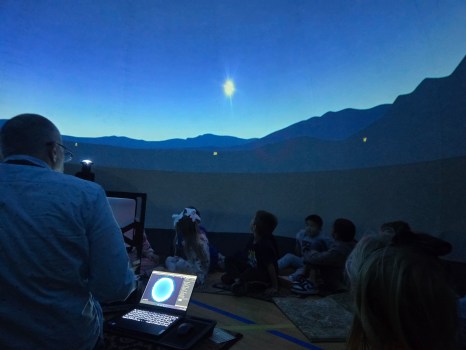

Hinsdale-Clarendon Hills Elementary District 181 has brought a deep look into the night sky inside at its schools with the recent addition of StarLab.
The mobile apparatus, which arrived this fall, brings an immersive planetarium experience to the schools by projecting the night sky, planets, and other astronomical and scientific concepts onto the inner surface of a dome. Once inside the dome, students see a projection of the night sky that can be sped up to show daily or yearly movements, helping them understand complex astronomical concepts more easily than from a textbook.
“We are always looking for ways to enhance our curriculum and learning opportunities for students,” said Kathy Robinson, the district’s assistant superintendent of learning. “Purchasing StarLab allows our students to learn science concepts we are teaching in the classroom in an immersive environment.”
Bill Eggert, a District 181 teacher on special assignment, said serious discussions about purchasing StarLab began during the 2023-24 school year, and a purchasing partnership with the District 181 Foundation was established during the 2024-2025 school year.
“The purpose of the StarLab is to enhance instruction of science standards and to get the students excited about astronomy,” Eggert said.
He said adding StarLab doesn’t change the curriculum, but rather enhances it.

‘Our teachers do an amazing job of modeling astronomy concepts in their classes through instruction, readings, demonstrations and hands-on student activities,” he said. “That said, there are some concepts that are much easier to teach and observe in a planetarium environment, such as changes in the sky due to the passage of time or how the sky appears from different locations on earth.”
A determination on which students would be using StarLab, and when they will use it, during each school year was initially made by examining where astronomy standards align at the various grade levels, Eggert said.
“Most of our astronomy instruction happens in first, fifth, and seventh grades, so our goal this year is to bring the StarLab to all (of those classes) in the district,” he said.
Eggert said his hope is that by using StarLab students gain a deeper understanding of the astronomy concepts being taught in class and that it provides classroom teachers with another point of reference they can use with their students as they teach their lessons.

“Many students who live in the area have never seen a clear night sky, due to all of the city lights where we live,” he said. “If anything else, I hope that seeing the StarLab inspires some of the students to become interested in astronomy and motivates them to look up at the sky at night to try to find some of the things we are teaching them about.”
Robinson said the cost of StarLab was $61,000 with the D181 Foundation donating $30,000. She said StarLab is expected to last 20-plus years.
“The materials are durable, and there are no components that need to be replaced, other than a projector bulb,” Eggert said. “The system runs from a laptop, and the purchase includes all future software updates.”
Chuck Fieldman is a freelance reporter for Pioneer Press.