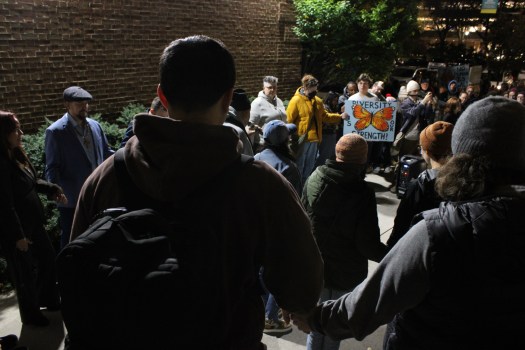

To thunderous applause from Skokie residents who rallied in support of immigrant rights beforehand, the Skokie Village Board further strengthened its village code to make it clear that U.S. Immigration and Customs Enforcement and U.S. Customs and Border Patrol agents cannot use village-owned property for civil immigration enforcement.
The Village Board took the action in a swift and unanimous way to approve the changes to its code on a first reading at its Nov. 3 meeting, a rare exception to how the Board usually approves an ordinance or resolution, i.e., in two readings across two meetings. The change took place just days after a violent Oct. 31 fracas involving Department of Homeland Security agents in nearby Evanston. North suburban schools have been going to indoor recess, closed campuses and keeping a closer eye on students.
The village will also post new signs with the reinforced ordinance on village property, according to Village Manager John Lockerby.
Nearby towns, including Evanston and Chicago, have created “ICE-free zones” in recent weeks. The resolutions are largely symbolic because the Illinois Trust Act already prohibits local governments from aiding federal immigration officers for civil arrests.
Skokie’s prior ordinances also have language that prohibits local resources from aiding federal immigration officers that do not have a criminal warrant. The Village Board adopted the changes to its Human Relations chapter first in 2017, then made another update after President Donald Trump was sworn in to serve his second term in office.

The new added language dictates that village property cannot be used as a “staging or debriefing area, processing location, operations base, or other support for civil immigration enforcement without a valid criminal warrant.” The ordinance also creates a precedent for the village to notify immigrants of their right to contact consulates, make support programs available for immigrants who are victims or witnesses to qualifying crimes and to promptly respond to requests for visa documents and forms.
Some residents, who spoke during public comment and at a rally outside of Village Hall before the meeting, and trustees said they wanted the ordinance to have sharper language that could allow the village to create barriers if need be.
“Although there’s so much appeal to that, it’s a very problematic, logistical problem to implement,” Lockerby said, pointing to that Skokie has over 30 village-owned parking lots. “I don’t think it’s logistically possible to put barriers and gates and staff security during hours of operation.”
Corporation Counsel Barbara Mangler pointed out that while other cities might have that language, it’s written in a broad way.
Mayor Ann Tennes said the ordinance could help the village in court, should federal agents gain access to village property without a criminal warrant.
“If there is a breach, we would need evidence, and this is what (it) would go to,” Tennes said. “We would seek legal counsel… It would go to not only the Illinois Office of Accountability, but we could seek relief through a court…. That seems to be where this is going, right?”

A sticking point that some trustees and residents had was that the village had yet to offer a strong sign or flyer that could be both used on public and private property. Trustee Gail Schechter previously told Pioneer Press that residents can get a psychological benefit from knowing the village’s stance and that it could be replicated.
Mangler, however, said she was concerned that doing so would give homeowners who put up such a sign a “false sense of security” given that it’s not likely that the village could impede on federal agents’ actions.
Before the meeting, a local group of activists, organized as Indivisible Skokie/Morton Grove/Lincolnwood, organized a rally with about 100 attendees. Chris Whitaker, a Skokie resident, said that the previous week federal agents had detained between 14 to 16 people in the northern suburbs, a number disputed between members of local rapid response teams, who say DHS officials underreport how many people are detained.

At public comment, Dr. Srikala Ayyagari, a former doctor at a Skokie health clinic, said she has been on the front lines serving refugees and undocumented patients. “Our patients are scared… It is hard to be a doctor and have a patient in the room and be in a soft lockdown because ICE will take them if they walk out of the door,” she said.
“I can only ask you three things that I ask myself when I practice medicine every single day. If not now, then when? If not here, then where? If not us, then who?”
“It is our responsibility to save ourselves, to go outside, to be part of the whistle response, to save each other. The ordinance has to be strong. We as a community have to be strong,” Ayyagari said.