
For the fourth year in a row, use-of-force incidents involving Chicago police officers are increasing, with advocates and officials saying the trend is helping to bring the reform process to a key point.
Chicago Police Department officers reported 2,930 such incidents through October 2025, compared with 3,089 incidents in all of 2024. The total has risen each year since 2021, according to data from the city’s Office of Inspector General.
During a Tuesday status hearing in the ongoing consent decree, police reform advocates noted to U.S. District Judge Rebecca Pallmeyer that 2025 has also seen an increase in CPD officers pointing their guns at citizens.
Department leaders say the upticks are due to enhanced data-collection practices, more rigorous training and more stringent oversight.
Regardless, Assistant Illinois Attorney General Mike Tresnowski told the court Tuesday that things have reached a “crucial point in the consent decree process,” and it’s time for real improvement to be shown.
“CPD’s approach to use-of-force policy and use-of-force training has come a long way” since 2017, Tresnowski said. “The crucial question is: Have these policies, trainings, (and) systems resulted in measurable change on the ground?”
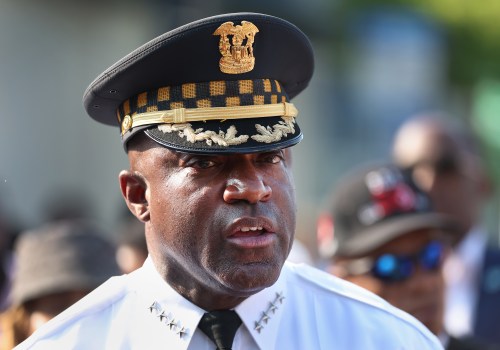
In an interview with the Tribune after Tuesday’s hearing, police Superintendent Larry Snelling stressed that the department’s internal policies now require officers to fill out use-of-force reports more often, even in instances where an officer was the victim of an attack.
“The more you get on paper, the more you can assess what’s going on,” Snelling said. “The more you create training around it, you can determine if there (are) patterns or practices that you need to address.”
“Look, if there was something that I was trying to hide,” he said, “we wouldn’t have all these (data) dashboards we have up now.”
Earlier this year, CPD released an internal report that detailed the rise in use-of-force incidents, which are analyzed by the department’s Tactical Review and Evaluation Division, or TRED. Department officials have acknowledged that TRED remains in a backlog of incidents to review. Firearm pointing incidents, though, are now reviewed by CPD captains assigned to each of the department’s 22 patrol districts.
“We want to get on it as soon as it happens,” Snelling said of the captains’ analyses. “This is how you change behavior. This is how you change the culture.”
The latest consent decree hearing came just days before the 10th anniversary of the release of the Laquan McDonald shooting video — arguably the most impactful police shooting in Chicago since the December 1969 killing of Fred Hampton. The McDonald video’s release sparked a U.S. Department of Justice investigation that ultimately led to the consent decree.
“We look at what happened in the Laquan McDonald shooting compared to now, (and) we have made major, major progress in transparency, effectiveness and investigating police-involved shootings,” Snelling said Tuesday.
Less than an hour after Tuesday’s court hearing began, a CPD officer shot and wounded a man in the Washington Park neighborhood. That shooting remains under investigation by CPD and the Civilian Office of Police Accountability.

The independent monitoring team, led by former federal prosecutor Maggie Hickey, last month released its 12th biannual report on the city’s compliance with the consent decree, codified in early 2019.
There are three levels of compliance: preliminary, secondary and full. Preliminary compliance signifies CPD has developed a training curriculum; secondary compliance means training has been implemented; and full compliance means that the policy is fully part of the department’s day-to-day operations.
The monitoring team found that CPD has reached preliminary compliance with 94% of monitorable paragraphs in the consent decree. Secondary compliance has been reached in 66% of paragraphs, and 23% of consent decree paragraphs have reached full compliance, Hickey said Tuesday.
Since the consent decree was established, the independent monitoring team has regularly called on CPD to bolster its data retention and analysis efforts. Despite the progress, associate consent decree monitor Paul Evans, the former commissioner of the Boston Police Department, said Tuesday that CPD officers still do not fully abide by the department’s body-worn camera policy.
“The CPD’s use of body-worn cameras has improved dramatically, but body-worn camera compliance remains a significant issue due to CPD officer too frequently, for example, activating their body-worn cameras later than required under the policy,” Evans said.