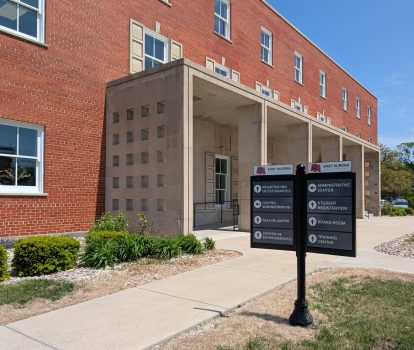

The East Aurora District 131 school board recently approved a $39.7 million tax levy for the district, for taxes payable in 2026.
Including its roughly $6.6 million debt service levy, a portion of which the school board opted to use operating funds to abate, the district’s total levy amount comes to just under $46 million.
At a school board meeting last month, Associate Superintendent and Chief Financial Officer Michael Engel explained that property values within the district are 80% residential property, 14% commercial, 5% industrial and 1% from the state railroad.
But property taxes aren’t the district’s main source of funding. State funding is, Engel explained.
In the district’s 2025-26 budget, for example, state funding accounted for 68% of the district’s roughly $263 million in expected revenue. Local sources, on the other hand, make up about $58 million of its anticipated revenue, and federal sources amount to about $25 million.
Of the almost $40 million levy the school board approved for the district, about half is set to go toward its education fund. Operations and maintenance and transportation make up the next largest portions, at over $7 million and $5.6 million, respectively. The levy also funds special education, the district’s municipal retirement fund, provides some working cash and more.
The district’s tax extension in 2024 was about $37.8 million, not including bonds, Engel said, making the district’s request a 4.99% increase over last year.
But the district will not necessarily be given that full amount, Engel said. Property values — and therefore the amount the district receives in property taxes — will likely be affected by new construction, and will therefore raise the district’s levy increase over 2.9%, which is the Consumer Price Index, or CPI, a measure of inflation set by the U.S. Bureau of Labor Statistics.
But it would likely not increase to the full 4.99% hike, Engel said. And the actual tax amount property owners pay is not set until after property values are assessed.
The district is also abating a portion of its debt service levy using operating funds, meant to reduce the cost to taxpayers.
At a school board meeting in October, Elizabeth Hennessy, a managing director at financial services firm Raymond James, explained the district’s options for abating a portion of its debt service levy to reduce the cost to taxpayers. To do so, she explained, the district transfers Evidence-Based Funding money it receives from the state to its bond and interest fund to make debt service payments.
The district has previously abated a portion of the levy, she explained, and if it opted not to do so or abate less this year, the district’s debt levy would go up, and its overall levy would increase by more than the CPI of 2.9%.
Hennessy presented the district with three options for this year: abating around $700,000, abating $350,000 or not abating at all.
“These abatements aren’t for free,” Hennessy said. “They’re reducing dollars that are going to kids, because we’re moving it from Evidence-Based Funding into the bond and interest to pay the debt.”
Board member Annette Johnson said she supported the $350,000 abatement, pointing to the value she sees in reducing some of the costs to taxpayers.
“I think it does help, you know, grow our neighborhoods and create some momentum for people to come and buy their houses on the East Side,” Johnson said at the meeting.
Engel emphasized that the funding from the levy in discussion would be used for next year’s budget, not the one passed in September for the 2025-26 school year.
He also pointed to the district’s moving from Tier 1 to Tier 2 in terms of what it gets from the state’s Evidence-Based Funding as a consideration for how much it decides to abate.
Evidence-Based Funding became law in 2017. Essentially, the Illinois State Board of Education combined multiple grant programs for school districts into one and now distributes it as “evidence-based funding,” according to the state board. The goal of the program is to provide equitable funding for districts in low-income communities and help them achieve adequate funding levels.
That funding relies on a distribution formula with tiers ranging from 1-4. A lower designation indicates that a district needs and receives more state assistance, according to the state board. A Tier 1 designation, for example, is given to districts that are furthest from “adequate” funding. And, as districts receive more funding, they are expected to get closer to “adequate” funding levels.
East Aurora had been considered a Tier 1 district for the Evidence-Based Funding grant program for all years on record since 2018 (funding remained flat in 2021), per figures from the Illinois State Board of Education. But this year, the district’s state designation was adjusted to Tier 2, according to the state board.
To give one-third of what it expects to get from Evidence-Based Funding — in the case of the highest abatement option — would be “quite a bit,” Engel said.
At that meeting, the board ultimately opted for the $350,000 abatement option, which got final approval from the board at its Nov. 3 meeting along with the tax levy.
According to Engel’s presentation, the next step is for the district to file the levy with the county clerk by Dec. 31. From there, in spring 2026, final property values are released, abatements are finalized and taxes are billed to taxpayers. The first installment is due in June, he noted, and the second in September.
mmorrow@chicagotribune.com