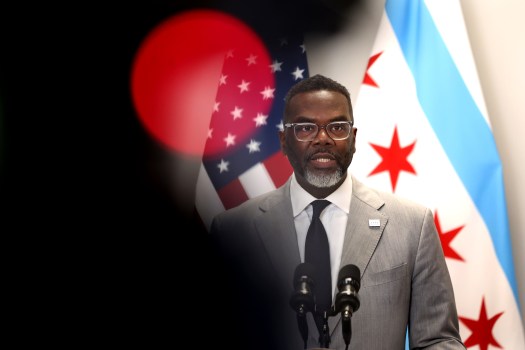
Former Mayor Lori Lightfoot once told us that selling out Chicago’s future parking meter revenue to investors far from the city was perhaps the worst decision of municipal governance in the history of municipal governance.
She made a good case. Mayor Richard M. Daley’s 75-year deal, as we’ve said here many times, was an unmitigated disaster that sold out Chicagoans for too little in return and remains no small cause of Chicago’s current budget woes. Now we see the Big Ten schools potentially falling prey to the same kind of temptation to let in private investment so as to get, and spend, money from the future now.
As reported in The Wall Street Journal, Big Ten Commissioner Tony Petitti has been arguing that the league’s 18 schools should take an offer of $2.4 billion of privately sourced cash in return for handing over some of their future earnings from media rights.
Tempting for sure. It’s getting mighty expensive to run a football program that now likely involves paying student-athletes, if that’s even the term anymore, as much as $20.5 million each. And with the revenue challenges faced by some of the Big Ten’s schools (there are fewer international students and 18-year-olds out there), you can see why Petitti’s suggestion that each school receive at least $100 million right now got a sympathetic hearing. There are fancy new dorms to be built and flashy practice facilities to entice recruits, although the notion that these things are still what motivates potential running backs is becoming quaint.
If you’ve not been paying attention, college football now is all about the money. (The reason that the $2.4 billion would not be divided equally is that not all Big Ten schools have the same media drawing power).
The top of the pecking order includes Ohio State University, the number one team in the country and its archrival, the University of Michigan, which has an elected and thus politically savvy Board of Regents. Reportedly, those Michigan governors are questioning the rush to follow Petitti’s plan. The Buckeyes should suspend the traditional rivalry here and support the team “up north.”
In this instance, the Wolverines are the winners. Chicago’s parking meter debacle is a reminder that when private capital fronts future cash for those in need of it in the present (such as a city desperate to balance a budget), the proposed deal generally is good for private investment and less good for whomever is getting the money now.
And, frankly, the people offering those deals (in this case, UC Investments, which manages the retirement funds for University of California employees) generally are more sophisticated in their financial analytical skills than the recipients of said funds, such as university presidents. In this case, the plan would be to create a spinoff entity called Big Ten Enterprises, essentially a holding company for media payouts and sponsorship deals. UC would then get a 10% stake in those rights in return for the $2.4 billion in up-front money.
Granted, giving away 10% of the future is a lot better than what the city of Chicago chose, which was to give away 100% of the future. Still, we think there are are numerous downsides for the schools.
Number 1 is that they will be contractually bound together, unable to leave the Big Ten for years.
Number 2 is that more power will reside in the Big Ten athletics bureaucracy, making the schools less in charge of their own fiscal and thus educational destiny.
Number 3 is that we don’t know how much media rights will bring in to the schools years from now, given that we hardly know what the media landscape actually will look like in the future. That’s not to mention the college football landscape, which just went through an unanticipated revolution.
Number 4 is that the media-drawing power structure within the league might change as coaches shift and winners become losers, causing all kinds of intra-league strife.

Number 5 is letting private investment into a league made up mostly of mission-based public universities.
Number 6 is the likelihood that the fees for those who negotiated this deal are likely far higher than the salary of your average assistant professor.
Number 7 is the generalized danger of selling out any kind of future revenue; it can be akin to selling your house to a flipper. Or getting a payday loan.
Number 8? Is college football not corrupted enough by money already without this?
We could get up to 10 if we tried, but that poetry is long gone, too, given that the Big Ten is now 18 schools, with students in smaller sports making cross-country flights all for the benefit of the schools’ bottom lines.
We see them at airports all the time, studying on the floor and looking exhausted.
So good for the U. of M. regents in applying the brakes here and reminding their peers that these mostly land-grant schools have responsibilities to their students, alumni and the citizenry of their home states which should come before kowtowing to the money-making schemes of their athletic league.
“We believe that the Big Ten has failed to consider many alternatives to this plan that avoid selling our soul to private capital,” Michigan regent Chair Mark Bernstein told the Journal.
“Selling our soul” is just the right verbiage in our minds. And, if a school ever were indeed to make such a culture-changing deal, it should at least be doing it for its own reasons and on its own terms.
Submit a letter, of no more than 400 words, to the editor here or email letters@chicagotribune.com.