Federal authorities said a man in all black approached a young woman on a Blue Line train late Monday, took out an iced tea bottle and poured clear liquid onto the woman’s head. Then he set her on fire.
Lawrence Reed allegedly stood at the front of the train car and watched as the 26-year-old woman, “engulfed in flames,” rolled on the floor of the train trying to snuff out the blaze.
Prosecutors Wednesday afternoon charged Reed, of Chicago, with a single count of terrorism against a mass transportation system for the apparently unprovoked attack in an unusual 13-page complaint filed in U.S. District Court.
Speaking to reporters after the hearing, U.S. Attorney Andrew Boutros said the victim remained in critical condition Wednesday, adding that if she died of her injuries, Reed could be eligible for the death penalty. Boutros added that he believed this case was the first time this particular terrorism charge had been brought here, though it’s been used in other districts, including in the September stabbing of a Ukrainian refugee on a light rail train in Charlotte, North Carolina.
Boutros said the surveillance video from the train is “difficult to watch” and showed there was no altercation between Reed and the victim before the incident.
“(She) was minding her own business and reading her phone when the defendant doused her with gasoline and lit her on fire,” Boutros said in the courthouse lobby.

Other passengers, he said, either “got out of the way” or simply watched while she desperately tried to put herself out. It wasn’t until she was able to get off the train that two passersby intervened, he said.
Chris Amon, special agent in charge of the U.S. Bureau of Alcohol, Tobacco, Firearms and Explosives in Chicago, said that given Reed’s extensive criminal record, he had “no business being on the streets.”
“Reed had plenty of second chances by the criminal justice system, and as a result we have an innocent victim in the hospital fighting for her life,” Amon said.
Boutros said Reed’s criminal history will be laid out in full at his detention hearing Friday. Asked about Reed’s mental health, Boutros said his competence to stand trial will be evaluated by the court and that Reed will have full access to that process.
“I’m not aware of him ever being declared mentally incompetent in connection with any” of his other criminal cases, Boutros said.
Days before the Blue Line attack, an unidentified person tried to set Chicago’s City Hall on fire. Police suspect that Reed, 50, was the aggressor in both cases, one of which has drawn the ire of Trump administration officials who frequently target blue cities’ public transit safety for political points.
Cook County court records show that Reed has a history of mental illness that has been a factor in several earlier criminal cases, including a 2020 attempt at setting the Thompson Center on fire.
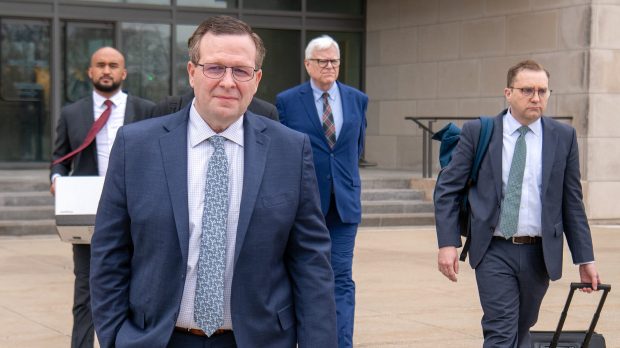
Hours after being taken into federal custody, Reed appeared before a judge at the Dirksen U.S. Courthouse handcuffed and shackled, dressed in a maroon T-shirt and what appeared to be a white shirt or towel wrapped around his face.
He immediately started shouting over U.S. Magistrate Judge Laura McNally, saying “I plead guilty! I plead guilty!” over and over. As the judge tried to continue with the hearing by advising him of his rights, Reed said “Don’t talk to me!” and started singing “la-la-la-la ” to drown her out.
A prosecutor later told the judge they were seeking detention based on a danger to the community and the fact the charge carries a maximum of life in prison, prompting Reed to shout, “What’s my charge?”
“Terrorist attack?” Reed said, shooting his head back. “Terrorist attack? Terrorism? Is that my charge? You said terrorism is my charge?”
After McNally confirmed it, Reed repeated: “It’s cool, it’s cool, it’s cool, it’s cool.”
Reed also repeatedly said he wished to represent himself. After repeating it again for at least the fifth time, McNally told him: “I understand. I have no ambiguity coming from you.”
Reed also claimed to be a citizen of China and asked that the Chinese Consulate be notified of his arrest.
McNally paused before saying, “All right.”
The judge set a detention hearing for Friday.
The complaint alleges that Reed filled a bottle with gasoline at a Garfield Park gas station about 30 minutes before the attack took place, getting on the Blue Line at the Kedzie stop before he allegedly approached the woman on the train.

Chicago police arrested Reed Tuesday morning as he was walking west on Washington Boulevard, per the complaint. In a statement Wednesday night, the department thanked officers for their “swift and coordinated” response.
According to his arrest report, officers were looking for Reed in connection with the alleged Blue Line attack, but later linked him to the City Hall fire and alleged that he’d thrown bricks through the window of a group home in the East Side neighborhood Monday.
Per the complaint, Reed yelled “burn alive, (expletive)” while officers were taking him to the Harrison (11th) District police station for questioning.
In July 2021, Reed was convicted of aggravated arson after he poured gasoline along a window ledge of the Thompson Center, which at the time was home to much of the state of Illinois’ Chicago operations, and tried to set the fluid on fire. He was sentenced to two years of mental health probation, which court records show he completed in December 2023. Two years earlier, he’d been arrested and charged with criminal damage to government property for smashing out windows on a Blue Line train, for which he was later sentenced to two years of probation.
Reed was arrested Tuesday while on pretrial release for an aggravated battery case stemming from charges that he allegedly hit a social worker in the face in a Berwyn hospital so hard the alleged victim lost consciousness.
Cook County Judge Teresa Molina-Gonzalez denied prosecutors’ petition to have Reed held in jail pending trial, instead ordering him released on electronic monitoring with regular check-ins with a probation officer. Reed pleaded not guilty to the charge Oct. 21, records show, and was supposed to return to court Dec. 4.
The Trump administration has been using CTA crime as a political cudgel for several months, but President Donald Trump’s Transportation Secretary Sean Duffy used the Blue Line attack to renew his criticism of the transit system’s approach to public safety in a Tuesday social media post.
“This horrific attack is EXACTLY why we need communities to take safety seriously. Blue cities cannot allow another Iryna Zarutska to happen,” Duffy wrote, referring to a 23-year-old woman killed in an apparently random fatal stabbing attack on a commuter train in North Carolina.
In September, Duffy wrote a letter to the CTA asking it to lay out its plans to reduce crime and fare evasion on the system — or risk losing federal funding.
“I appreciate your prompt attention to this matter to avoid further consequences, up to and including redirecting or withholding funding,” wrote Duffy, who has sent similar letters to the leaders of mass transit agencies in the Democratic-led cities of New York, Los Angeles, Washington, D.C., and Boston.
In a news release about the letters to transit leaders in Chicago and Boston, the U.S. Department of Transportation pointed specifically to cashless bail policies in the two cities, which it claimed “allows deranged criminals to repeatedly terrorize public spaces.”

The CTA’s acting president, Nora Leerhsen, defended the agency’s safety practices in a response to Duffy dated Oct. 3.
“We recognize that it is absolutely critical that we remain laser-focused on providing a safe and secure ride for everyone on our system,” Leerhsen wrote. “We share your focus on this important issue.”
Leerhsen claimed crime on the Blue Line specifically had dropped 30% over last year.
She also outlined the transit agency’s various crime-fighting initiatives, including its use of an AI-gun detection technology called ZeroEyes and the opening of a new strategic support center this summer in collaboration with Chicago police.
The CTA referenced the strategic support center again in a statement following the Blue Line attack, saying it was working with public transportation unit detectives embedded within the support center to aid their investigation.
Chicago Tribune’s Madeline Buckley contributed.