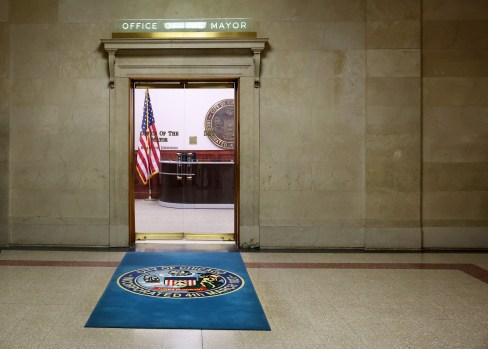

Mayor Brandon Johnson’s proposed head tax on companies with more than 200 employees appeared dead after the City Council’s Finance Committee on Monday rejected the mayor’s budget.
But oh, no, no, mayoral ally Ald. Jason Ervin, 28th, chair of the Budget Committee, said at the City Club on Wednesday. The mayor has a veto, and opponents of his head tax don’t have the votes to override. They’ll need to work with the mayor’s budgeteers on a plan the council can approve and the mayor will sign.
While it’s true Johnson’s City Council opponents lack the votes to override a Johnson veto, the mayor can’t yet pass his $16.6 billion budget, filling a $1.19 billion budget gap, either. And both sides face a hard deadline — Dec. 31, after which city spending must stop until a new budget is passed.
This is a classic political standoff, and the major players on both sides need to get to work, on behalf of the people of Chicago, to work through their differences and build a path toward a budget that can run an efficient, safe, equitable and fiscally sound city. Already, city workers are worried about their jobs, residents are concerned about city services and Chicago’s credit rating is suffering from the uncertainty.
For weeks, there has been talk that opposition leaders in the City Council might offer their own alternative budget. Well, put it on the table if it exists. The city can ill afford a first-ever government shutdown because the mayor and council can’t get a budget passed.
It did not need to play out this way. After last year’s long budget impasse, all parties promised to do better. The Johnson administration said it would float meaningful ideas to council members early in the year. That did not happen.
Johnson did appoint a task force to scour for new ideas. And he did pay the Ernst & Young consulting firm — which now calls itself EY — $3.2 million to come up with its own ideas, while also providing data to the city task force.
But those cries for outside help came up short. The budget task force was told to focus on ways to grow revenue, less so on the cost cuts that are sorely needed. EY was allowed to look for savings, but only in carefully constrained channels. Even so, EY still found as much as $1.3 billion in annual cost savings, alongside additional revenue sources.
The biggest category of potential savings was in optimizing the delivery of city services, from which EY found economy measures in public safety — police, fire, emergency management and safety administration — that could save nearly $600 million, by its math.
But consider this reality check: Of the major tactics EY tallied in its 101-page report, “none were identified as being both highly feasible and having high fiscal impact,” the firm stated. The practical reality is that few of EY’s proposals will be put into practice.
Results of the city’s budget task force could be more tangible. The Johnson administration has claimed $200 million in savings from task force proposals integrated into the mayor’s budget — but it provided scant detail to support the claim. This has Civic Federation President Joe Ferguson, whose organization served on the task force, scratching his head.
“Use is claimed. Itemization is incomplete,” he said in a text exchange.
That said, the itemizations listed by the task force and EY do offer interesting ideas. Many are small, but persistence and practical problem-solving can help fill a $1.19 billion budget hole, or largely reduce it, by stacking such fixes one at a time.
It’s well past time for Johnson and his growing legion of City Council opponents to get to work, using the semi-official data from the outside sources, the deep knowledge and capabilities of the mayor’s finance team, and whatever the council has to offer to find ways of getting to “yes.”
Editorial: Death of Mayor Brandon Johnson’s head tax should lead to negotiations with unions
Preconditions won’t help. The administration and aldermen need to stop drawing red lines and start talking about what they’re willing to consider.
It’s understandable that the city’s largest cost center — the Police Department’s proposed $2.1 billion budget — is ring-fenced against cuts. A decline in homicides and other violent crime shows progress; this is no time for public safety cutbacks.
Other departments have explaining to do. According to a department-by-department analysis of Johnson’s spending plans published by the Better Government Association, the Department of Water Management is due for a $357 million increase, aviation is penciled in to spend $119 million more next year and the Department of the Environment is budgeted for $50 million, up from $2.4 million, the largest percentage increase of any department.
Are there meaningful trims to be found in these department budgets, as well as others?
Johnson, who saw his negotiating leverage weaken last year as the Dec. 31 deadline approached, would be well advised to find compromises now.
The mayor still evidently hopes to lean almost exclusively on the revenue side of the ledger — and on the “ultra-rich” in particular. But unless he can find ways to soften opposition to the head-tax plan, he’ll need to find answers elsewhere.
There’s no stomach for a property tax hike, either in Johnson or the City Council. And those positions hardened this week after Cook County Treasurer Maria Pappas announced that property taxes last year jumped nearly 17% citywide, and the city’s South and West sides are paying a disproportionate part of the increase.
There are only so many categories that can stay off the table as time passes and the pressure mounts.
Johnson and his progressive allies say a grocery tax would affect poorer residents most. But the money it might generate could tempt them as Dec. 31 approaches.
An automatic inflation-connected escalator to property taxes — passed under Mayor Lori Lightfoot, who stopped using it as she faced reelection, and unused by Johnson — could deliver roughly $56 million in new revenue, the budget task force estimated. Might Johnson and the City Council be tempted to implement that tool? After all, it was designed to reduce the political heat surrounding property tax increases.
In its way, what we’re seeing in city government is a sign of progress: The City Council for a second year is acting independently and setting its own agenda for the city budget. The next step would be to start building, or helping build, a budget that represents its agenda, not just the mayor’s.
The council should also work constructively with the Johnson administration to consider all reasonable options, then pass a budget that is balanced, fair and fiscally responsible — before the clock strikes midnight on Dec. 31.
David Greising is president of the Better Government Association.
Submit a letter, of no more than 400 words, to the editor here or email letters@chicagotribune.com.