
The proposed map for Indiana’s Congressional districts does offer Republican candidates an advantage in all districts, but also makes some districts more competitive for a potential Democratic win, according to Indiana University Indianapolis professor of political science Aaron Dusso.
When he saw the proposed map, Dusso said it was immediately clear that Republicans’ goal was to push for all nine of Indiana’s Congressional districts to lean Republican. Currently, of Indiana’s nine Congressional districts, seven are held by Republicans and two are held by Democrats.

The proposed map breaks up the two Democratic districts: the First District, held by U.S. Rep Frank Mrvan, into two pieces and the Seventh District, held by U.S. Rep André Carson, into four pieces, Dusso said. It also shifts the remaining seven districts in a way that could make them more competitive in the 2026 midterm elections, he said.
The map utilizes the “cracking” method of redistricting, where the map drawer breaks up — or cracks — the support of one party to give the other party an advantage, Dusso said.
In the past, Dusso said Indiana has utilized the “packing” redistricting method, which is when the map drawer places — or packs — the majority of the opposition party into one or two districts to give the majority party the advantage.
“The cracking method is more risky. The value in why most states follow the packing method is it makes almost every district completely uncompetitive and you’re going to win without any problem,” Dusso said. “The cracking method, though, you can win more but it’s a risk. A lot of politicians are not very risk accepting.”
The safer bet for Indiana Republicans, Dusso said, would’ve been to pack more Democratic voters into the Seventh District, near Indianapolis, and break up the First District to go for eight Republican seats to one Democratic seat.
While Republicans have maintained that the redrawn map was done with political advantage in mind, the map is racially gerrymandered, Dusso said.
“There’s no question that as you break up Marion County, you’re breaking up the voting power of the Black community,” Dusso said.
Under the proposed map, about four Republican districts become more competitive, Dusso said. While those districts lean Republican, the incumbent candidates will have to go to new areas to campaign, he said.
“They should win, but they’re in districts where they’re not just going to be able to do nothing in the general election,” Dusso said. “There’s a lot of starting over. You can’t just call the same precinct captains and community leaders that you called up before. You’ve got to make new relationships.”
If the economy and President Donald Trump’s approval rating don’t improve by the 2026 election, then it places incumbent Republican candidates in a difficult position for the general election, Dusso said, as their seats become competitive for potential Democratic candidates.
The proposed map takes the current First District and splits Lake and Porter counties between the First and Second districts. With the proposed First District stretching from Lake County, southern portions of Porter County and eastward through Wabash County, Mrvan will have to campaign in new areas, Dusso said.
Republicans will have to run a strong candidate in the First District, Dusso said, because Mrvan is more known in Northwest Indiana as the incumbent.
The proposed map completely breaks up the current Seventh District, which positions Carson to choose between the new Ninth, Sixth or Seventh districts, Dusso said. Not knowing where Carson will run makes all three districts highly competitive, he said.
If he were in Carson’s position, Dusso said he would run in the new Seventh District because it doesn’t appear that Republicans have a candidate for the new district.
But, even in the new district — which has a portion of Marion County and then stretches east — Carson will have to campaign and meet new voters, Dusso said.
Another big shift, Dusso said, is the Ninth District, which now stretches from a portion of Indianapolis south to Louisville. U.S. Rep. Erin Houchin, R-Salem, currently represents the Ninth District, and if she seeks reelection, she will have to go to Morgan County and a part of Marion County to campaign for the first time, Dusso said.
By splitting up Marion County into four districts, it’s possible that Republicans have opened the door for Democratic candidates who didn’t want to challenge Carson but now live in a different district, Dusso said.
Ultimately, any district that gives the Republican candidate a 55% advantage becomes competitive for Democrats, Dusso said, especially in a midterm election with an unpopular Republican President and Congress.
How competitive the districts become depends on the candidates the state and national Democratic parties support in Indiana, Dusso said.
“What this map does is it moves the starting line for Democrats much, much closer to the finish line,” Dusso said. “They are going to be closer to the finish line than they have been in decades. Now, it’s up to the leadership of the Democratic Party here in Indiana and nationally to try and take advantage of that.”
The Trump administration has been pressuring Republican-led states, including Indiana, since August to conduct mid-census redistricting to ensure a Republican majority in the U.S. House of Representatives in the 2026 midterm elections.
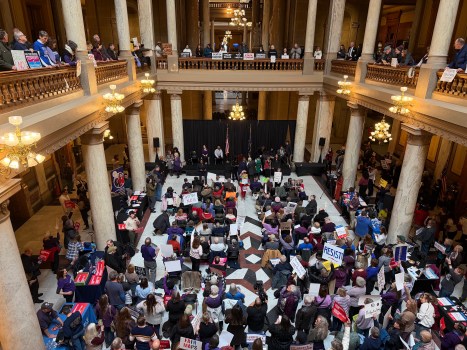
While the Indiana Senate leadership has stated it doesn’t have the votes to pass new maps, the House has started the process and, as of Monday, released a redistricting bill and a proposed map. The House Elections and Apportionment Committee approved House Bill 1032 Tuesday in a 8-5 vote. The bill will be heard by the House Thursday on second reading.
House Bill 1032, authored by State Rep. Ben Smaltz, R-Auburn, would allow the legislature to amend congressional districts at a time outside of the release of the U.S. Census, which is when redistricting typically occurs.
The bill also establishes new Indiana Congressional districts, and states that any challenges to the new maps will be heard by the state’s Supreme Court. The bill states that the current Congressional Districts won’t expire before Nov. 3, 2026.
“We have drawn these maps to create a Republican political advantage,” Smaltz said.
Julia Vaughn, executive director of Common Cause, said the proposed map “is unfair” to Hoosiers in the Calumet region and Marion County, who have for decades voted for Democrats.
The map will give many Hoosiers “a muffled voice” in Congress, Vaughn said.
“It is unfair to Black and brown voters in the First and Seventh Congressional districts who will see their political power diluted by being cast into districts with rural voters,” Vaughn said. “If you believe that voters in the First and Seventh Congressional districts would be better served by Republicans, the appropriate way to address that would be finding and supporting good candidates to challenge Democratic incumbents, not drawing the lines to unfairly give your candidates an advantage.”
House Democratic Leader Phil GiaQuinta, D-Fort Wayne, said in a statement the maps “will make it harder” for Hoosiers to get by.
“Most Hoosiers will already tell you that government does very little for them. How does being lumped in a district with Hoosiers in vastly different regions with vastly different concerns make government work better for constituents? It doesn’t,” GiaQuinta said.
The proposed map is not redistricting but “rigging,” said Senate Democratic leader Shelli Yoder, D-Bloomington. It does not reflect the needs of Hoosiers, Yoder said, and it was drawn “to produce results President Trump wants.”
“It is cheating, not competing, and it strips Hoosiers of the most basic power they have in a democracy: the ability to choose who represents them,” Yoder said.