Skip to content
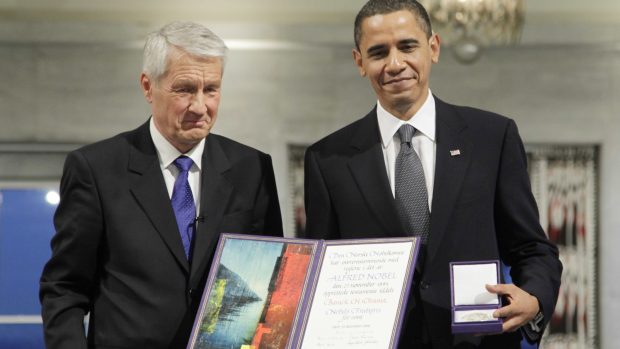
President and Nobel Peace Prize laureate Barack Obama with his medal and diploma alongside Nobel Committee Chairman Thorbjorn Jagland at the Nobel Peace Prize ceremony at City Hall in Oslo, Norway, on Dec. 10, 2009. (John McConnico/AP)
PUBLISHED:
Getting your Trinity Audio player ready...

Here’s a look back at what happened in the Chicago area on Dec. 10, according to the Tribune’s archives.

Is an important event missing from this date? Email us.

Vintage Chicago Tribune: Nobel Prize winners with Chicago connections

Weather records (from the National Weather Service, Chicago)

  • High temperature: 62 degrees (1879)
  • Low temperature: Minus 8 degrees (1978)
  • Precipitation: 2.18 inches (1971)
  • Snowfall: 10.9 inches (1934)
Nobel Prize winning professor Albert A. Michelson of the University of Chicago in an undated photo. (University of Chicago)
Nobel Prize-winning professor Albert A. Michelson of the University of Chicago in an undated photo. (University of Chicago)

1907: Albert A. Michelson, the first head of the physics department at the University of Chicago, won the first Nobel Prize ever presented to an American (though he was born in Prussia) in science. The U.S. Naval Academy graduate measured the speed of light with unsurpassed accuracy and built several machines for studying the length of light waves.

Charles Gates Dawes, circa June 15, 1924. (Chambers Studio)

1925: Vice President Charles Gates Dawes won the Nobel Peace Prize (shared with Sir Austen Chamberlain) for his Dawes Plan, which helped stabilize Germany’s finances and repay reparations after World War I. The award was accepted by Laurits Selmer Swenson, U.S. minister in Oslo, in 1926.

heart attack killed Dawes in 1951. His home is now the Evanston History Center.

Jane Addams, right, with Mary McDowell, circa 1917. McDowell was the kindergarten teacher at Hull House and, among other things, a founder of the settlement Woman's Club. (Chicago American)

1931: Hull House founder Jane Addams was presented the Nobel Peace Prize (shared with Nicholas Murray Butler) for her activities in the Women’s International League for Peace and Freedom, which she helped to found and served as its first president. Addams was the second woman — and the first American woman — to win the award.

1935: John Jacob “Jay” Berwanger, University of Chicago running back, received the first Heisman Memorial Trophy recipient, although the honor wasn’t called that until a year later. The trophy was named for club athletic director John W. Heisman after he died in 1936. Berwanger traveled to New York to accept “a special trophy at a luncheon,” the Tribune reported.

Vintage Chicago Tribune: Meet Jay Berwanger, the University of Chicago football player who won the 1st Heisman

Berwanger, an Iowa native, was often dubbed the “one-man football team” for his ability to play offense, defense and special teams for the Maroons (the University of Chicago abandoned the sport just four seasons after Berwanger departed).

Finances are what might have persuaded the man with a blue-collar background to choose a career in sales over suiting up in the NFL.

Tom Harmon of Michigan with the College All-Stars, circa 1941. (Chicago Tribune historical photo)

1940: The Chicago Bears selected University of Michigan back Tom Harmon with the No. 1 pick in the NFL draft.

Harmon, a Gary native, was considered by many who covered college football — including the Tribune — to be its best player that year. He was a two-time All-American, was named The Associated Press’ athlete of the year in 1940 and received the Maxwell Award as the college football player of the year.

When the Tribune gave him its Silver Football trophy in early 1941, he said, “This moment is perhaps the happiest in my life.” That was just months after the Michigan running back became the school’s first Heisman Trophy winner.

Before Caleb Williams, the Chicago Bears selected only 2 No. 1 draft picks — and both were disappointing

But instead of signing with the Bears, Harmon signed one for $15,000 with Columbia Pictures — to star in a film called “Harmon of Michigan.” The Tribune called the movie’s storyline “a weak, stupid and incredible affair, punctuated with banal dialog and incident.” He followed that up with a sports director radio contract in Detroit.

Harmon did play football in Chicago in 1941 but not for the Bears — before more than 98,000 fans at Soldier Field as part of the Chicago Tribune All-Star Charity Football Game.

Lincoln Park Zoo Director R. Marlin Perkins, left, holds a red rat snake and "Zoo Parade" announcer Jim Hurlbut holds a common king or chain king snake as Perkins returns to the show following a snake bite on April 22, 1951. (Don Davenport/Chicago Park District)
Lincoln Park Zoo Director R. Marlin Perkins, left, holds a red rat snake and "Zoo Parade" announcer Jim Hurlbut holds a common king or chain king snake as Perkins returns to the show following a snakebite on April 22, 1951. (Don Davenport/Chicago Park District)

1944: R. Marlin Perkins was named director of the Lincoln Park Zoo. The next year, Perkins began his career as a television animal show host. His ”Zoo Parade” went on the air live on NBC that year, when there were only 300 television sets in the city.

A large crowd attended the dedication ceremony for Merrill C. Meigs Field on June 30, 1950, in Chicago. (Howard Borvig/Chicago Herald American)

1948: Chicago’s downtown airport was officially opened on Northerly Island. A ”sky parade” of official planes and about 100 private planes emerged from overcast skies in subfreezing temperatures for the occasion, but its dedication as Meigs Field took place two years later.

Pickets outside the Chicago & North Western Railway Passenger Terminal on Dec. 10, 1970, represent Local 528. Their signs state the railroad workers are striking the line which serves 45,000 commuters daily. (Edward Smith/Chicago Tribune)

1970: A one-day national rail strike by the Brotherhood of Railway and Airline Clerks — the third of its kind in 50 years — was ended under threat of a federal judge who called the union in contempt of court. Some 40,000 union railroad workers in the Chicago area were involved in the short-lived strike.

Bill Veeck holds the keys to Comiskey Park after officially assuming control of the Chicago White Sox on Dec. 10, 1975. (Michael Budrys/Chicago Tribune)

1975: With American League owners set to move the Chicago White Sox to Seattle and allow Charlie Finley to move his A’s to Comiskey Park, Bill Veeck and his investors repurchased the club from John Allyn — keeping the Sox in Chicago.

Chicago White Sox owner Bill Veeck, right, leaves his card a giant Christmas card expressing his appreciation to Mayor Richard J. Daley, left, and all who played a role in keeping the team in Chicago which was presented to City Council on Dec. 19, 1975. Veeck conceded the illustration might be optimistic. (George Quinn/Chicago Tribune)
Chicago White Sox owner Bill Veeck, right, leaves a giant Christmas card expressing his appreciation to Mayor Richard J. Daley, left, and all who played a role in keeping the team in Chicago which was presented to the City Council on Dec. 19, 1975. Veeck conceded the illustration might be optimistic. (George Quinn/Chicago Tribune)

Veeck sold the team to Skokie real estate developer Jerry Reinsdorf and New York television executive Eddie Einhorn in January 1981.

An approximately 400-year-old bell, weighing more than 600 pounds, was installed in the bell tower of Church of Our Saviour, 500 block of W. Fullerton Parkway on Dec. 10, 1976. Rev. J. Wilson Reed, left, and Episcopal Bishop of Chicago, Rev. James W. Montgomery, right, blessed the bell before its installation. (Quentin C. Dodt/Chicago Tribune)
An approximately 400-year-old bell, weighing more than 600 pounds, was installed in the bell tower of Church of Our Saviour, 500 block of West Fullerton Parkway on Dec. 10, 1976. The Rev. J. Wilson Reed, left, and Episcopal Bishop of Chicago, the Rev. James W. Montgomery, right, blessed the bell before its installation. (Quentin C. Dodt/Chicago Tribune)

1976: A bronze bell dating back to the late 1500s and weighing 600 pounds was installed at Church of Our Saviour in Lincoln Park. It is the oldest known bell in Chicago.

The Chicago Tribune reported on Oct. 7, 1978, on the installment of the University of Chicago's first female president for the university, Hanna Gray. (Chicago Tribune)
The Chicago Tribune reported on Oct. 7, 1978, on the installment of the University of Chicago's first female president, Hanna Gray. (Chicago Tribune)

1977: Hanna Holborn Gray was named the 10th president of the University of Chicago — the first woman to hold the position. She was installed in October 1978.

President Barack Obama talks with Nobel Institute Executive Director Geir Lundestad, left, as first lady Michelle Obama, second from right, and others look on during a Nobel Signing Ceremony at the Nobel Institute in Oslo, Norway, on Dec. 10, 2009. In a break with Nobel tradition, the former secretary of the Nobel Peace Prize committee, Lundestad, said that the 2009 award to Obama failed to live up to the panel's expectations. Lundestad wrote in a 2015 book that the committee had expected the prize to deliver a boost to Obama. Instead the award was met with fierce criticism in the United States, where many argued Obama had not been president long enough to have an impact worthy of the Nobel. (Susan Walsh, File/AP)
President Barack Obama talks with Nobel Institute Executive Director Geir Lundestad, left, as first lady Michelle Obama, second from right, and others look on during a Nobel Signing Ceremony at the Nobel Institute in Oslo, Norway, on Dec. 10, 2009. In a break with Nobel tradition, the former secretary of the Nobel Peace Prize committee, Lundestad, said that the 2009 award to Obama failed to live up to the panel's expectations. Lundestad wrote in a 2015 book that the committee had expected the prize to deliver a boost to Obama. Instead the award was met with fierce criticism in the United States, where many argued Obama had not been president long enough to have an impact worthy of the Nobel. (Susan Walsh/AP)

2009: Just 11 months after he celebrated his election as president in Grant Park and nine months after his inauguration, President Barack Obama became a Nobel laureate. He was the fourth U.S. president to win the Nobel Peace Prize and the third to do so while in office (the other two were Theodore Roosevelt and Woodrow Wilson).

The bestowal of one of the world’s top accolades on Obama, who had yet to score a major foreign policy success, was greeted with gasps from the audience at the announcement ceremony in Oslo, Reuters reported.

Obama, as if accepting the unusual circumstance of the award, accepted it “as a call to action” rather than a reward for accomplishments.

Chicago Cub executives, general manager Jed Hoyer, left, and president Theo Epstein, right, introduce pitcher Jon Lester at Spiaggia restaurant in Chicago, on Dec. 15, 2014. (José M. Osorio/Chicago Tribune)
Chicago Cub general manager Jed Hoyer, left, and president Theo Epstein, right, introduce pitcher Jon Lester at Spiaggia restaurant in Chicago, on Dec. 15, 2014. (José M. Osorio/Chicago Tribune)

2014: Left-handed pitcher Jon Lester agreed to a six-year, $155 million deal with the Chicago Cubs.

Lester, who led the Cubs to five playoff appearances, three National League Central titles and the 2016 World Series title, received a $10 million buyout from the team in October 2020.

Want more vintage Chicago?

Subscribe to the free Vintage Chicago Tribune newsletter, join our Chicagoland history Facebook group, stay current with Today in Chicago History and follow us on Instagram for more from Chicago’s past.

Have an idea for Vintage Chicago Tribune? Share it with Kori Rumore and Marianne Mather at krumore@chicagotribune.com and mmather@chicagotribune.com