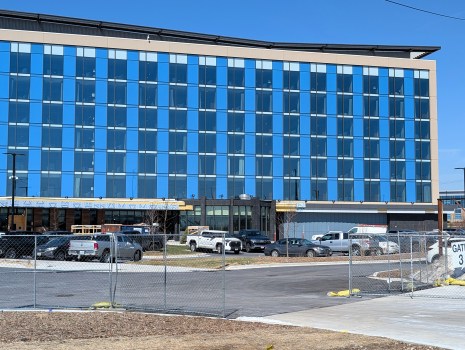


Geneva residents in March are set to vote on the issuance of $59.4 million in bonds to help pay for the construction of a new police station in the city.
The Geneva City Council unanimously approved placing a referendum question for the bond sale on the spring ballot at a special meeting on Monday.
If the referendum question is approved, the city plans to build a new police station on a city-owned property adjacent to the Public Works site on South Street.
The city had been planning to put a public safety facilities bond referendum question to voters in last April’s election, but the measure was ultimately pulled from the ballot after the city discovered a calculation error that would have doubled the projected property tax payment.
But the City Council has revisited the idea, and now is moving forward with putting the question to voters in the March 17, 2026, primary election.
Geneva’s current police station is located just off the Fox River at 20 Police Plaza. The building previously housed the police department, fire department and Tri-Com Central Dispatch, City Administrator Alex Voigt said previously, but the latter two entities have since gotten their own facilities.
The city adopted a facilities master plan earlier this year, which identified a new police station as a top priority. City staff has previously pointed to issues like a lack of office space, flooding, sewer back-ups and a partial roof collapse at the current police station.
So, Geneva has been weighing the construction of a new, 45,000-square-foot police station on the property next to the Public Works site on South Street.
Issuing $59.4 million in bonds would enable the project to include an indoor firing range and indoor parking for all vehicles at the new police station, officials have said. Voigt has explained that the ballot measure’s language indicates that the money can be spent on public safety, meaning any excess funds could be used on other public safety projects — like Fire Station 2 on the city’s west side, which has also been identified as a priority project for the city.
The city has indicated it would sell the property at 20 Police Plaza once the new police station is completed.
According to the city, the property tax impact the approval of the referendum question would have on an average Geneva household would be about $272 annually. The city created an online calculator on its website at www.geneva.il.us for residents to determine the estimated property tax impact they would see if the referendum question is approved, based on the value of their homes.
At Monday’s City Council meeting, Geneva Finance Director Jennifer Milewski presented the calculator tool, noting that it allows residents to indicate any exemptions they receive to get a sense of the impact the bond referendum would have on their property tax bills.
Ald. Amy Mayer noted that residents should use their property tax bill to find the value of their home rather than looking at estimates online.
And Kent Floros, a partner at law firm Chapman and Cutler, explained that, if approved by voters in the spring, the city would not be able to issue the debt until the summer at the earliest. The city has a five-year period to issue the bonds following approval of the referendum question, and the bonds have a payback period of up to 20 years.
Ald. Dean Kilburg said that the city should look at what bonds other taxing bodies in the community would be retiring soon, to determine what residents’ property tax bills would look like overall.
Ald. Brad Kosirog asked about the funds being used for other public safety projects, not just the police station. Voigt explained that the city would highlight that in its community engagement efforts, but that the police station was indicated as a priority by the community of the projects in the city’s facilities master plan.
The City Council ultimately voted unanimously on Monday to approve putting the question on the March ballot.
Also at Monday’s meeting, the council continued its discussion of putting to voters a question about whether Geneva should move to become a home rule municipality — but that’s not set to be included on the March ballot.
An Illinois municipality with a population of more than 25,000 automatically receives home rule status, according to the state constitution. Communities with a population lower than 25,000 can become home rule units by putting the question to voters.
Geneva’s population currently stands at a little over 21,000, per the most recent available U.S. Census Bureau figures.
Being a home rule municipality allows local governments more flexibility in lawmaking, as the Illinois constitution allows them to essentially exercise any power not specifically limited by the state.
City staff has previously explained that having this authority would allow the city to issue bonds for each of its facility improvement projects separately and over time, instead of having to rely on a single referendum to borrow all of the money upfront. It would also allow them to access new sources of revenue, like business licenses and impact fees on new development, and to have broader powers around economic development, officials have said.
A switch to home rule was previously on the table for the March ballot, and both it and the bond referendum were discussed extensively, but the council ultimately decided on starting with the bond referendum.
However, the city on Monday did give the green light to pursue education efforts on home rule in the community, in preparation for the matter being put to voters in a future election.
Ald. Martha Paschke asked whether these education efforts would overlap with communications to the community about the bond referendum, and Voigt said that education on home rule would start after the bond question, because the city “want(s) to be very clear that they’re two separate and distinct paths.” Voigt also noted that discussing home rule with voters would be a longer process comparatively.
At the meeting, Ald. Mark Reinecke suggested the city amend the language of the resolution on the home rule education efforts to be worded in “a more neutral manner.” The original wording of the measure described educating the public on “the merits of” pursuing home rule.
In response, Paschke said she was “a bit confused about why (the city) would put energy and funding behind an education campaign if we don’t believe there are merits to what we’re putting forward.”
“I don’t want there to be a presumption by our community and our residents that we have decided on the course of action, but, rather, we would like to discuss both the strengths and limitations of home rule and be open to a discussion of our community’s concerns,” Reinecke explained. “Rather than presenting this as, ‘We are here to educate you on a decision that’s already been made.’”
Ald. Anaïs Bowring said she believes what the city is doing is “indicating that (the city thinks) this is a useful avenue to pursue,” and suggested the city not adjust the language.
“I don’t think that merit, to me, indicates the exclusion of all possible downsides,” Bowring said. “But, I will say this, I have yet to find — in all the research that I have done and talking with people — downsides to home rule.”
Mayer suggested that the modification wouldn’t change the meaning of the resolution, and Ald. William Malecki said he didn’t have an issue with the wording change, but said he wanted to ensure that the public knows that the city intends to educate the community on home rule “for the reason of moving Geneva forward, you know, to a better place five years from now, 10 years from now.”
And Ald. Jeff Palmquist pointed to the resolution’s language about the future vote, saying that’s “really what … we’re getting to.”
The language change was ultimately approved, with Bowring and Paschke voting against it.
The measure on the education efforts was also approved, with only Ald. Larry Furnish voting against it. The ballot question on home rule status, per the resolution approved Monday, is set to occur no later than the general election on Nov. 7, 2028.
mmorrow@chicagotribune.com