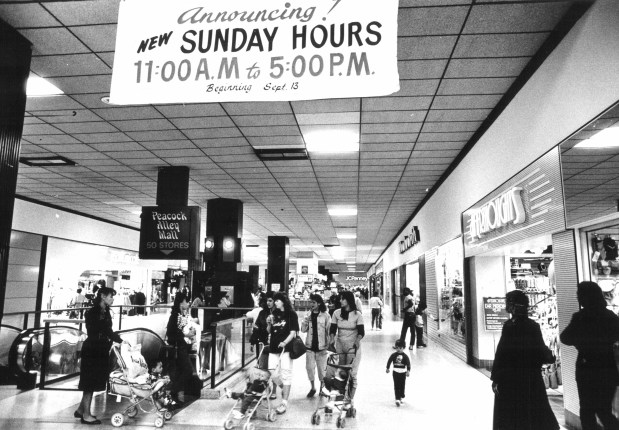


If the Bears are looking beyond Arlington Heights, they should strongly consider looking back to Chicago and building at another prime location, on the Southwest Side of the city, that is ripe for redevelopment — the soon-to-be defunct Ford City Mall.
The infrastructure is either already there or easily added — a major airport (Midway) is blocks away, along with a cluster of associated hotels; there have been talks (and even plans) of extending the Orange Line from Midway to Ford City for years; and it is right by the major thoroughfares of Cicero Avenue and 79th Street. Moreover, the location is historic, as it was the site of a major manufacturing center for bomber engines during World War II. To cap it off, if you faced the stadium toward the northeast, you would still get a distant but visible view of the Chicago skyline.
Perhaps most importantly, the Bears would be able to buy the land for a song at this point — the mall was last sold in 2019 for $16.6 million.
— James Shine, Chicago
An Indiana stadium?
Bears President and CEO Kevin Warren has got to be kidding. A “world-class stadium” in Indiana? Talk about your textbook oxymoron.
For openers, how are fans going to get there? Oh, they could pay to take the Skyway or they could drive to the site on Interstate 80/94. Pick your poison, unless bumper-to-bumper semis going in excess of 70 mph is your idea of an easy drive. All those trucks on a Sunday night and all those Bears fans slightly tipsy after a game: Imagine the possibilities.
World-class? Hmm. The Bears think the 326 acres they own in Arlington Heights would be perfect, if only the General Assembly rolled over and gave them the power to negotiate property taxes with local governmental agencies. No doubt they’d get that authority in Indiana, but where, exactly?
For 326-plus acres of property across the state line, odds are it won’t be pristine prairie or farmland. Far more likely, the land will be a brownfield in need of major remediation. Check that. It’s Indiana. Passing a magic wand over the site should suffice for cleanup.
— Douglas Bukowski, Berwyn
Mayor’s ‘negotiation’
Mayor Brandon Johnson’s response to the news that the Bears will include Indiana as a potential site for a new stadium was to say, “The Bears belong in Chicago.” In the future, I think the mayor will be able to add another entry to his resume that no former Chicago mayor has ever been able to claim: the mayor who lost the Chicago Bears.
So much for the “collaborator in chief.” Saying his “door is always open” is not how you negotiate with a sports team looking for a new stadium, but then again, he has proved that he is simply not good at negotiating or governing, for that matter.
— Mike Kirchberg, Chicago
Their Decatur origins
Enough already with all the hand-wringing and political posturing over the location of the new Bears stadium. The solution is simple: The Bears should move back to Decatur.
— Joyce Keithley, Chicago
Rolling in her grave
One of my favorite memories of growing up in a household that loved their football was listening to my mother enthusiastically belting out the Chicago Bears fight song on Sunday afternoons. I assume some people still remember the old-timey gusto that went into singing the clever lyrics of “Bear Down, Chicago Bears,” especially the lines: “You’re the pride and joy of Illinois! Chicago Bears, bear down!”
I have to say that today, I hear my dear old mother rolling around in her underground Bear haven, having heard the news of the Halas Hall bigwigs proposing to move the team across the mighty Calumet to northwest Indiana, and she’s hissing out new lyrics, “You’re a bunch of skinflint Indianans, Hammond-Whiting Bears — come home!”
Monsters of Michigan City? I don’t think so.
— Dave Jones, Chicago
Delivery robot debate
Regarding the editorial “Chill out aldermen, the delivery robots are cute” (Dec. 11): I thought the only thing I needed to worry about this past summer was welcoming my newborn baby into our family and healing from the third-degree perineal tear she gave me. I was wrong.
One day as I was walking with my newborn strapped to my chest, I came head to head with a delivery robot. I lost the standoff. We were on a sidewalk with other people, next to a busy street filled with cars. I figured it would sense I was there and stop. It did not. It nearly ran into me and my newborn and left me with very narrow space to move around it. I grumbled under my breath and kept walking.
I was annoyed, but I resigned myself to accepting these new neighbors of ours without pondering if they posed any sort of problem beyond battling them out for sidewalk space. At the time, it seemed like a small inconvenience.
My husband, Josh, however, grew more and more troubled by them. He pointed out how they blocked sidewalks that are meant for people. It is annoying if you are able to go around them, but if you have a wheelchair or stroller, it may be impossible.
He started a petition at nosidewalkbots.org. The slogan is “Sidewalks Are for People” (pets too, but that wasn’t as catchy). The petition didn’t take off until just recently. Now it has over 3,000 signatures, with more added daily.
We have read reports of collisions with the robots, even to the point of needing stitches. That people with walkers can’t get around them and that the robots block pathways for kids in strollers or people in wheelchairs (snow or no snow). They are forcing people off sidewalks just to deliver food.
I get the novelty and awe of them. I do agree that they are cute. My 4-year-old loves them. However, at what point do things become a “real” problem? Shouldn’t we be able to make room for the people who need it?
While I believe that all the other questions or concerns raised about the delivery robots are debatable (job loss, privacy/surveillance concerns and data on whether they actually alleviate congestion), the problem that we should care about is accessibility. Let’s not overlook real problems caused by robots that are cute.
— Kaleene Robertson, Chicago
Civility isn’t weakness
I am both privileged and blessed to say that the Honorable William J. Bauer was my dear friend for more than 50 years. Our first real meeting took place in February 1971, in the chambers of Judge Abraham Lincoln Marovitz.
Bill, then a United States attorney, and I — representing an indigent criminal defendant — were on opposite sides of a fiercely contested case arising from a bank robbery and murder. At issue was whether due process could prevail over executive privilege. The case proved to be unique and precedent-setting. More importantly, it marked the beginning of a lifelong friendship grounded in mutual respect and integrity.
Much has been written about Bauer’s intellect, discipline and devotion to the rule of law. All of that is true. But it does not fully explain the man I knew. Bill possessed something rarer in our profession: courtesy without weakness and conviction without cruelty.
John Henry Cardinal Newman once described a true gentleman as one who never inflicts pain, who is fair in dispute, measured in word and tone, and guided by the long view — that we should conduct ourselves toward an adversary as if he might one day be a friend. That description fits Bill exactly.
Even in sharp disagreement, he never confused force with hostility or argument with animus. He listened carefully, spoke precisely and treated everyone in the room with dignity. He was rigorous without being unkind and confident without being dismissive.
In a profession not always known for gentleness, Judge Bauer understood that civility is not weakness but strength. I was fortunate to witness that strength — for more than five decades — in the courtroom and in friendship.
Bill’s example helped shape the character of the federal judiciary in Chicago and remains part of his lasting contribution to the city’s legal life.
— Robert P. Cummins, trial lawyer, Chicago
Note to readers: We’d like to know your hopes for the new year. Please send us a letter, of no more than 400 words, to letters@chicagotribune.com by Sunday, Dec. 28. Include your full name and city/town.
Submit a letter, of no more than 400 words, to the editor here or email letters@chicagotribune.com.