






It never gets easy, our yearly look back at the many people — and some places, trends and other things — that departed in the past 12 months. But in so doing, we — meaning some of the Tribune’s critics, writers and contributors — are reminded of what a rich and rewarding spot we live. Though many of the people you will read about have had a global impact, most have plied their magic here, a nurturing place. We have been fortunate enough to share their talents, and if there is a minor joy to the making of these yearly lists, it is in knowing that you may never have heard of these people or tasted their creations. And doing so will surely make 2026 a bright new year.
From Tribune columnist Rick Kogan
It is a long way from Lake Forest to the moon — 240,000 miles, give or take — and James Lovell made that trip twice, never setting foot on the moon but seeing things that few people have ever seen and living a life of estimable grace. He died in August in that leafy northern suburb where he had lived for many of his 97 years, running with his son Jay a terrific restaurant named Lovell’s.


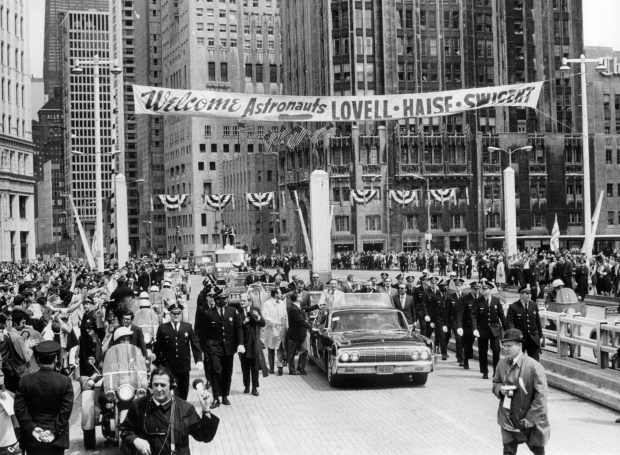


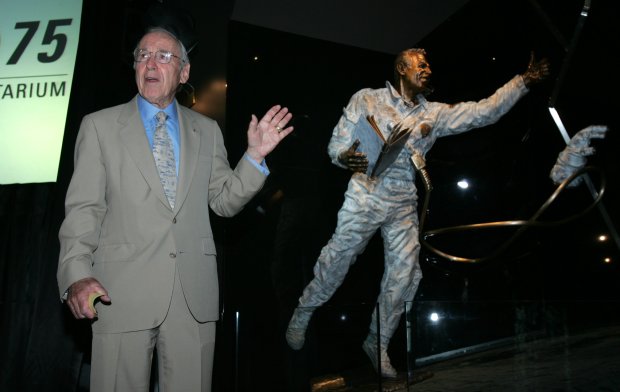


It served good food and was filled with some of the memorabilia he had accumulated during his long, high-flying and honor-filled career. There was a moon rock and a framed “Apollo 13” movie poster signed by actor Tom Hanks, who portrayed Lovell in the 1995 film. Many of his obituaries understandably focused on Hanks, who posted his thoughts online, saying in part, “There are people who dare, who dream, and who lead others to places we would not go on our own. Jim Lovell, who for a long while has gone further into space and for longer than any other person on our planet, was that kind of guy. His many voyages around Earth and on to so-very-close to the moon were not made for riches or celebrity, but because such challenges as those are what fuel the course of being alive.”
Lovell wore the tag “hero” lightly. He was self-effacing, gentlemanly and energetically friendly. As an astronaut, he was a member of a very exclusive club. There have been 600-some people who have flown into space. By comparison, there have been more than 900 Nobel Prize winners and more than 3,500 Congressional Medal of Honor recipients.
To know him was to like and admire him. Local author Robert Kurson wrote about him in 2018’s “Rocket Men: The Daring Odyssey of Apollo 8 and the Astronauts Who Made Man’s First Journey to the Moon” that vividly captured that 1968 flight and its crew, Lovell and fellow astronauts Frank Borman and Bill Anders, the first humans ever to leave Earth for another destination and how this mission helped save the country’s space program.
The three of them are gone now, Borman dying in 2023, Anders in 2024 and Lovell in June. But they come to vivid life in the book. Kurson tells another wonderful story: “In all the time I knew Jim, he expressed just a single regret — that he’d been forced to give up flying at age 85.”
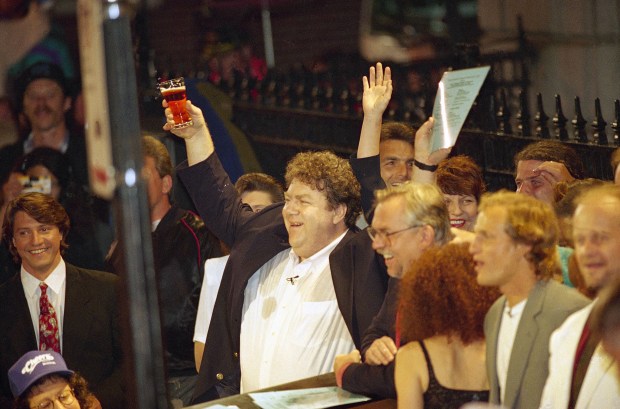
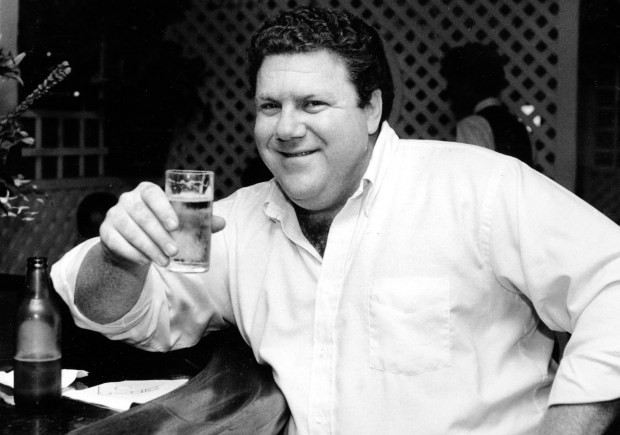
George Wendt was a child of Beverly, that tightly-knit, leafy neighborhood on the South Side. He was also a product of Old Town, that equally lovely but more frenetic neighborhood where he lived for a time and enlivened the stage of the Second City.
Wendt died of cardiac arrest on May 20 in Los Angeles, where he had lived since 1980 with his wife, Bernadette Birkett, whom he had met at the Second City. He was 76 years old.
He had grown up in a home near the corner of 92nd Place and Bell Avenue, where a street sign now features his name. The neighborhood is filled with fans and friends and many remember Wendt’s mom, Loretta Wendt, who died in 2010. That’s when George told me, “She was of her time, a housewife and mom, but I have always thought that had she been born in another era, she could have been as successful as Elaine May or Tina Fey.”
Some famous folks showed up at a second City memorial service in October. Thoughtfully organized and hosted by two of Wendt’s oldest friends and collaborators, Tim Kazurinsky and Peter Burns, the event included film clips of Wendt’s decades-old work at the Second City, some riotously funny, some zany. These peppered a parade of speakers who offered anecdotes most pleasingly upbeat, and among them were Jim Belushi, Joel Murray, Mark Nutter, Tom Tulley, Bruce Jarchow and Nancy McCabe-Kelly, and all the way from Ireland, Vinnie O’Shea.
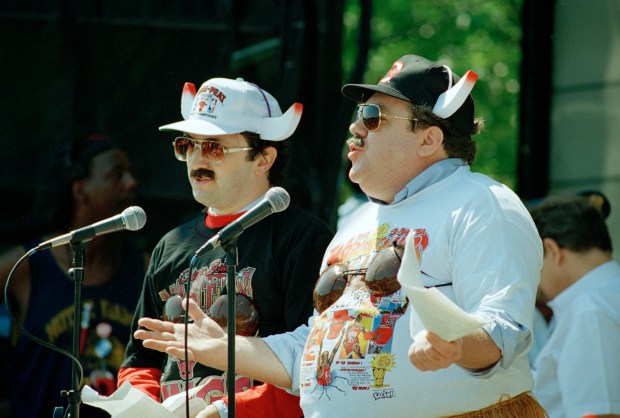
Wendt’s fame as Norm on “Cheers” — and the many Emmy nominations that came with it — understandably overshadowed his other work in TV, film and theater, of which there was plenty. He was also made larger than life through his turn on the popular Saturday Night Live bit about “Da Bears.”
The Second City memorial lasted a little less than two hours and it ended with a singalong (“Where Everybody Knows Your Name,” natch) and people walking out into the Old Town night knowing a little bit more about their old friend, colleague and relative, appreciating him more than ever, missing him too.

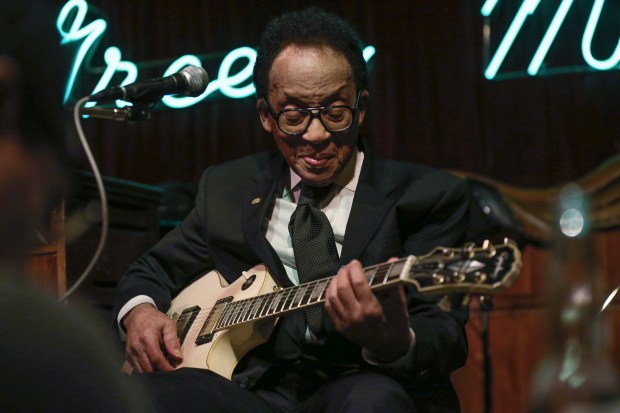


When George Freeman was about to turn 92 years old in 2019, the Tribune’s former jazz critic Howard Reich sat with him and heard him say, “I’ve played with Gene Ammons, Sonny Stitt, Stan Getz, my brother Von, Johnny Griffin, Ben Webster, Coleman Hawkins. And, of course, I played with Charlie Parker. It’s just amazing.”
Yes, it was, and Reich was among those with whom Freeman shared his “extraordinary wealth of information … his experiences, insights and anecdotes.” George was also a world-class conversationalist and storyteller.
I thought of Reich when Freeman died on April 1 and I recalled with pleasure the times that I was lucky enough to hear Freeman talk and play. I was also reminded what a glorious family he had, being the elder brother of Chicago tenor saxophone giant Von Freeman (who died in 2012) and their brother, drummer Eldridge “Bruz” Freeman (who died in 2006), and Von’s son, tenor saxophonist Chico Freeman.
I was also drawn to the many stories Reich had written about this remarkable family and to George’s many late-career albums brought forth as the result of his relationship with Joanie Pallatto and Bradley Parker-Sparrow and their Chicago-based Southport Records. Just listen to any (or all) of these: “Rebellion,” “George Burns!” “George The Bomb!” and “Everybody Say Yeah!”
You may have noticed that the above story is punctuated with more than one “!” Few lives deserve them more.


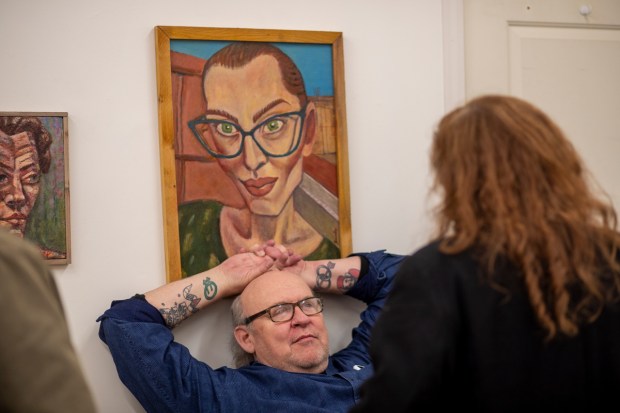


Tony Fitzpatrick was a boundlessly creative man in many realms — visual arts, theater, film, radio, literature and random conversations — who died in October while awaiting a double lung transplant. He was only 66 and his family was with him, wife Michele and their kids, daughter Gaby (Gabrielle) and son Max, who said, “He put up an honorable fight, never gave up. He can now rest with Studs Terkel, Mike Royko, Nelson Algren, and Lin Brehmer as one of the greatest Chicago storytellers there ever was. He did everything and he did it his way.”
Yes, he did.
A relatively aimless and hard-drinking young man born and raised in the western suburbs, a child of a loving family, he was a little angry and a bit crazy, searching for ways to express himself. He would find it first in art and then, after stopping drinking and finding Michele, dive into life with stunning energy.
There came an astonishing stream of paintings, poems, performances, etchings, radio and film work, prolific and successful and internationally acclaimed enough to make other artists envious.
His voice was common on radio stations, especially WLUP. He could be found at poetry slams and eventually on stages and screens, in such films as “Primal Fear,” “Mad Dog and Glory” and “Philadelphia,” and most recently as a security guard in the “Patriot” TV series.
He remained busy in his final weeks. A steady stream of pals, journalists and admirers visited his hospital room. One of them, the actor Richard Kind, the day after seeing Fitzpatrick in the hospital, was at Wrigley Field and dedicated (“Tony Fitzpatrick, this is for you”) his rendition of “Take Me Out to the Ball Game.”
From the hospital, he “hosted,” via Zoom, the opening of his new art exhibition, “Songbirds and Crucifixions,” at Great Lakes Tattoo. He gave interviews about his new book, titled “The Sun at the End of the Road,” filled with Fitzpatrick’s distinctive art, poetry and prose, and as he put it, “some of what I remember, some of what I have learned and damn near all of what I love — birds, stories, people and dogs.” Mostly people.
From Tribune writer Nina Metz
One of the biggest movie stars of the 1970s, who could tackle everything from wry comedy to paranoid thrillers, Robert Redford’s appeal on screen was rooted in his elusiveness, thawing perhaps most effectively when playing opposite Paul Newman in 1969’s “Butch Cassidy and the Sundance Kid” and in 1974’s “The Sting.” The driving force behind the Sundance Film Festival, he was integral in helping boost the work of indie filmmakers. Perhaps it’s poetic that a man so essential to the movies died as the film industry is experiencing its own kind of death.

HBO’s streaming platform began as HBO Max, was changed to simply Max for reasons that defy good sense, and then changed back again to HBO Max earlier this year as part of the death of coherent media company branding. Who wants to bet a bunch of consultants made bank somewhere in this process? Joining the pack is Apple, which launched its streaming platform as Apple TV+ and then recently announced, with no fanfare, that the app would simply be known as Apple TV going forward. Sure. Whatever. At least cable channel MSNBC had a reason to rebrand as MS NOW; that’s because parent company (and NBC owner) Comcast is spinning off its cable channels that were formerly under the NBCUniversal umbrella into a new company and needed to create a distinction between (the old) MSNBC and NBC News. So “NBC” needed to be stripped of its identity. No doubt, there will be more rebrands in the year to come. Like that old saw about the weather, if you don’t like it, just wait a few minutes.
Sure, Disney only temporarily capitulated to the current presidential administration by suspending late-night talk show host Jimmy Kimmel earlier this year. But that there was any suspension at all, thanks to pressure from the FCC, does not speak well for how media companies view their independence at the moment, or for the spines of their CEOs. Just look at Paramount Global, which pulled the plug on its late night talk show host, Stephen Colbert (whose CBS show will end this spring) and agreed to pay $16 million to settle a lawsuit brought by Donald Trump over the editing of a “60 Minutes” interview with Kamala Harris, leading many to speculate that both were done to ensure federal approval of Skydance’s recent acquisition of the company.
From Tribune writer Christopher Borrelli
When Michael Sumler died last spring in a car crash outside Atlanta, you could feel his obituaries straining to explain exactly what Sumler did as a member of Kool & The Gang. For Rolling Stone, he “worked alongside” the ‘70s funk legends. In Billboard, he was their “Beloved Hype Man.” Mitch Dudek, writing in the Sun-Times, was the most gracious: “Chicago Mike” kept “tabs on the group’s wardrobe” but also “hyped up crowds with dance moves and sang backup.” In a social media post after his death at 71, the band itself described the South Side native as their “longtime wardrobe valet.”

Sumler, no matter what you might call his role in the group, was a member of a loosely affiliated fraternity of entertainers who, though rarely celebrated, come to the stage first, working a waiting crowd into shape, prepping the room for the promised riches to come.
The most famous of these men (they were always men) was Danny Ray, who died in 2021 at 85. He was known for his superlative-fueled introductions of James Brown (“The Godfather of Soul! The Amazing Mr. Please, Please Please!”). Hype Men, as they’re best known, were once a must-have for a great R&B show, but hip hop made the role a stepping stone: What would Public Enemy be without Flavor Flav hyping Chuck D? Jay-Z was Big Daddy Kane’s hype man; Diddy played the part for Notorious B.I.G.
Sumler — who was more like Jerome Benton in The Time, attending to the look of the group and its choreography, then slipping in with the backup singers for the rest of a concert — was discovered by a member of Kool & the Gang’s security while playing a South Side club with his band Power Pac. He started touring with Kool & Co. in 1985, just as their ‘70s hits were being dwarfed by their 1984 blockbuster album, “Emergency.”
“My father was a modest man, and yet … no, he was not!” said Monica Ford, one of Sumler’s two daughters. “We would go shopping and we would always end up talking to someone about Kool & the Gang — perfect strangers! My father loved being in music.”
Sumler grew up on 114th Street and spent most of his life on stages. “There are different things you can be in a group,” said Elesia White, Sumler’s other daughter. “My dad was part of the Kool family, but if you asked what he was? He’d say ‘entertainer.’”
Edmund White, who died in June at 85, wrote about sex. Not exclusively; he wrote around 30 books, some fiction, some histories, some memoirs, many a blend. But sex was always prominent. It was his “great subject,” he liked to say. He first wrote about sex as a teenager, when he was growing up in Evanston and Rockford. Specifically, he wrote about gay sex, without apology, when the subject itself was culturally off the table. He wrote so early and so frankly about sex between gay men that two of his best-received books, “The Joy of Gay Sex” (1977) and “States of Desire” (1980), were made immediate antiques only a few years later, when AIDS started tearing through gay communities. White was present then, too: He cofounded the Gay Men’s Health Crisis in 1982, and was its first president; a few years after, he was diagnosed HIV-positive.
He was so associated with writing about sex, it’s important to say he was never one thing. He was a bright intellectual child, but his own mother, an Illinois state psychiatrist, labeled him “borderline psychotic.” I interviewed him several times over the years and he was always generous, though very discerning; extremely accepting but a bit snobby. “A Boy’s Own Story” (1982), his breakthrough, was often categorized as fiction but was closer to semi-autobiographical, particularly in recounting the cruelties of being gay in Chicago in the 1950s. It led to a trilogy — “The Beautiful Room is Empty” (1988), “The Farewell Symphony” (1997) — collectively recounting gay life in the late 20th century.
Still, his writings on sex were so vivid — and cringy and explicit and elegiac, into his 80s — you had to remind yourself he could be hilarious and, as many critics noted, deeply Proustian, close to aristocratic, with a touch of Henry James. Every time I spoke with him, I could feel my cheeks reddening. The last time we talked, I asked, naively, when he was a kid growing in Evanston, did he linger over sex scenes in novels? He proceeded to tell me about the “several hundred” men he had sex with in Chicago before he was 16. As in his books, the details were extraordinary: “I would have sex with men in their station wagons, which would be full of their children’s toys.”
White broadened the cultural portrait of gay life, and remained ambitious into his final years. In one of his last books, set in 2050, an elderly couple remembers their sexual partners. In meta fashion, White himself is one of those affairs. He imagines himself almost completely forgotten by 2050. You could sense anxiety about his legacy, though at the same time, as White once told the Paris Review, he never regretted what he wrote: “Something that would please me alone — that became my sole criterion.”

When José Jiménez was a child, he moved around Chicago nine times and attended four different elementary schools. Jiménez, better known as “Cha Cha,” liked to repeat those numbers. He knew they told the story of gentrification in the city better than any neighborhood housing committee could. He understood it was not just his story but one shared by many low-income residents of Chicago who were displaced in the 1960s and 1970s, particularly around Lincoln Park. He died in January at 76.
Jiménez described himself as a “revolutionary,” not as the leader of a non-profit or a community organizer. Which was wise — there was nothing formal about his history: His family moved to the United States from Puerto Rico in the late 1940s when he was a baby, and, at only 11, he helped create the Young Lords street gang on the Near North Side. As he told interviewers later, Chicago gangs then were about territory, and Lincoln Park was ground zero for a huge urban redevelopment plan by Mayor Richard J. Daley.
Still, fighting was involved. Jiménez landed in jail often.
But during one stint in 1968, he read Malcolm X and American theologian Thomas Merton and Martin Luther King, Jr., and left prison with a renewed vision for the Young Lords. They would be an activist voice of affordable housing and healthcare for Puerto Ricans, modeled on the confrontational tactics of the Black Panthers. He was so taken with the Panthers he connected to chairman Fred Hampton and — together with the Young Patriots, a group of White Southerners in Uptown — launched the Rainbow Coalition to build a united multiracial front. (Jesse Jackson would later name his National Rainbow Coalition partly in honor of the group.)
The Young Lords petered out by the 1980s, but not before confronting landlords, occupying buildings and starting community centers. They inspired similar groups around the country to be aggressive about social services, helping raise the cause of human rights in Latino communities. But as Jiménez told an oral history project on the Young Lords, they were accidental activists: “We were just trying to defend our ‘hood.”


If you added up every line spoken by Michael Madsen and Ron Dean in every movie and TV show they appeared in — and between the two, they appeared in more than 400, mostly in the ‘80s and ‘90s — it’s unlikely you’d have enough dialogue for an entire movie. Both grew up in Chicago and neither said much on screen. They were character actors — they didn’t have to. Madsen, who died in June at 67, played criminals with a steady brooding menace. Dean, who died in October at 87, played police with a ruddy, brooding command. They were like the Crown Victoria of actors, projections of authority.
And yet here we are singling them out.
They were heavies, disposable but somehow weirdly timeless. Madsen was the one with a little marquee value: He was that guy who cut off the ear in “Reservoir Dogs,” and that guy in “Kill Bill” who buried Uma Thurman alive; he played Susan Sarandon’s restless beau in “Thelma & Louise,” and he was the guy who pulls the gun on the other guy who won’t fire the nuke in “WarGames.” He was a one-man film noir, like his hero, Robert Mitchum. Dean, meanwhile, was a great hard-ass. He played the hard-ass dad who drops off Emilio Estevez in “The Breakfast Club,” and a hard-ass coach in “Rudy”; he was a detective who sweats Harrison Ford in “The Fugitive,” and the cop who gets shot (in Twin Anchors restaurant) by Harvey Dent in “The Dark Knight.” He was that guy with the bullhorn in “Risky Business” who told Tom Cruise to “get off the babysitter.”
Strangely, Madsen and Dean were also aligned in life. As a teenager, Madsen did jail time for burglary and theft; in his last years, he was arrested for child endangerment and domestic violence. When Dean was 16, he escaped a jail lockup, found a gun in a desk and shot to death a Chicago police officer; he served 12 years in prison. After he got out, he found his way onto local theater stages, eventually appearing at Steppenwolf and Goodman. Madsen was a mechanic in Wilmette when he decided to audition for Steppenwolf; he soon landed a small role in “Of Mice and Men.” Both were also poets who would have appreciated how lyrically twinned they were, a pair of everyday schmoes from Chicago with meaty faces who became shorthand for blue-collar guys.
Without Burt Meyer and Mario Pasin tinkering around the North Side, building a trading route to the North Pole and Santa Claus that continues today, it would be hard to picture nearly any Christmas morning between 1960 and 1995. Boomers and Gen Xers were the primary constituents of Meyer and Pasin, though, you could argue, their influence never faded. You might even say work kept them young: Pasin, who was born in Oak Park, died in August at 95, and Meyer, who was born in Hinsdale, died in October at 99.
Pasin was the owner of Radio Flyer, the Belmont Cragin toy maker responsible for the classic red metal wagon. In the 1960s, he took over the business from Antonio Pasin, his father, who had founded the company in 1917. Meyer was a toy designer whose inventions also became childhood benchmarks. He created Rock ‘Em Sock ‘Em Robots. And Lite Brite. And MouseTrap. He spent 25 years at Marvin Glass & Associations, as one of the stars of a legendary team at the former River North studio that dreamed up Operation, Ants in the Pants, Simon, Spirograph, Inchworm, Gnip Gnop, Mystery Date …
Meyer’s creations — which were designed for Marvin Glass and then licensed out to major toy manufacturers such as Hasbro, Mattel and Parker Brothers — took full advantage of the post-World War II plastics age. Mario Pasin, conversely, steered Radio Flyer into its wood-paneled wagon days, and NASA-inspired ‘60s designs, then wagons with a touch of ‘70s muscle car. The first plastic Radio Flyer wagon wasn’t introduced until 1994.
That you never heard of Meyer or Pasin speaks louder than a rusty wagon. After Pasin’s death, his son Robert, who became CEO in the ‘90s, recalled his father as a portrait of sturdy midcentury Americana, not unlike a RadioFlyer. “He just went peacefully about his business … puffing on his cigar while quietly sitting with my mom in the living room.”
From contributing critic Bob Gendron
Recent news of the Music Box adding a third screen to its revered Southport Avenue location next year would’ve doubtlessly thrilled Dennis Wołkowicz. A self-taught pipe organist and historical preservationist who performed as an accompanist to silent film around the Chicago area, he recognized the community connections between old theaters and their surrounding neighborhoods. He had a special passion for reinvigorating the Six Corners district on the Northwest Side — an area blocks away from the two-flat in which he lived his entire life.

Wołkowicz epitomized the get-it-done Chicago spirit. Against all odds, he signed on to manage the then-threadbare Gateway Theater — a gem inside the Copernicus Center in Jefferson Park — in the mid-’80s. He began the venue’s comeback by screening silent films and installing a vintage 1927 organ, a move that prompted him to sharpen his skills on an instrument he admired as an adolescent. In the next decade, Wołkowicz co-founded the Silent Film Society of Chicago. The nonprofit’s Silent Summer Film Festival drew 8,000 attendees in its heyday. One of Chicago’s last photoplay organists, Wołkowicz took on another challenge in the mid-2000s when he agreed to manage and renovate the neglected Portage Theater, which he helped win landmark status.
He will be missed for being seen and heard at the organ at film screenings around the city. Performing upwards of 60 dates per year, often under the easier-to-pronounce alias Jay Warren, he appeared at the Davis, Logan, Pickwick, Patio, Arcada and Music Box theaters, as well as City News Cafe and various churches. As time-old traditions of going to the movies give way to streaming, Wołkowicz’s legacy reminds us of the shared experiences and auditory delights lost by staying home.

For Jack DeJohnette, timing was everything. Arguably the most accomplished and prolific drummer to hail from Chicago, he started playing clubs as a teenager. During that era in the early 1960s, he found himself in the crowd for a local John Coltrane residency. When the saxophonist’s percussionist, Elvin Jones, failed to materialize at the start of a set, DeJohnette stepped in. The moment crystallized a career marked by boundless adventure, unflagging virtuosity and rhythmic innovation.
Though DeJohnette departed for New York in the mid-’60s, he never forgot the sounds and lessons he absorbed in his hometown. A composer, improvisor, bandleader and sideman who possessed perfect pitch, DeJohnette left his mark on dozens of his own LPs as well as recordings by a who’s who of jazz giants — Miles Davis, Charles Lloyd, Keith Jarrett, Freddie Hubbard, Dave Holland, John Abercrombie and Pat Metheny included. His extensive work for a pair of seminal labels (ECM and CTI) with divergent tastes spoke to his adaptability, diversity and thirst for discovery.
Hard bop, funk, swing, psychedelia, electric fusion, rock: DeJohnette navigated those styles and others with command and sensitivity. He considered himself a “colorist” and relished the opportunity to tackle pieces he’d played before as if they were brand-new. His curiosity and aptitude never ebbed. He came full circle in 2013 at Millennium Park by reuniting with several Chicago visionaries who formed the Association for the Advancement of Creative Musicians and with whom he collaborated half a century earlier. DeJohnette followed that feat by returning to the piano — his first instrument — for his first solo piano LP, “Return” (2016). In 2022, he won a Grammy four months before turning 80. Yes, we lost DeJohnette. But not the deep rabbit hole of records on which he’s credited and which beckon our attention.

Chicagoans might know Jerry Butler from his decades-spanning role as Cook County Board Commissioner. Others may remember him for improving healthcare access while chairing the Health and Hospitals Committee. However admirable, his public service pales compared to the outsized impact he made on soul music.
Having cut his teeth singing gospel in churches and crooning on street corners near his family’s residence at the Cabrini-Green housing project, Butler became the first lead singer for the Impressions. His resonant baritone, creamy-smooth deliveries, suave control and formal presence were such that the group’s label — Chicago-based Vee-Jay Records — plotted to feature him as a solo artist from the time the Impressions recorded their haunting debut, “For Your Precious Love.” (Rolling Stone ranks the 1958 single one of the 500 greatest songs of all time.) In “Move on Up,” his definitive book on Chicago soul, Tribune contributor Aaron Cohen views its creation as the lynchpin to an independent- and community-minded social shift that swept the city.
Due to internal tensions, Butler separated from the Impressions in 1960. Over the next 15 years, he logged a string of solo hits, ranging from “Only the Strong Survive” and “Make It Easy on Yourself” to “Let It Be Me” (a duet with fellow Chicago transplant Betty Everett) and “He Will Break Your Heart.” The latter is one of his collaborations with childhood friend and former Impressions mate Curtis Mayfield.
In the process, Butler earned his “Iceman” nickname and induction into the Rock & Roll Hall of Fame as part of the Impressions. The biggest tribute of all? His music continues to transcend generations via cover versions by rock ‘n’ roll contemporaries like Bruce Springsteen, the Hives and the Black Keys.
From Tribune critic Chris Jones
The silver-haired publicist was at once a classic, old-school Chicagoan and a fish out of Midwestern water, a glamorous promoter with all of the dynamic pizzazz of Hollywood or midtown Manhattan. Margie Korshak ran the media show at most every Broadway musical to play Chicago for five decades, took care of much luxury retail (in more ways than one), and banged the drum for concert venues. Just as importantly, she served as the mentor of the famed “Margie’s Girls,” acolytes who often went on to found their own agencies and businesses after seeing firsthand what a woman could do in this profession. Cheerfully typified by the pink neon “Margie” sign in her John Hancock Center office, Korshak was known for grabbing hunter and quarry alike by the hand and pushing them together as if it were their destiny. At her memorial service, the famed British producer Cameron Mackintosh sent a Broadway singer from her favorite musical, “Les Misérables,” to sing “Bring Him Home,” or, in this case, “Bring Her Home.” A grand exit, fully deserved.

The prominent, four-theater building on Halsted Street in Lincoln Park, the Royal George Theatre, now meeting the wrecking ball after a long period of uncertainty, was the epicenter of Chicago’s now struggling commercial theater sector, the home of populist entertainment like “Love Letters,” “Art,” and “Forever Plaid” (a six year run!). It also hosted the world premiere of what became “Smokey Joe’s Cafe” and the iconic first national tour of “Angels in America.” Stars aplenty appeared there, especially in the 1980s and 1990s, and rarely were its theaters dark. Chicago loses a very viable mainstage theater with nearly 500 seats, attached parking and a Lincoln Park location. No small matter.
The low-slung West Lakeview Stage 773 building might be architecturally unimportant but, especially when it was known as the Theatre Building, it played a vital role in the history of the off-Loop theater movement after its founding by Byron Schaffer Jr. in 1977. With three sought-after rental venues of roughly equal size, it served as an early-career home for numerous Chicago theater artists, from Joan Allen and John Malkovich to Aidan Quinn, William Petersen and David Schwimmer. The Theatre Building was the first Chicago home of the famed Steppenwolf Theatre Company and also hosted a long list of small companies, from Famous Door Theatre Company to New Tuners and Porchlight Music Theatre to the Bailiwick Repertory. Sacred artistic ground, you’d think, but soon to be merely condominiums and retail.

The founder of Theo Ubique Theatre Company, a tiny operation that spent most of its existence in a Rogers Park coffeehouse, Fred Anzevino was (as much as any single person), the inventor of Chicago-style musicals. Whether the show was “Light in the Piazza” or “Cats,” he’d cram prodigious young musical-theater talent into a tiny space and then also ask them to serve drinks at intermission. Actors made bank on the tips and audiences would flock to one of the few available tables to catch a glimpse of the stars of the future. Anzevino was a rare judge of talent, especially when it came to vocal quality. After his death this year, his new Howard Street theater was filled with artists and audience members, coming together in gratitude.

Tom Stoppard was simply far smarter than any other contemporary playwright and more able to make the connections that underpin our lives — he wrote of string theory and sex, God and risk management, rock music and physics. He was interested in how science meets art, love turns into betrayal, moral rectitude gets undermined by insecurity. He understood how the roll of the dice changes our fate, how life is mostly a game, how everything was just a whole lot more complicated than we realized when we sat down in a theater seat to unravel “Arcadia” or “The Real Thing” or “Rock ‘n’ Roll,” or “Travesties” or, especially, “Leopoldstadt,” his final opus where the theater’s greatest relative thinker homed in on what matters most to all of us: our identities.
From contributing critic Lauren Warnecke
Few made a bigger impact on Chicago dance than Shirley Mordine, who pioneered the city’s model for training and presenting modern dance at scale. Mordine, 89, founded the dance department at Columbia College Chicago, serving as its chair for three decades.

It was partially self-serving. In creating the Dance Center, as the department is now called, Mordine trained dancers in her idiosyncratic, theatrical style, bringing generations of students into her professional company, Mordine & Company Dance Theater. The company, which recently dissolved after more than 50 years, was a launch pad for myriad artists who trained, danced and performed with Mordine — giving them a reason to stay in Chicago.
Mordine was an uncompromising leader in the studio and the boardroom. When confronted with “Why?” she’d ask, “Why not?” Rigor and tenacity are how she got things done. In 1972, Mordine founded the Dance Presenting Series at Columbia College, convincing artists from across the country and globe to perform in Chicago for the first time or return after long absences. She launched a Chicago edition of DanceAfrica, which for years was a festival of traditional and contemporary African dance at the Medina Temple. Those kinds of partnerships laid the groundwork for many cross-cultural collaborations, which weren’t popular when Mordine arrived in Chicago in the late 1960s. Ever interested in the world, with dance as the vehicle to explore it, Mordine forged kinetic connections with breakdancers and Bharatanatyam artists — connections which today feel like second-nature among Chicago’s dance scene.
Death is delayed, but not denied, for the Fine Arts Building’s elevators. Construction has begun converting their system — believed to be the last manually operated elevators in the city and original to the 1898 building created for the Studebaker Carriage Company. Managing artistic director Jacob Harvey has said the building’s three Otis cabs, hailed by a single button ringing a bell on each floor, had become too cumbersome to keep; replacement parts were almost impossible to find. There’s also the matter of staffing them. Operator Waclaw Kalata, a fixture in the building for three decades, is both an artist and a scientist, performing a kind of precise choreography eight hours a day — a job younger generations have not found appealing, given the lack of remaining opportunities to do it. For hangers-on, the good news is, elevator construction is long and expensive. Already behind schedule, the Fine Arts Building expects at least one manual cab to run through 2026.
From contributing critic Hannah Edgar
It wasn’t an LGBTQ event without Lori Cannon. Cannon’s wit was as incandescent as her signature flaming red hair, but her generous heart was brightest of all. She first became a local fixture after becoming one of the earliest Chicagoans to volunteer on behalf of those diagnosed with HIV/AIDS, at a time when the disease was still little understood. She earned the moniker “Chicago’s AIDS Angel” and a posthumous tribute from Gov. JB Pritzker, who praised her for “(leading) the way with chutzpah and humor.”

Caring for others was second nature for Cannon, 74, who died Aug. 3 from pancreatic cancer. A lifelong Chicagoan, she spent much of her adolescence taking care of her brothers, both of whom had complex medical needs. Together with other activists, she founded Open Hand Chicago, a meal service for those bedridden with AIDS, in 1988. Its successor, the Edgewater food pantry GroceryLand, followed in 1994. She was instrumental in the creation of both ACT UP’s Chicago chapter and the Legacy Project, the organization behind the Legacy Walk placards on Halsted Street.
“When my contemporaries were dying in my arms, literally dying in my arms, my life was changed. I knew I couldn’t count on the government,” Cannon told the Tribune in 2004. “That’s when I knew this was my mission. I knew I couldn’t save lives, but I knew I could serve.”
As medical advances allowed individuals to live with HIV, Cannon remained just as dedicated to awareness as she was four decades prior.
A sign hung in GroceryLand read, “LATEST AIDS STATISTICS: 0,000,000 CURED.”
“I can’t wait till we can shut down and hang up a shingle, ‘It’s been a pleasure to serve you, and now we’re going to do something else,’” she told the Tribune in 2004. “Studs Terkel asked me once, ‘What would your life have been like without AIDS?’
“And I said, ‘Studs, I’ll never know.’”
From contributing critic Britt Julious
Slo ‘Mo was revolutionary. As Chicago’s longest-running LGBTQ nightlife party, the event not only offered a safe space for the queer community in the city, it brought together generations of music fans. That was in large part due to the ethos and efforts of founder and co-host Kristen Kaza.
Kaza deeply understood the power that music can bring to those across the racial, gender and generational lines. Slo ‘Mo was a welcoming and affirming place for queer folks to be free and fulfilled, loved and loud, happy and whole. And as Kaza shared with me, “Slo ‘Mo has played a beautiful role, contributing to the quilt of queer cultural experiences that weave intergenerational joy with the healing and connecting of music so unique to Chicago.”
Its last monthly party took place in October, but organizers plan on celebrating the party’s impact with a proper farewell in 2026. And although Slo ‘Mo is sunsetting, its legacy will live on as a source of joy and resiliency, love and community.
They say all good things must come to an end, but that does not feel fair, especially for a place as beloved as The Promontory. The live music and event venue became a trusted source of music events and cultural programming for folks on the South Side of Chicago and beyond.
New venues pop up around the city overnight, it seems, and yet, most are concentrated in North and West Side communities, leaving the vast landscape on the South Side as something of a barren land. The Promontory fit in nicely, filling a large hole and offering Chicagoans, both from the South Side and beyond, a place to gather under the sights and sounds of Black music and culture.
I spent many years attending concerts, readings and dance parties that traversed genres as different as jazz and Afrobeats, hip-hop and R&B, house and soul. Through it all was a singular vision of community and culture. It will be sorely missed.
Born and raised in Chicago, Ronald Michael Carroll took to music from a young age. His roots began in the church choir, but he gained an interest in house music during his teen years. That’s why the charismatic and prolific DJ Ron Carroll became a staple on the Chicago and European house music scenes, as a DJ, singer and producer. An advocate for the LGBTQ and HIV-positive communities, Carroll was an outsize influence for many decades.
His first record, “My Prayer,” released in 1993, was a perfect introduction to who Carroll was as an artist: open and spiritual, motivating and true. Those words, too, are at the root of what makes Chicago house music — and house music as a whole — so enduring for audiences around the world.
Later, Carroll launched his own label, Body Music Records, and released a number of seminal records, singles and collaborations, including “Lucky Star” and “Back Together.” The latter, a gorgeous, sumptuous, soulful classic has been a dance floor standard for more than 20 years. Few things feel as profound and powerful as the moment a Ron Carroll track drops during a long, satisfying night out.
Carroll died from a heart attack in September at the age of 57.

From A+E editor Doug George
Looking around Chicago theater, it’s worth remembering that a few companies and individuals were part of shaping what it is today, and that includes Joyce Piven, who died early in 2025.
Piven, along with her late husband Byrne Piven, founded the Piven Theatre Workshop in Evanston in the 1970s. The studio counts John and Joan Cusack, Aidan Quinn and Lili Taylor among its students, as well as Piven’s own children, the Hollywood figures Jeremy and Shira Piven. As Chris Jones recounts in his Tribune obituary, Piven was an early member of the Playwrights Theatre Club, which started in Chicago in 1953 and eventually became Second City. For years, Piven Theatre also put on professional productions in Evanston’s Noyes Cultural Arts Center and was an early supporter of the playwright Sarah Ruhl. The workshop continues to train new classes of students, supported in part by a memorial fund in Joyce’s name.
Lastly, satirist Tom Lehrer died in July, his life and work memorialized in the Tribune by Rick Kogan. Born in New York and Harvard-educated, Lehrer had no connection to Chicago, aside from performing here twice at Orchestra Hall, and he produced most of his work in the 1960s. And that work consisted of just two studio albums and a handful of compilations.

But his songs managed to reach a generation of nerdy Gen-X listeners that tuned into weekly broadcasts of “The Dr. Demento Show” on the radio — a generation that memorized the periodic table for chemistry class by listening to “The Elements,” a song that consisted of nothing more than a lightning-fast recitation of all known chemical elements to the tune of Gilbert and Sullivan’s patter song “Major-General” from “The Pirates of Penzance.” A generation (or this member of it, anyway) much entertained by Lehrer’s layering of a jaunty piano melody with lyrics about murdering avian wildlife with cyanide in “Poisoning Pigeons in the Park.”
That aforementioned radio program also deserves a mention. “The Dr. Demento Show,” hosted by Barry Hansen, was created in 1970, went into syndication in 1974 and broadcast until 2010 — its over-the-air run concluding following the loss of key station WLUP-FM in Chicago. Hansen shifted to online streaming until he retired this year, having helped launch “Weird Al” Yankovic’s career and bring new listeners to satirists like Lehrer, Stan Freberg and Bob Newhart. The final episode, released on Oct. 11, was a countdown of the show’s 40 most requested songs across its 55 years, culminating in “Fish Heads.”